Momentum: five questions to try now
Real past-paper questions, the answer key from the mark scheme, and the explanation that goes with it. No account needed to answer them.
Question 1
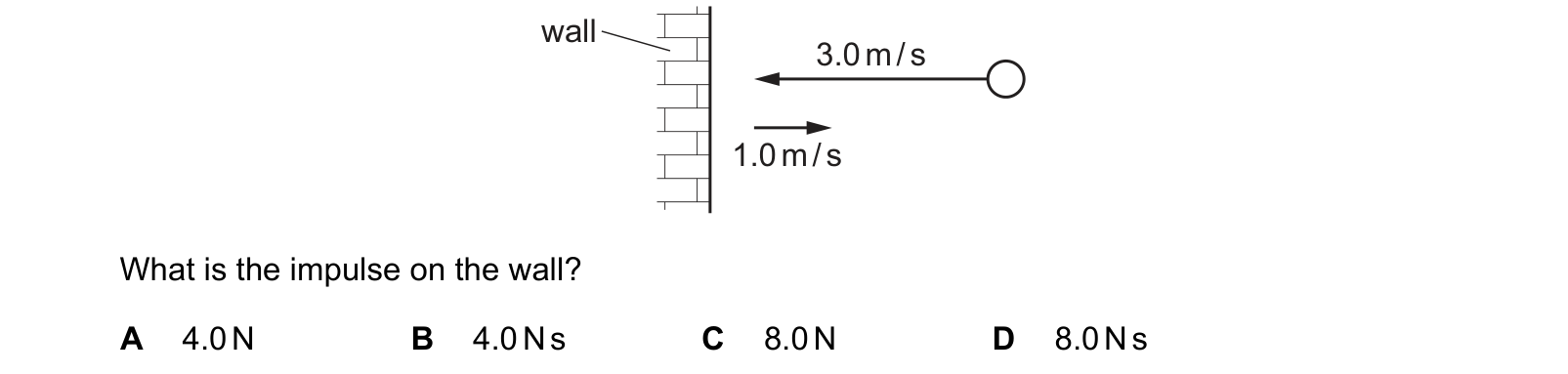
A ball has a mass of 2.0 kg. The ball approaches a wall at a speed of 3.0 m / s and rebounds at a speed of 1.0 m / s. What is the impulse on the wall?
Answer: D.
change in velocity = 3.0 + 1.0 = 4.0 m / s
impulse = m x change in v = 2.0 x 4.0 = 8.0 N s, which is D.
C has the right number with the wrong unit. Impulse is a force multiplied by a time, so it is measured in newton seconds, not newtons. Two of the four options are eliminated on units alone, which is worth doing first.
B, 4.0 N s, comes from subtracting the speeds, 3.0 - 1.0, as though the ball carried on through the wall.
The question asks for the impulse on the wall, and by Newton's third law that is equal in size to the impulse on the ball, so the calculation is the same either way. The directions are opposite, but only the magnitude is asked for.
Note the ball comes back slower than it arrived, so kinetic energy has been lost in the bounce. Momentum is still exchanged in full, which is why a bouncing ball pushes on a wall harder than one that simply stops.
Question 2
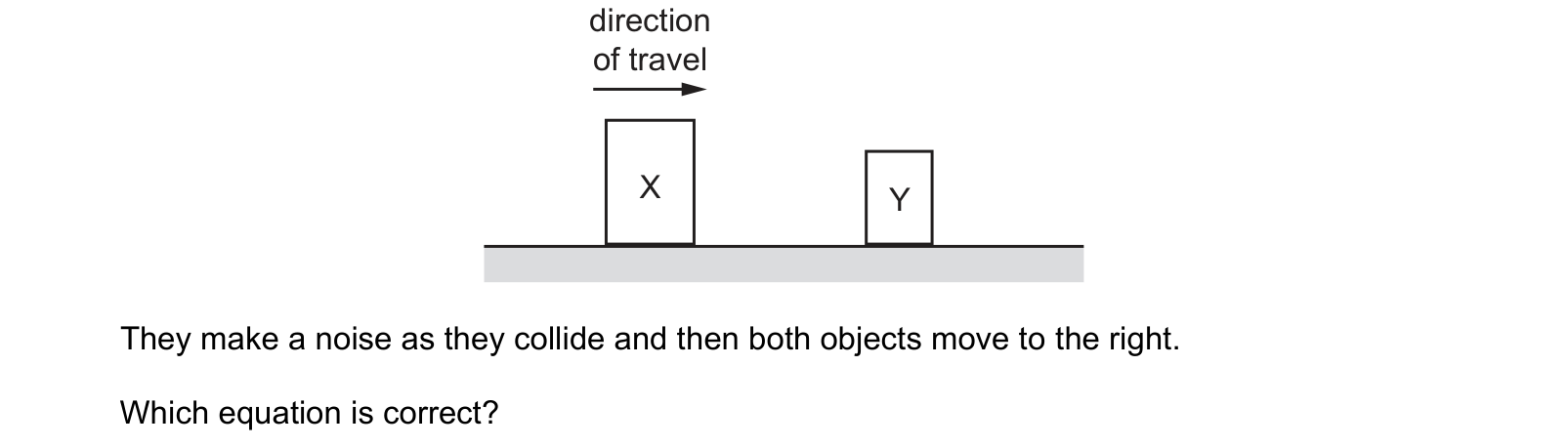
Object X moves to the right along a frictionless surface towards a stationary object Y, as shown.
direction They make a noise as they collide and then both objects move to the right.
Which equation is correct?
Answer: D.
C claims kinetic energy is conserved, and the stem quietly rules it out: they make a noise as they collide. Sound carries energy away, and some also goes into heating and deforming the objects, so the kinetic energy afterwards is less than before. This is an inelastic collision.
A and B are each half right in a way worth understanding. The changes in momentum, and the impulses, are equal in size but opposite in direction: X loses exactly what Y gains. Written as an equality without the minus sign, both statements are wrong.
That opposite sign is Newton's third law. The force X exerts on Y and the force Y exerts on X are equal and opposite, they act for the same length of time, so the impulses are equal and opposite too.
Question 3
A rocket is launched upwards from the surface of the Moon.
Hot gases are ejected downwards over a very short period of time.
Which statement is not correct?
Answer: C.
Question 4
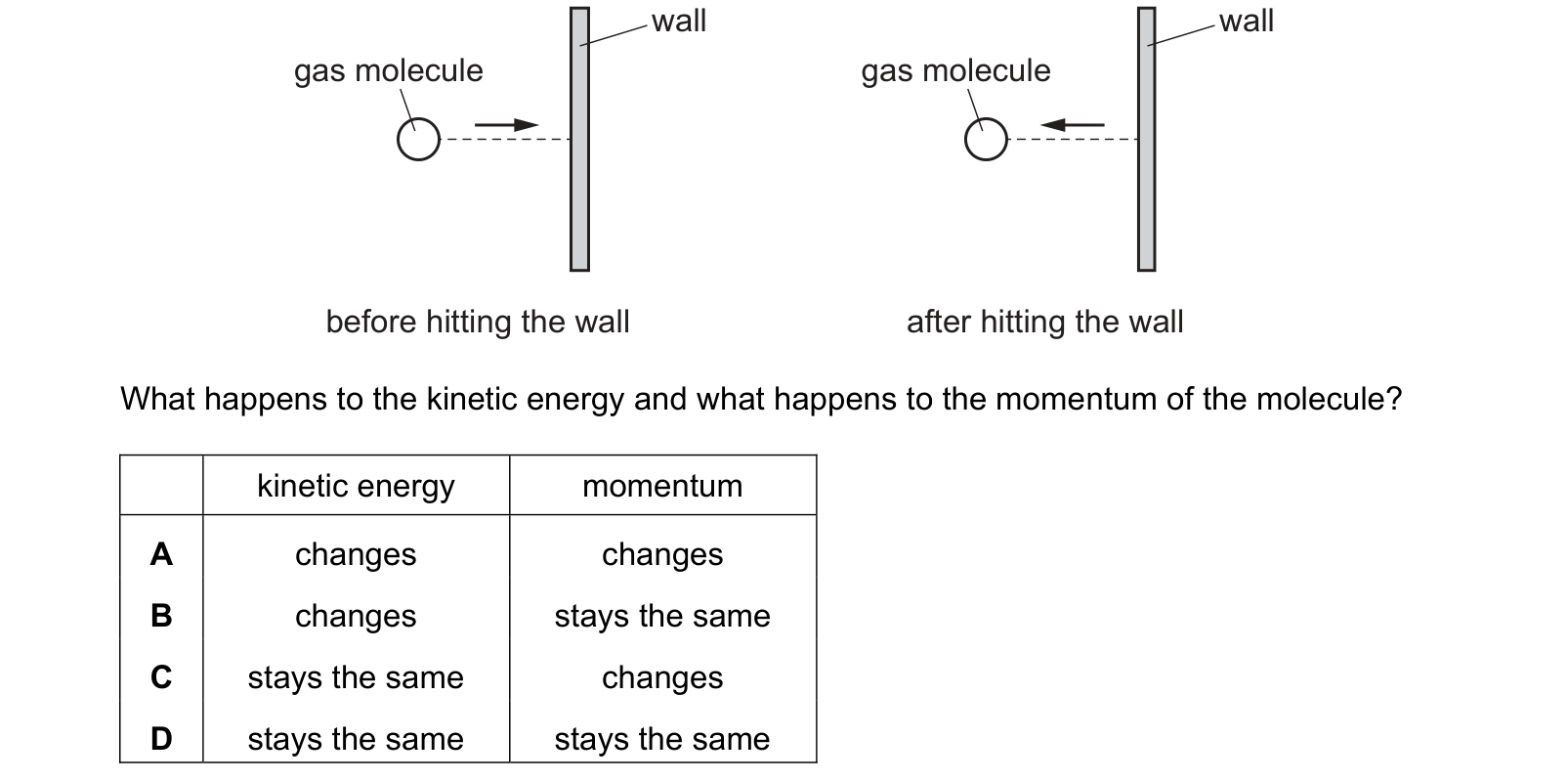
A gas molecule strikes the wall of a container. The molecule rebounds with the same speed. What happens to the kinetic energy and what happens to the momentum of the molecule? Each answer gives, in order: kinetic energy; momentum.
Answer: C.
Kinetic energy is half m v squared. It depends on the speed and not on the direction, and the speed is unchanged, so the kinetic energy stays the same.
Momentum is mass times velocity, and velocity is a vector. The molecule was heading towards the wall and is now heading away from it, so its velocity has reversed and its momentum has changed, by twice its original value.
Stays the same and changes, which is C.
D is the tempting one. Nothing was lost in the bounce, so it feels as though nothing changed. But a reversal is a change even when the size is identical, and it is the whole reason the wall feels a force: force is the rate of change of momentum, and if the momentum did not change there would be no push on the wall at all.
A collision like this, with no kinetic energy lost, is called elastic. Gas molecules are treated as bouncing elastically, which is why a sealed gas does not gradually cool itself by hitting its own container.
Question 5
A constant force acts on a body causing the momentum of the body to increase.
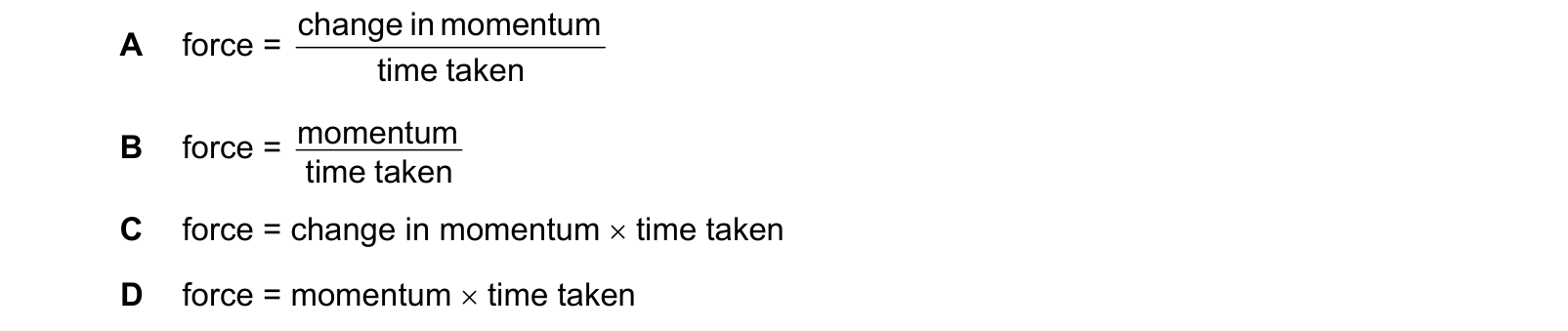
Which expression relates the force to the momentum and the time taken?
Answer: A.
B uses the momentum itself rather than the change in it. That would say a body coasting along with steady momentum has a force on it, which contradicts the first law.
C and D multiply by time instead of dividing. Check that with units: momentum is measured in N s, so momentum multiplied by seconds gives N s2, which is not a force. Dividing N s by s leaves N, and only one option does that.
What this practice covers
These questions are drawn from past CIE 0625 Physics papers and filtered to momentum. You answer, you find out immediately whether you were right, and you get the reasoning for the correct option and for each distractor. Wrong answers go to a mistakes locker so you can come back to exactly those.
Practice is free. You need an account only so your progress and your mistakes are still there next time.
Keep going Paper 1 and Paper 2 MCQs →
What examiners see students get wrong here
These are the errors that cost marks on momentum, taken from our own topic notes. Read them before you practise and you will recognise the traps in the questions.
- Subtracting the speeds in a rebound instead of adding them.
- Forgetting that momentum is a vector and ignoring signs.
- Saying kinetic energy is conserved in a collision the question has told you is noisy or sticky.
- Writing the changes in momentum of two colliding objects as equal without the opposite sign.
- Assuming the incoming object always stops after a collision.
- Quoting momentum in newtons, or impulse in kg m/s² .
- Thinking a crumple zone reduces the change in momentum rather than the force.
Revise it first
If any of the above is unfamiliar, work through the notes before practising: Momentum revision notes.