67 past-paper questions on this unit. Five of them are below. Answer on the page: each one is marked the moment you pick, the correct option is shown whether or not you found it, and the full explanation opens either way.
CIE 9708Paper 3 MCQsFree account
Utility: five questions to try now
Real past-paper questions, the answer key from the mark scheme, and the explanation that goes with it. No account needed to answer them.
Question 1
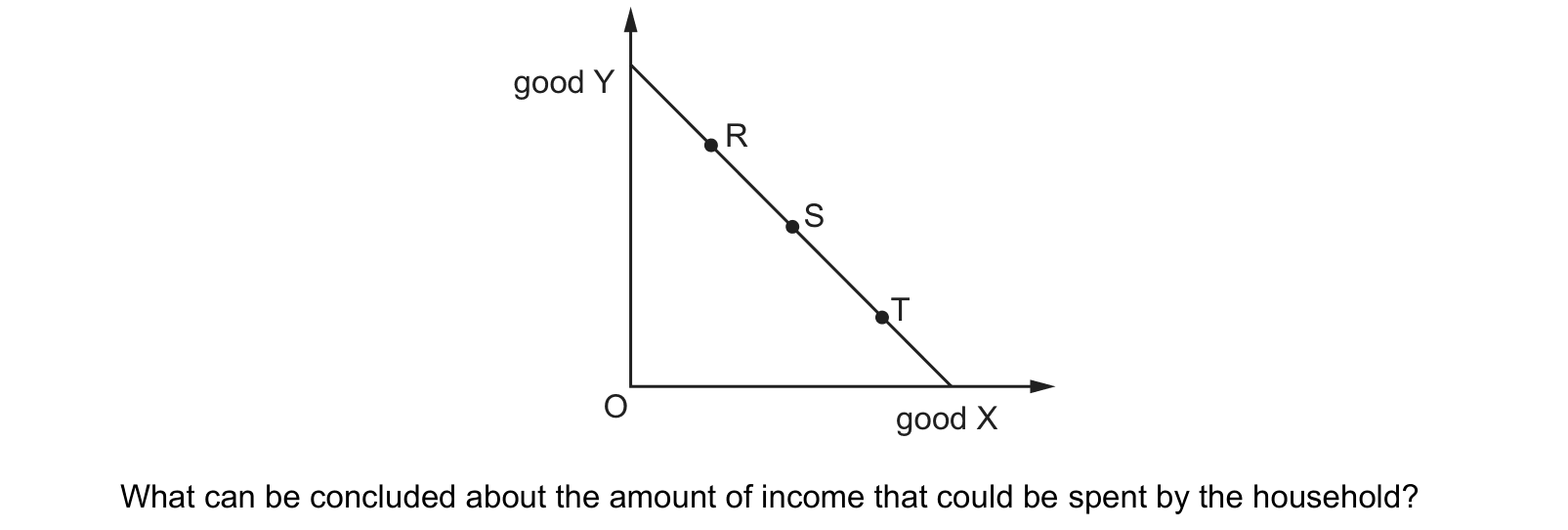
The graph shows the budget line for a household as used in indifference curve analysis. R S T O good Y good X What can be concluded about the amount of income that could be spent by the household?
Answer: D.
A budget line is the set of combinations that exactly exhaust the household's income at the given prices, so every point on it costs the same. R, S and T all lie on the single line drawn, so the income spent is identical at all three, which is D. What changes as you move along the line is the MIX of the two goods, more of X and correspondingly less of Y, not the total outlay. A, B and C each single out a point as involving a different amount of spending, and that comparison is only available between points on DIFFERENT budget lines, where a line further from the origin represents a larger income and one nearer to it a smaller income. Only one line is drawn here, so no such difference exists to be read off.
Question 2
The diagram shows a notice on a motorway near Cambridge. This road was recently cleared of 17 bags of litter. Clearing litter puts local authority road-workers’ lives at risk. What is this an example of?
Answer: C.
A nudge changes behaviour by altering how a choice is presented rather than by changing what is permitted or what it costs. The notice does exactly that: it makes the consequences of dropping litter vivid and personal by naming the road-workers who have to clear it, while leaving every option open and every price unchanged. Government regulation would mean a rule backed by a penalty, and a sign that only informs bans nothing and fines nobody. A merit good is one the government judges people consume too little of relative to their own interest, such as education or vaccination, and nothing here is being provided to individual consumers in that way. A public good must be both non-rival and non-excludable, and although a clean road comes close on both counts the question asks what the notice is an example of, not what the road is. Keeping the policy instrument separate from the problem it addresses is what this question really tests.
Question 3
The diagram shows a change in a consumer’s budget line from RR to SS. O product Y product X R S R S What might explain why this occurred?
Answer: A.
The correct answer is A, a decrease in income and a fall in the price of X.
Explanation: 1. Decrease in income: A decrease in income would shift the budget line inwards (leftward) towards the origin as the consumer has less purchasing power. 2. Fall in the price of X: A fall in the price of good X would lead to an expansion of the budget line outwards (rightward) as the consumer can now afford more units of X with the same income.
In this case, a decrease in income (RR to SS) shifts the budget line inwards, while a fall in the price of X (from R to S) leads to a parallel outward shift of the budget line. These changes together result in the budget line moving from RR to SS.
Therefore, option A is the correct answer as it accurately explains the change in the consumer's budget line from RR to SS.
Question 4
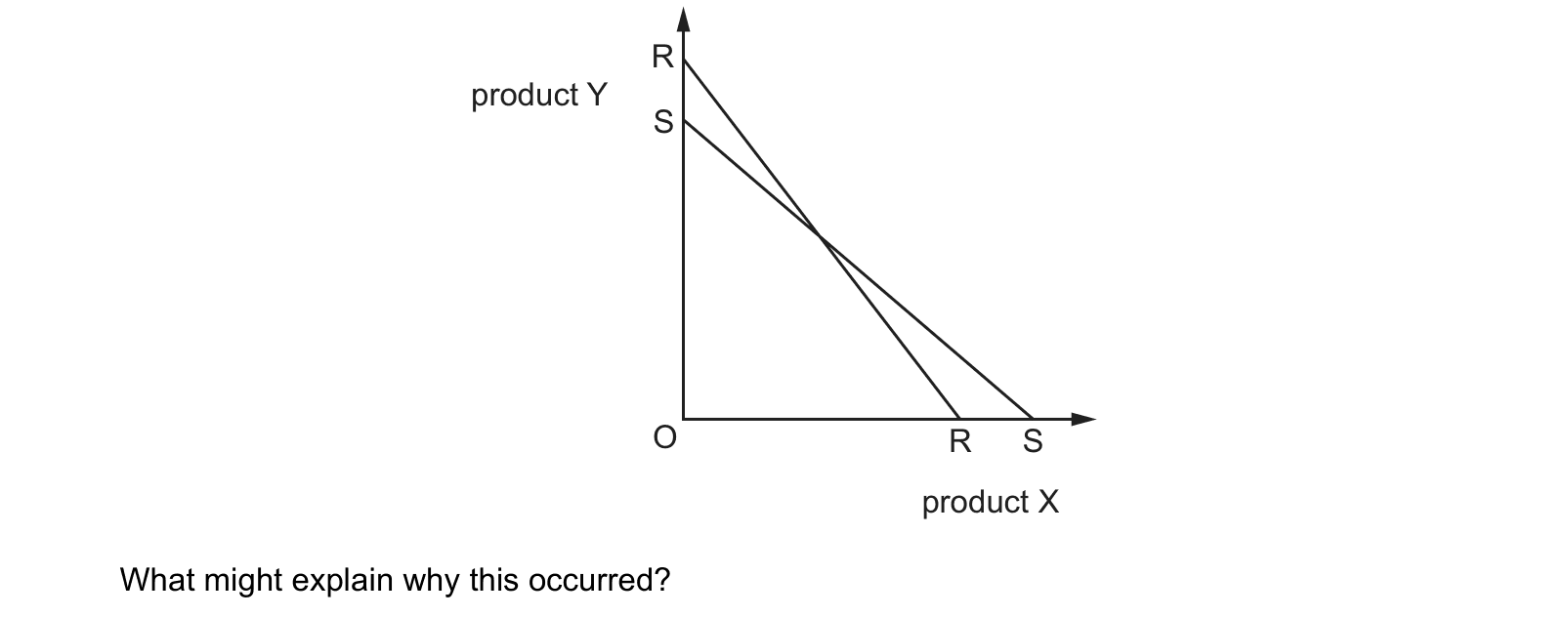
The diagram shows a change in a consumer’s budget line from RR to SS. R product Y S O R S product X What might explain why this occurred?
Answer: A.
Read the two intercepts separately, because each one is income divided by a single price. The vertical intercept has fallen from R to S, so income measured in units of product Y is smaller, and with nothing in the options changing the price of Y that means INCOME has fallen. The horizontal intercept has moved outward from R to S, so income measured in units of product X is larger, and that can only happen alongside a smaller income if the price of X has fallen by proportionately more. A decrease in income with a fall in the price of X is A. B would pull the horizontal intercept inward on both counts, since a smaller income and a dearer X each buy less X. C and D both have income rising, which would lift the vertical intercept rather than lowering it. Checking one axis at a time is what makes this question quick, because each axis pins down one of the two changes on its own.
Question 5
When the price of a good falls, the overall effect on the quantity demanded can be separated into income and substitution effects. Which statement describes a Giffen good?
Answer: C.
A price fall always makes a good cheaper relative to others, so the substitution effect always works to raise quantity demanded. What separates goods is the income effect, which works through the rise in real income that the lower price creates. For an inferior good that extra real income is spent on better alternatives, so the income effect reduces demand for the good and pulls against the substitution effect. A Giffen good is the extreme case in which the good absorbs so large a share of a poor household's budget that this negative income effect outweighs the substitution effect entirely, leaving quantity demanded lower after the price has fallen and giving an upward sloping demand curve. The option in which the income effect is smaller describes an ordinary inferior good, where demand still rises but by less than it would for a normal good, and that is the distractor most candidates take. An income effect working in the same direction describes a normal good, and calling the income effect irrelevant would leave the outcome to substitution alone, which no good satisfies.
These questions are drawn from past CIE 9708 papers and filtered to utility. You answer, you find out immediately whether you were right, and you get the reasoning for the correct option and for each distractor. Wrong answers go to a mistakes locker so you can come back to exactly those.
Practice is free. You need an account only so your progress and your mistakes are still there next time.
These are the errors that cost marks on utility, taken from our own topic notes. Read them before you practise and you will recognise the traps in the questions.
Confusing TU with MU.
Saying falling MU means falling TU.
Omitting the change in quantity from the MU formula.
Comparing MU alone instead of MU/P when prices differ.
Giving the ratio MUx/MUy = Px/Py without explaining reallocation.
Forgetting the budget constraint.
Treating exact equality as compulsory when goods are indivisible.
Deriving market demand when the syllabus asks for an individual demand curve.
Revise it first
If any of the above is unfamiliar, work through the notes before practising: Utility revision notes.