Externalities and Social Costs and Benefits: three questions to try now
Real past-paper questions, the answer key from the mark scheme, and the explanation that goes with it. No account needed to answer them.
Question 1
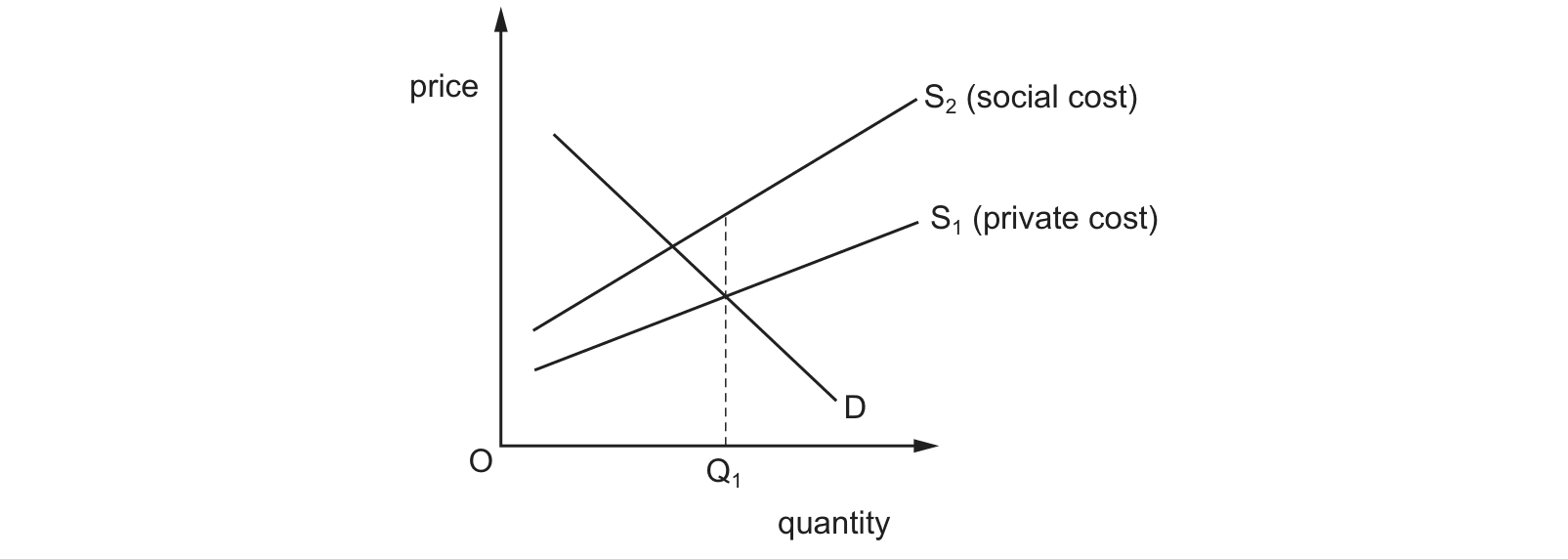
In the diagram, Q1 is the quantity produced of a good as the result of market forces. (private cost) S2 (social cost) Q1 D Which concept is present at output Q1?
Answer: B.
The other options would each look different on the diagram. A subsidy (A) or a positive externality (C) would put the social curve BELOW the private one. A specific tax (D) shifts the private supply curve itself rather than opening a gap between two separate curves.
Question 2
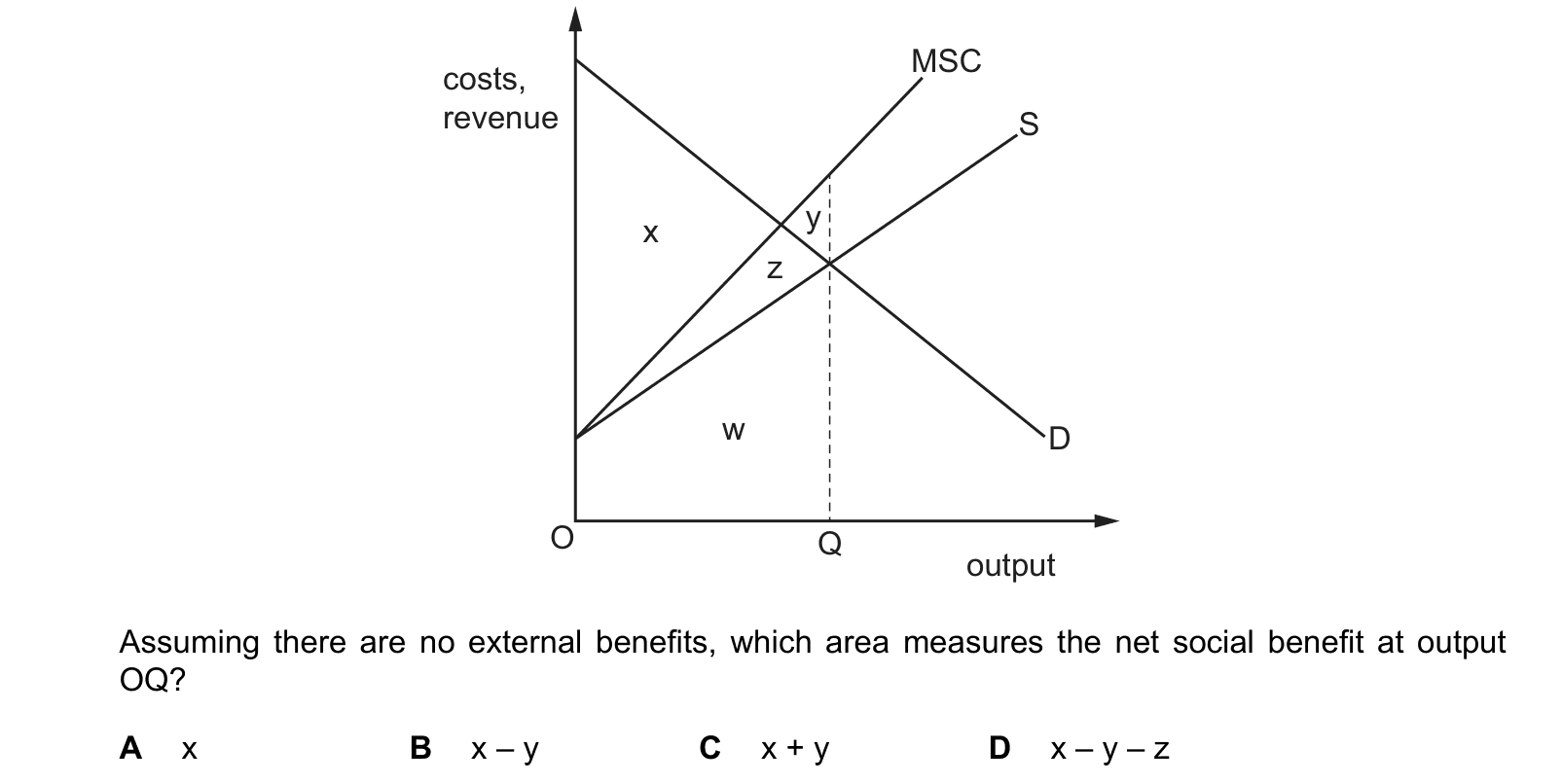
The diagram shows the demand for and supply of a good and the marginal social costs (MSC) for that good. Assuming there are no external benefits, which area measures the net social benefit at output OQ?
Answer: B.
Subtracting it once gives x minus y. A leaves the external cost out altogether, C adds it as though harm to third parties were a gain, and D takes off a further area on top, deducting more than the externality actually costs.
Question 3
The production of a firm which operates in an imperfectly competitive market gives rise to external production costs. Which statement about this firm must be correct?
Answer: C.
The other options all claim more than the question supports. Nothing has been said about external BENEFITS, so A cannot be judged either way. B reverses the relationship, which would need a negative external cost. D compares social cost with social benefit, which is a claim about whether output is too high, and that depends on the size of the externality rather than on its existence.
What this practice covers
These questions are drawn from past CIE 9708 papers and filtered to externalities and social costs and benefits. You answer, you find out immediately whether you were right, and you get the reasoning for the correct option and for each distractor. Wrong answers go to a mistakes locker so you can come back to exactly those.
Practice is free. You need an account only so your progress and your mistakes are still there next time.
What examiners see students get wrong here
These are the errors that cost marks on externalities and social costs and benefits, taken from our own topic notes. Read them before you practise and you will recognise the traps in the questions.
- Using MPC = MPB as the social optimum. This is the market equilibrium. The social optimum is MSC = MSB.
- Calling all harmful effects external costs. A cost borne by the buyer or seller is private, not external.
- Confusing a third-party effect with imperfect information. They are distinct market failures.
- Treating merit goods as identical to positive externalities. Merit-good underconsumption can arise from information failure.
- Shading the gap between MSC and MPC as welfare loss. That gap is MEC; welfare loss covers inefficient units.
- Using the wrong curve for the source of the externality. Production externalities usually create a cost-side divergence; consumption externalities usually create a benefit-side divergence.
- Assuming positive production externalities mean MSB must exceed MPB. A consistent cost-side representation may instead show MSC below MPC.
- Calling adverse selection moral hazard. Adverse selection concerns hidden characteristics before contracting; moral hazard concerns hidden action after contracting.
Revise it first
If any of the above is unfamiliar, work through the notes before practising: Externalities and Social Costs and Benefits revision notes.