Three past-paper questions are below. Answer on the page: each one is marked the moment you pick, the correct option is shown whether or not you found it, and the full explanation opens either way.
CIE 9708Paper 3 MCQsFree account
Costs, Revenue and Profit: three questions to try now
Real past-paper questions, the answer key from the mark scheme, and the explanation that goes with it. No account needed to answer them.
Question 1
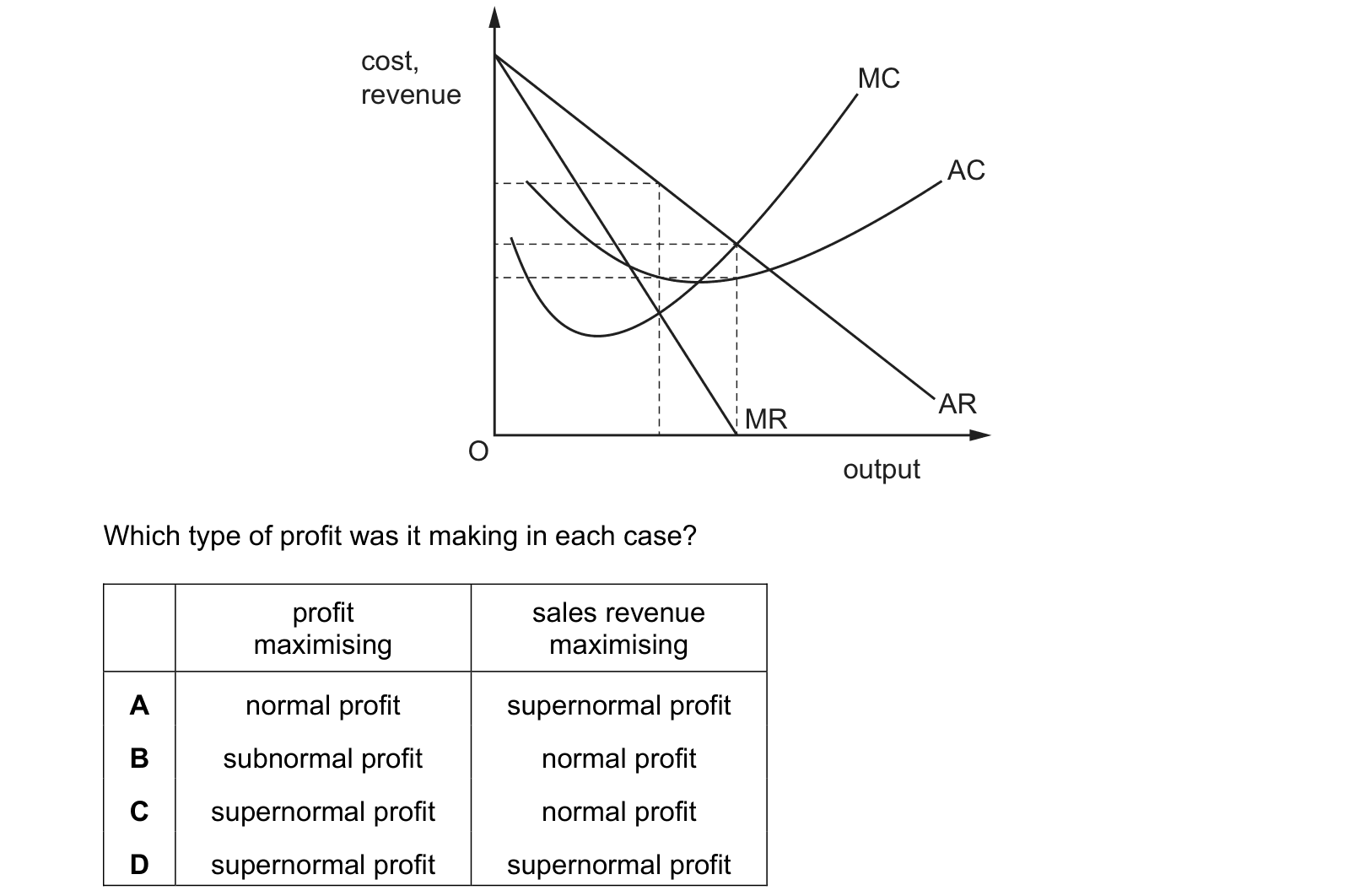
The diagram shows a firm in imperfect competition. It changed its aim from profit maximising to sales revenue maximising. Which type of profit was it making in each case?
Answer: D.
Compare average revenue with average cost at each of the two outputs. Profit maximisation is where marginal revenue equals marginal cost. Sales revenue maximisation is where marginal revenue is zero, which lies further to the right, because the firm keeps expanding for as long as an extra sale adds anything at all to revenue. The diagram shows the average revenue curve still above the average cost curve at that larger output, so the firm more than covers its costs including normal profit and earns supernormal profit at BOTH objectives, which is D. A and B each place one of the two positions at normal profit or worse, which would need average revenue to have fallen to or below average cost, and it has not. C makes that mistake for the revenue-maximising output alone. What genuinely changes between the two positions is the SIZE of the supernormal profit, which is smaller once revenue rather than profit is the target.
Question 2
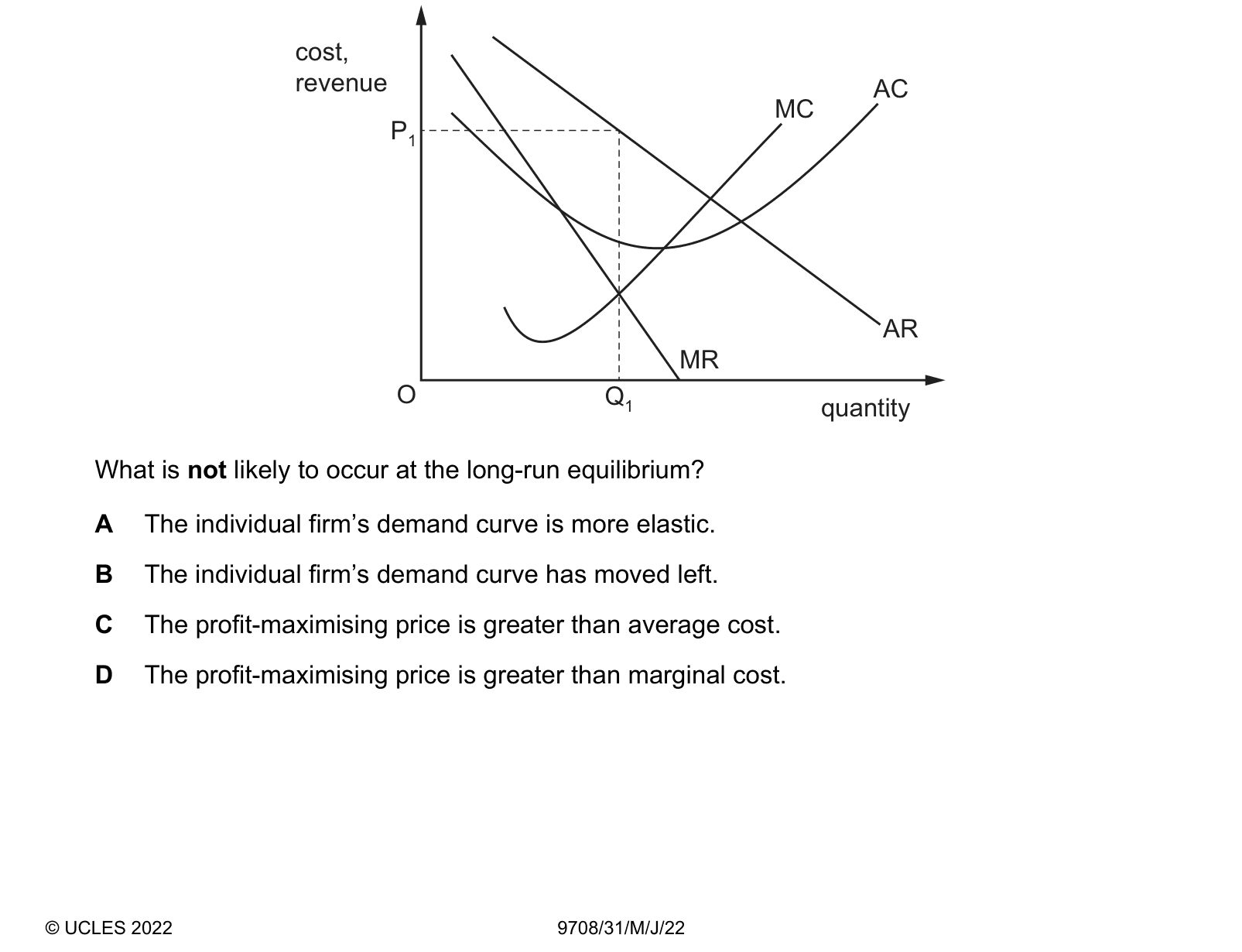
The diagram shows the short-run equilibrium for a firm operating in a monopolistically competitive market. What is not likely to occur at the long-run equilibrium?
Answer: C.
In monopolistic competition entry and exit are free, so short-run supernormal profit attracts new firms and keeps attracting them until that profit has gone. Long-run equilibrium is therefore the position where price equals average cost exactly, leaving normal profit only, which is why price being greater than average cost is the one thing that will no longer be true. The other three all describe the long-run position correctly. Each existing firm's demand curve moves left, because the entrants take a share of the market and fewer customers are left for each firm at any given price. It also becomes more elastic, since consumers now have more close substitutes to switch to if one firm raises its price. Price still exceeds marginal cost, because the demand curve slopes downwards, so marginal revenue lies below price and the profit maximising output leaves a gap between the two. That surviving gap is why monopolistic competition remains allocatively inefficient even once profits are only normal.
Question 3
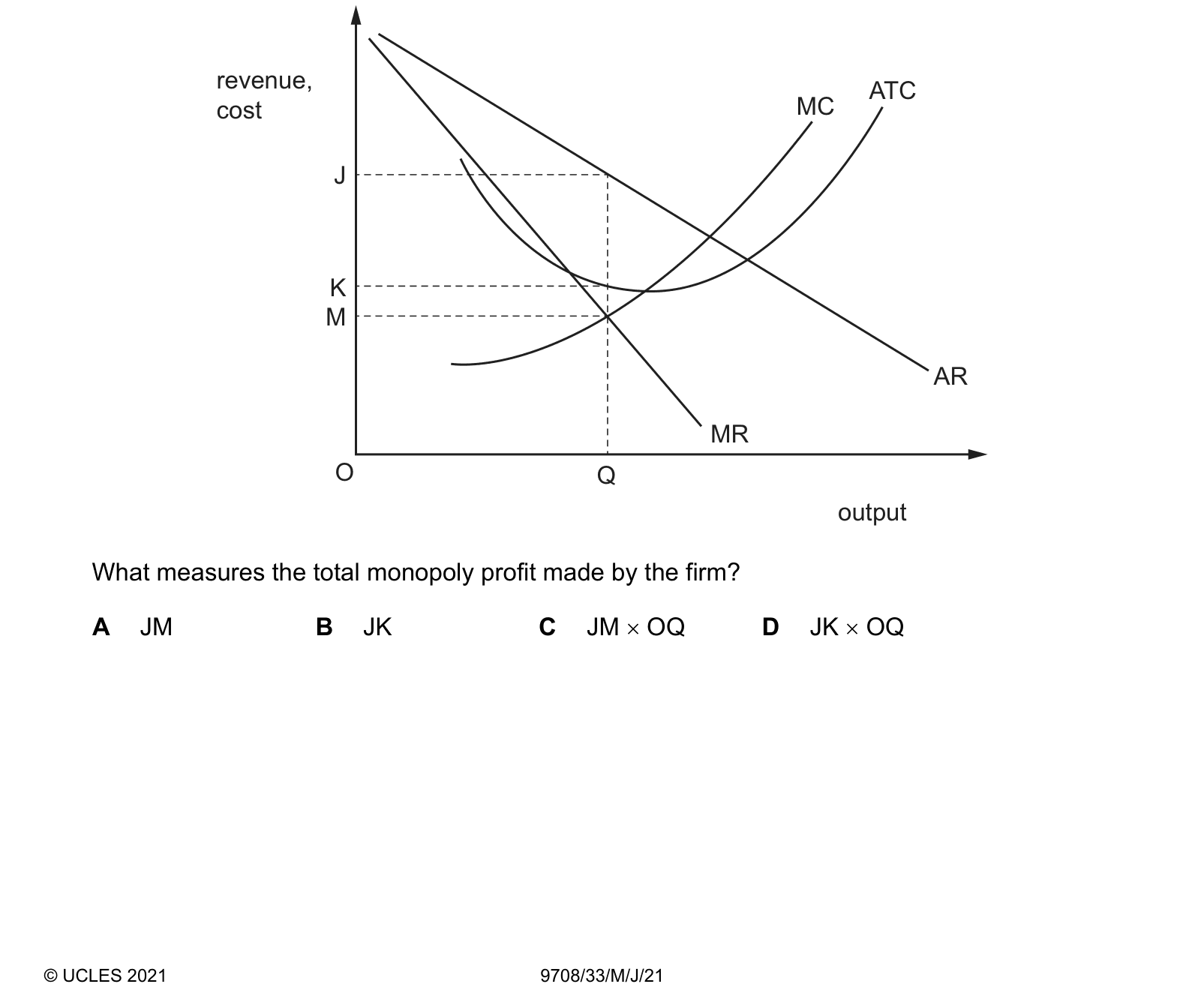
The diagram shows the cost and revenue curves of a profit-maximising monopolist. What measures the total monopoly profit made by the firm?
Answer: D.
Profit is the gap between what a unit sells for and what it costs on average, multiplied by how many units are sold, so you need two readings off the diagram and then a multiplication. The monopolist produces where MC cuts MR, which fixes output at Q. Go straight up from Q to the AR curve to find the price the firm can charge, which is J, and stop on the way at the ATC curve to find the average cost, which is K. The gap JK is therefore the profit on each unit, and multiplying it by the OQ units actually sold gives total profit: JK × OQ. B stops one step early and gives profit per unit rather than the total. M is where MC meets MR, so JM is the gap between price and MARGINAL cost; that is a measure of market power, not of profit, because it says nothing about average cost. C makes the same mistake as A and then multiplies it out.
These questions are drawn from past CIE 9708 papers. You answer, you find out immediately whether you were right, and you get the reasoning for the correct option and for each distractor. Wrong answers go to a mistakes locker so you can come back to exactly those.
Practice is free. You need an account only so your progress and your mistakes are still there next time.
These are the errors that cost marks on costs, revenue and profit, taken from our own topic notes. Read them before you practise and you will recognise the traps in the questions.
Defining short run as a fixed calendar period.
Saying diminishing returns begin when MP is negative.
Calculating MP as TP divided by labour.
Calculating MC as TC divided by output.
Treating monthly payment as proof that a cost is fixed.
Saying a rise in fixed cost shifts MC.
Confusing diminishing returns with decreasing returns to scale.
Treating returns to scale and economies of scale as exact synonyms.