Five practice questions are below. Answer on the page: each one is marked the moment you pick, the correct option is shown whether or not you found it, and the full explanation opens either way.
IB Economicsconcept drillsFree account
Barriers to Development: five questions to try now
Real questions, the answer key from the mark scheme, and the explanation that goes with it. No account needed to answer them.
Cross-board concept practice · originally a CIE 9708 question, used here because the concept is the same. It is not IB Economics past-paper material.
Question 1
Economists have proposed that the best policy to promote development is ‘trade not aid’. What is implied by this proposal?
Answer: B.
'Trade not aid' is an argument about the SOURCE of a developing country's income: it should come from selling exports rather than from receiving transfers, because export earnings are self-sustaining while aid is not. For that to work developed countries have to open their markets, so the implication is greater access to those markets, above all in agriculture and textiles where tariffs and quotas bite hardest. C keeps aid at the centre of the strategy and so contradicts the slogan even though it directs the aid towards exports. A and D both point away from trade rather than towards it, since self-sufficiency means producing at home what could be bought more cheaply abroad, and import substitution behind trade barriers is the protectionist alternative that 'trade not aid' was formulated against.
Cross-board concept practice · originally a CIE 9708 question, used here because the concept is the same. It is not IB Economics past-paper material.
Question 2
A developing country experiences economic growth. The economic growth is most likely to lead to economic development when it
Answer: D.
Growth becomes development only when the extra output reaches ordinary people as jobs, incomes and services, so the test is how widely the gains are spread. Labour-intensive expansion spreads them by construction, because such an industry grows precisely by taking on more workers and the wages go to households right across the workforce. B fails that test, since mineral extraction is capital-intensive, employs relatively few people, and its revenues often accrue to foreign owners or a narrow domestic elite. C states the concentration outright, because rewards flowing mainly to entrepreneurs is exactly what growth without development looks like. A is not a benefit in the form described, since rapid rural to urban migration typically outruns housing, sanitation and transport and produces slums and congestion.
Cross-board concept practice · originally a CIE 9708 question, used here because the concept is the same. It is not IB Economics past-paper material.
Question 3
Which change is most likely to increase both economic growth and economic development in the long run?
Answer: B.
Growth is a rise in output while development is a broader improvement in welfare and opportunity, so the answer has to serve both, and last. Investment in human capital does all three: better health and education raise what workers can produce, which is growth, while improving lives directly, which is development, and the effect persists for decades. C buys output today at the cost of output tomorrow, because a non-renewable resource once used is gone. D does the same in a different way, raising output now while compulsory overtime damages health and leisure, which pushes development backwards. A gets the mechanism the wrong way round, since a lower saving ratio means fewer funds available to finance investment, so the capital stock grows more slowly and long-run growth is weaker.
Cross-board concept practice · originally a CIE 9708 question, used here because the concept is the same. It is not IB Economics past-paper material.
Question 4
Why do economists draw a distinction between economic development and economic growth?
Answer: C.
Growth and development need separate names because they measure different things. Growth counts the QUANTITY of output an economy produces, while development asks about the QUALITY of the lives lived in it: health, education, poverty, and the range of choices open to ordinary people. The distinction is needed precisely because the two can move apart, so an economy can grow steadily for years while most of its population sees no improvement in how it lives. A does not distinguish them at all, since it defines a stage of development by the level of output, which is a growth measure. B and D each name a real economic issue, the allocation of resources and the balance between investment and consumption, but neither of them is the reason the subject keeps two separate words.
Cross-board concept practice · originally a CIE 9708 question, used here because the concept is the same. It is not IB Economics past-paper material.
Question 5
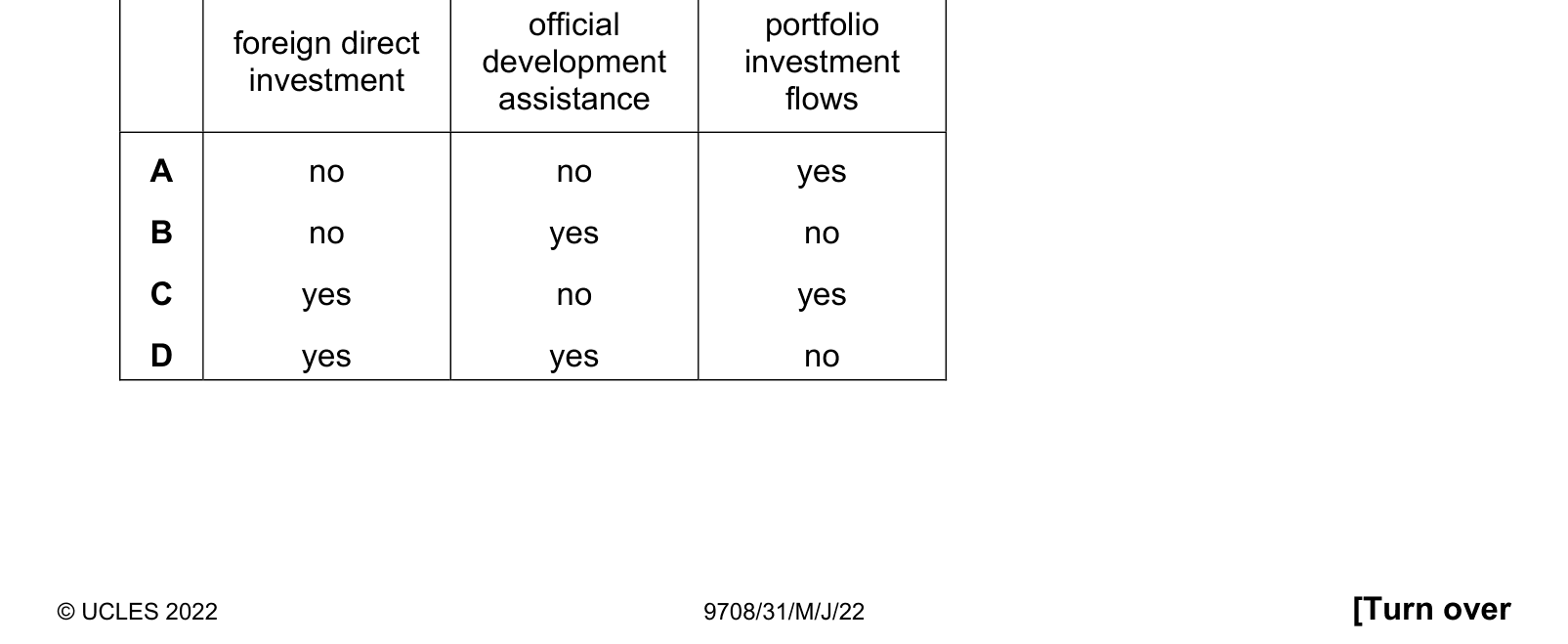
Which items in the table are classified as foreign aid? Each answer gives, in order: foreign direct investment; official development assistance; portfolio investment flows.
Answer: B.
Aid means a transfer intended to assist, which is what official development assistance is. The other two are commercial: portfolio investment buys financial assets for a return, and foreign direct investment builds or buys productive assets for profit. Both bring money in, but neither is aid, the test is whether a return is expected.
These questions are drawn from past Cambridge papers, mapped across to this topic because the concept is the same. You answer, you find out immediately whether you were right, and you get the reasoning for the correct option and for each distractor. Wrong answers go to a mistakes locker so you can come back to exactly those.
Practice is free. You need an account only so your progress and your mistakes are still there next time.
These are the errors that cost marks on barriers to development, taken from our own topic notes. Read them before you practise and you will recognise the traps in the questions.
Listing barriers without saying which one binds for the specific economy in the data.
Presenting the poverty trap as a single mechanism when the savings gap, foreign exchange gap and human capital gap each drive it.
Ignoring institutions, which condition whether any strategy in 4.10 can work.