Benefits of International Trade
Contents: 9 sections
IB Economics · Unit 4 The Global Economy · syllabus 4.1
Why trade happens at all, and why both sides can gain even when one country is better at everything. Comparative advantage is the single most examined idea in this unit.
Key definitions
| Term | Exam-ready definition |
|---|---|
| Absolute advantage | Producing more of a good than another country using the same resources. |
| Comparative advantage | Producing a good at a lower opportunity cost than another country. |
| Terms of trade | The rate at which one country's exports exchange for its imports. |
| Autarky | A situation in which a country does not trade and consumes only what it produces. |
Why countries trade
Trade allows countries to specialise in what they produce relatively well and exchange for the rest, raising total world output beyond what any country could achieve alone.
Benefits of trade:
- Lower prices and greater choice for consumers.
- Economies of scale, since firms serve a world market rather than a domestic one.
- Greater competition, which drives efficiency and innovation among domestic firms.
- Access to resources and technology a country lacks.
- Higher output and growth, and the export revenue to finance imports of capital goods.
Absolute and comparative advantage
Absolute advantage means producing more of a good with the same resources than another country.
Comparative advantage means producing a good at a lower opportunity cost than another country. This is the basis of the gains from trade, and the distinction is the most-tested idea in the topic.
The crucial insight: a country can have an absolute advantage in everything and still gain from trade, because it cannot have a comparative advantage in everything. Opportunity costs are relative, if you are better at producing both goods; you are still relatively better at one of them, and that is where you should specialise.
Comparative advantage lies with the lower opportunity cost. Never with the larger output.
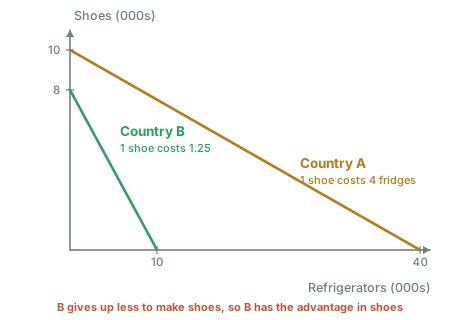
The figure makes the argument visible. The US can produce more of both goods, an absolute advantage in each, but its frontier is far flatter: one shoe costs it 4 refrigerators, while in Mexico one shoe costs only 1.25. Mexico is therefore the lower-opportunity-cost producer of shoes and the US of refrigerators. The point marked just beyond each frontier is what each country consumes after specialising and trading: a combination neither could reach alone, which is the gain from trade drawn rather than asserted.
Calculating it
Set out what each country gives up to produce one unit:
| Cloth | Wine | Opportunity cost of 1 wine | |
|---|---|---|---|
| Country A | 20 | 10 | 20 ÷ 10 = 2 cloth |
| Country B | 30 | 30 | 30 ÷ 30 = 1 cloth |
Country B has an absolute advantage in both. But B sacrifices only 1 cloth per wine while A sacrifices 2, so B has the comparative advantage in wine and A in cloth. Both gain if they trade at any rate between the two opportunity costs, here, between 1 and 2 cloth per wine.
Check from the other side, since the exam may ask for either good: A gives up 10 ÷ 20 = 0.5 wine per cloth, B gives up 30 ÷ 30 = 1. A sacrifices less wine per cloth, confirming A's comparative advantage in cloth. The two calculations must agree; if they do not, one fraction is inverted.
Assumptions and limitations
Worth naming, because they are the evaluation:
- No transport costs (which can exceed the gains for bulky, low-value goods).
- Constant returns to scale and perfect factor mobility (in practice, workers displaced by imports cannot instantly move to export industries).
- No trade barriers.
- Perfect information and stable comparative advantage over time.
Specialisation also creates dependency and vulnerability: a country specialised in one primary commodity is exposed to volatile prices and demand shocks, which is the standard critique of comparative advantage as a development strategy.
There is a distributional point too, and it is often the sharpest one available. Comparative advantage says trade raises total output; it does not say everyone gains. Workers in an industry displaced by imports bear a concentrated loss while consumers gain a little each. That asymmetry, concentrated losers, dispersed winners, is why protectionism is politically durable even when the aggregate case against it is strong.
Worked example
A country imposes a 20% tariff on imported steel to protect domestic producers.
- The tariff raises the price of imported steel
- domestic steel becomes relatively more competitive
- domestic production rises and imports fall
- domestic steel producers gain revenue and employment, and the government collects tariff revenue.
But trace it further, because this is where the marks are. Steel is an input for car manufacturing, construction and machinery. Those industries now face higher costs, so their output falls and their exports become less competitive. Employment saved in steel may be lost in the much larger steel-using sector. Meanwhile consumers pay more, and trading partners may retaliate against unrelated exports.
Judgement. Protection may be justified where the industry is genuinely infant and a credible plan exists to remove the tariff. Where the industry is mature and declining, the protection preserves inefficiency, and adjustment assistance, retraining, relocation support, addresses the employment concern at lower cost to consumers and downstream industries.
Where the gains actually come from
It is worth being able to say this in one sentence, because many answers describe specialisation without explaining why it creates anything.
Before trade, each country must produce everything it consumes, including the goods it is relatively bad at making. Producing those goods uses resources that would have produced more value elsewhere, so the opportunity cost of self-sufficiency is real output foregone. Specialisation moves resources into their lowest-opportunity-cost use in every country at once, so world output rises without any new resources or technology. Trade is then simply how each country converts its larger output of one good into a bundle of both.
The gain is created by reallocation, not by exchange. Exchange is what distributes it.
When the model breaks
The gains from trade are conditional, and naming a condition is how evaluation marks are earned.
- Transport costs can exceed the cost advantage, in which case trade does not happen and the model is silent rather than wrong.
- Increasing opportunity costs are the realistic case. Straight-line production possibility curves assume constant opportunity cost, so complete specialisation is optimal. With a bowed-out curve, opportunity cost rises as a country specialises, and the gains run out before specialisation is complete.
- Factor immobility. The model assumes resources move freely between industries. In practice a steelworker does not become a software engineer, so the adjustment costs of specialising fall on identifiable people in identifiable regions, which is where the political resistance to trade comes from.
- Externalities and dynamic effects. A country with a comparative advantage in a primary commodity may specialise into a sector with little scope for productivity growth, which is the argument behind much development policy in 4.10.
Real-world examples
- Bangladesh in ready-made garments is the standard comparative advantage case: no absolute advantage in productivity terms, but a low opportunity cost of labour in that sector, and now one of the world's largest exporters of clothing.
- The Netherlands in horticulture shows that comparative advantage is not the same as natural endowment. A country with limited land and little sunshine is a leading exporter of flowers and greenhouse vegetables because of accumulated technology and logistics.
- Trade in the same product both ways, such as Germany exporting cars to France while importing cars from France, is not explained by comparative advantage at all. It is intra-industry trade driven by product differentiation and economies of scale, and noticing that the model does not cover it is a strong evaluative point.
Exam technique
- Compute opportunity cost explicitly before naming who has the comparative advantage. Show the division.
- State the opportunity cost with its units both ways round, for example "one unit of X costs 1.33 units of Y", so the comparison is unambiguous.
- If asked whether trade is beneficial, give the range of terms of trade within which both countries gain. Outside it, one country would rather not trade.
- Do not claim a country gains because it produces more. Larger output is absolute advantage, and it is not what decides specialisation.
Common exam mistakes
- Explaining gains from trade using absolute advantage when the question is about comparative advantage.
- Comparing absolute output figures instead of opportunity cost ratios.
- Forgetting that the terms of trade must lie between the two opportunity cost ratios for both countries to gain.
- Treating the assumptions (no transport costs, constant returns, factor immobility between countries) as realistic rather than as limitations to evaluate.
Quick revision
- Countries trade because opportunity costs differ.
- Absolute advantage is producing more with the same resources; comparative advantage is producing at a lower opportunity cost.
- Gains from trade exist whenever opportunity cost ratios differ, even if one country holds absolute advantage in everything.
- The exchange ratio must sit between the two domestic opportunity cost ratios.
- Evaluate through the assumptions: transport costs, returns to scale, and the fact that specialisation raises dependence.
Check you have it
Cross-board concept practice · originally a CIE 9708 question, used here because the concept is the same. It is not IB Economics past-paper material.
Question 1
Germany, one of the world’s strongest trading nations, achieved a surplus on current account of the balance of payments in 2021–2022.
Which income flow would not have been included in the calculation of Germany’s current account?
Answer: D.
The current account records flows of goods, services, primary income and secondary income. Building a pipeline is the acquisition of a long-term physical asset abroad, foreign direct investment, and transactions in assets belong in the financial account, not the current account. The distinction is between paying for things that are used up or earned in the period (current) and acquiring claims and assets (financial).
Why the other options are all current account items:
- A, sales of German cars overseas, is trade in goods.
- B, foreign exchange earned from visitors, is trade in services, tourism is a service exported to non-residents.
- C, transfers of aid to less developed countries, is secondary income: money moves with nothing supplied in return.
Cross-board concept practice · originally a CIE 9708 question, used here because the concept is the same. It is not IB Economics past-paper material.
Question 2
A country operates a floating exchange rate. Why might a government change to a fixed exchange rate?
Answer: C.
Explanation:
A floating exchange rate system allows the exchange rate to be determined by market forces of supply and demand. This can lead to volatility and uncertainty in the exchange rate, which can be disadvantageous for businesses engaged in international trade.
Moving to a fixed exchange rate system provides businesses with more stability and predictability in planning their international transactions. It reduces the risk of sudden fluctuations in the exchange rate that could impact their profitability.
Options A, B, and D are not the primary reasons for a government to change to a fixed exchange rate:
A - to increase the stock of foreign currency reserves: While having a fixed exchange rate may require maintaining higher levels of foreign currency reserves to defend the pegged rate, this is not typically the primary reason for switching to a fixed exchange rate regime.
B - to make the terms of trade more favourable: Terms of trade refer to the ratio between a country's export prices and import prices. Changing to a fixed exchange rate may not directly impact the terms of trade as it relates more to international trade dynamics.
D - to use the exchange rate to reduce domestic prices: While a fixed exchange rate could potentially be used to influence domestic prices through changes in the exchange rate, this is not typically a primary reason for making the switch. The main goal of moving to a fixed exchange rate is usually to provide stability and certainty for businesses and investors.
Cross-board concept practice · originally a CIE 9708 question, used here because the concept is the same. It is not IB Economics past-paper material.
Question 3
A country operates a fixed exchange rate. There is a major fall of international confidence in its government’s economic policies. What is likely to be the result?
Answer: B.
What the syllabus asks for on this topicSyllabus points
Syllabus points
- The benefits of international trade for consumers, producers and economies.
- Absolute advantage and comparative advantage, and the difference between them.
- Calculating comparative advantage from output or input data.
- The assumptions the model rests on, and what happens when they fail.
Related IB Economics topics
Not the topic you were looking for? Describe what you are stuck on in your own words and we will take you to the notes that answer it.