Barriers to Development
Contents: 7 sections
IB Economics · Unit 4 The Global Economy · syllabus 4.9
Why some economies stay poor. Strong answers identify which barrier actually binds for the economy in the question, rather than listing all of them.
Key definitions
| Term | Exam-ready definition |
|---|---|
| Poverty cycle | A self-reinforcing loop in which low income causes low saving, low investment and low productivity, which causes low income. |
| Savings gap | The shortfall between the saving a country generates and the investment it needs to grow. |
| Foreign exchange gap | The shortfall between export earnings and the foreign currency needed to buy imported capital goods. |
| Dutch disease | A resource boom appreciating the exchange rate and making a country's other export sectors uncompetitive. |
| Tariff escalation | Importing countries taxing processed goods more heavily than raw materials, which discourages developing countries from moving up the value chain. |
Barriers to development
Economic
- Low savings and the poverty cycle. Low income → low saving → low investment → low capital stock → low productivity → low income. Breaking this loop is the central development problem.
- Low human capital: poor health and education limit productivity.
- Poor infrastructure: transport, power and communications raise costs for every firm.
- Dependence on primary exports: volatile prices, and possibly deteriorating terms of trade (Prebisch–Singer, 4.5).
- High indebtedness, where debt service consumes revenue that could fund development.
- Capital flight and the emigration of skilled workers (brain drain).
Institutional and political
- Weak property rights and rule of law, deterring investment.
- Corruption, diverting resources and raising the cost of doing business.
- Political instability or conflict.
- Inefficient or inequitable tax systems, limiting the state's capacity to fund anything.
Social and geographic
- Inequality, including gender inequality, which wastes half the population's potential.
- Rapid population growth, spreading capital and services more thinly.
- Landlocked geography or vulnerability to climate shocks.
The resource curse
Counter-intuitively, abundant natural resources are frequently a barrier rather than an advantage, and knowing why is a strong evaluative asset.
- Dutch disease. A resource boom brings foreign currency flooding in, which appreciates the exchange rate. That makes every other export, manufactures, agriculture, uncompetitive, so the non-resource economy shrinks. When the resource runs out or its price collapses, there is nothing left to fall back on.
- Volatility. Commodity prices swing, so government revenue does too, making budgeting and long-term investment nearly impossible.
- Institutional damage. Concentrated, easily taxed resource rents invite corruption and rent-seeking, and reduce a government's need to raise broad taxation, which historically weakens the accountability that comes with it.
- Under-investment in human capital, because the resource generates income without needing an educated workforce.
The remedy most often cited is a sovereign wealth or stabilisation fund: save the windfall abroad, spend only the sustainable income from it, and thereby avoid both the appreciation and the boom-bust cycle. Norway is the standard example of the resource curse being avoided by design rather than luck.
The three gaps, told apart
"The poverty cycle" is often written as if it were one mechanism. It is more useful, and better rewarded, to separate the constraints, because each has a different remedy.
- The savings gap. Incomes are so low that almost all of them are consumed, so there is little domestic saving to fund investment. The remedy is external finance: aid, borrowing or foreign direct investment.
- The foreign exchange gap. Capital equipment must be bought abroad and paid for in foreign currency, which must be earned by exporting. A country can have the domestic funds and still be unable to buy the machinery. The remedy is export earnings, or foreign currency inflows.
- The human capital gap. Even with the machinery, output stays low if the workforce is unhealthy or poorly educated. The remedy is slow and cannot be imported.
A strategy that closes one gap and not the others achieves little, which is the point that makes an evaluation in 4.10 work.
Why institutions sit underneath everything else
Institutional barriers deserve separating from the economic list rather than sitting inside it, because they determine whether any other policy can function.
Weak property rights mean an investor cannot be confident of keeping the returns, so investment does not happen at any interest rate. Weak contract enforcement means firms trade only with people they know, which caps the size of the market and therefore the scale a firm can reach. Corruption operates as a tax that is both unpredictable and unrecorded, and unpredictability deters investment more than a high but known rate would. And a state that cannot raise tax revenue cannot fund the health, education and infrastructure that every other strategy depends on.
This is why "institutional reform" appears in 4.10 as a strategy rather than as background. It is the precondition, and saying so is a strong closing judgement.
Real-world examples
- Botswana is the counter-example to the resource curse. Diamond revenue was channelled through relatively strong institutions and a stabilisation fund, and income per head rose from among the world's lowest at independence to upper-middle-income.
- Venezuela shows Dutch disease and volatility together: oil at its peak crowded out other exports, and when the price collapsed there was little else earning foreign currency.
- Landlocked economies such as those in central Africa and central Asia face transport costs to port that can exceed a manufacturer's entire labour cost advantage, which is why geography appears on the barrier list at all.
- Brain drain in health care is well documented, with several countries training doctors and nurses who then emigrate, so the public spending produces a return for a richer country.
Exam technique
- Identify which barrier BINDS for the economy in the data before discussing any others. Listing all of them without ranking caps the analysis.
- Trace the poverty cycle as a chain with arrows in your working, then write it out. Examiners reward the sequence, not the phrase.
- Distinguish the savings gap from the foreign exchange gap explicitly if the data mentions imported capital or export earnings.
- If natural resources appear in the stimulus, consider whether they are an advantage or a curse, and give the mechanism rather than the label.
Common exam mistakes
- Listing barriers without saying which one binds for the specific economy in the data.
- Presenting the poverty trap as a single mechanism when the savings gap, foreign exchange gap and human capital gap each drive it.
- Ignoring institutions, which condition whether any strategy in 4.10 can work.
Quick revision
- Economic: low savings and investment, the savings and foreign exchange gaps, primary product dependence, capital flight, indebtedness.
- Social and human: poor health and education, rapid population growth, gender inequality.
- Institutional and political: weak property rights, corruption, instability, poor infrastructure.
- Identify the binding constraint before recommending anything.
Check you have it
Cross-board concept practice · originally a CIE 9708 question, used here because the concept is the same. It is not IB Economics past-paper material.
Question 1
Which macroeconomic indicator is least likely to identify a developing country?
Answer: D.
Cross-board concept practice · originally a CIE 9708 question, used here because the concept is the same. It is not IB Economics past-paper material.
Question 2
What is not included in the Human Development Index?
Answer: A.
Explanation:
The Human Development Index (HDI) is a composite index that measures a country's average achievements in three basic aspects of human development:
1. Health: Indicated by life expectancy at birth,
2. Education: Measured by mean years of schooling and expected years of schooling,
3. Standard of living: Reflected by gross national income per capita.
The HDI does not directly include infant mortality rates in its calculation. Infant mortality rates relate to health outcomes, but they are not directly part of the HDI. Instead, the HDI focuses on life expectancy at birth as a measure of overall health outcomes.
Therefore, while infant mortality rates are important indicators of a nation's health status, they are not included in the Human Development Index.
Cross-board concept practice · originally a CIE 9708 question, used here because the concept is the same. It is not IB Economics past-paper material.
Question 3
The table shows data for Namibia and Spain from 2014 to 2017, giving real GDP per capita ($) and health spending per capita ($) at constant price levels. What can be concluded about whether there has been an increase in economic growth and economic development in Namibia and Spain between 2014 and 2017? Each option gives economic growth first, then economic development.
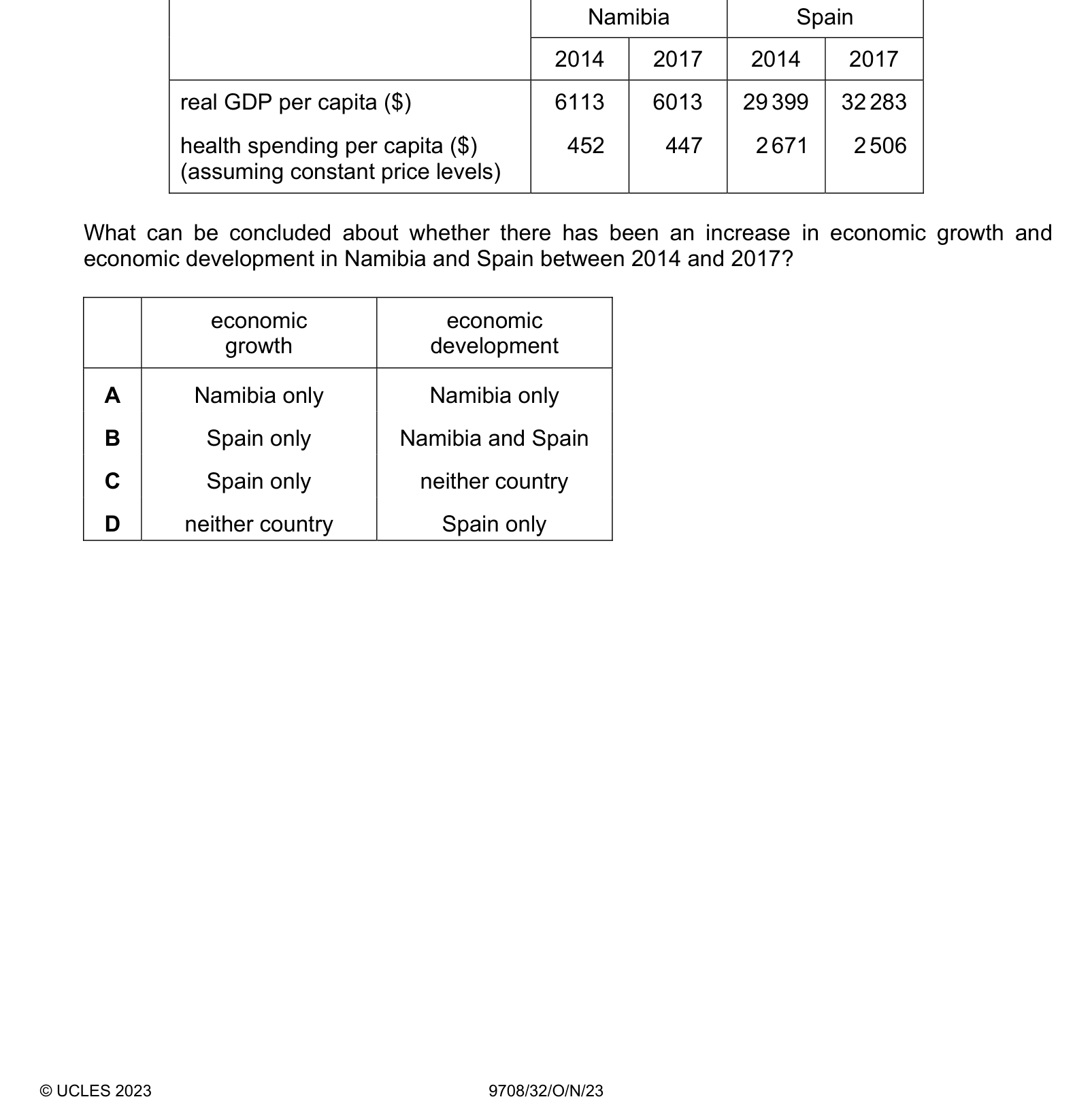
Answer: C.
What the syllabus asks for on this topicSyllabus points
Syllabus points
- Economic barriers, including the poverty cycle, low productivity and primary product dependence.
- Institutional and political barriers.
- Social and geographic barriers.
- Why abundant natural resources can act as a barrier rather than an advantage.
Related IB Economics topics
Not the topic you were looking for? Describe what you are stuck on in your own words and we will take you to the notes that answer it.