Supply-Side Policies
Contents: 10 sections
Aims
Supply-side policies aim to increase the economy's productive capacity, shifting LRAS to the right and the PPC outward, by improving the quantity or quality of factors of production, or the efficiency with which they are used.
Their distinguishing feature is that they act on long-run capacity, not on demand. That gives them a unique property worth stating early in any answer:
Supply-side policies can raise output and reduce the price level at the same time, because LRAS shifts right. Demand-side policies always trade one against the other.
Aims include: sustainable long-run growth, low inflation, reduced structural unemployment, improved international competitiveness, and an improved current account.
Actual versus potential growth
The distinction governs which policy is appropriate, and it is the source of most errors in this topic.
- Actual growth is an increase in real output, moving from inside the PPC towards it, or a rightward shift of AD along an upward-sloping SRAS. It uses existing capacity better.
- Potential growth is an increase in capacity itself, the PPC shifting outward, LRAS shifting right. It is what supply-side policy targets.
An economy in recession has idle capacity: the problem is a shortfall of demand, not of capacity. Supply-side policy raises a ceiling the economy is nowhere near. That is why diagnosing which kind of growth is missing comes before recommending anything.
Market-based versus interventionist
The syllabus requires this distinction, and the cleanest way to hold it is by asking who acts: does the policy remove obstacles so markets work better, or does the government provide something directly?
Market-based policies
Increase competition and incentives by reducing government interference.
- Deregulation: removing rules that restrict competition, lowering barriers to entry.
- Privatisation: transferring state assets to the private sector, on the argument that the profit motive drives efficiency.
- Trade liberalisation: lowering tariffs and quotas to expose domestic firms to competition.
- Labour market reforms: reducing trade union power, relaxing employment protection, reforming minimum wages to improve flexibility.
- Incentive-related tax cuts: lower income tax to encourage work effort and participation; lower corporation tax to encourage investment.
- Reducing benefit levels or tightening eligibility to sharpen work incentives.
The incentive argument is contested, and saying why earns evaluation marks. A cut in income tax has two opposing effects on how much people work. The substitution effect makes an extra hour more rewarding relative to leisure, encouraging work. The income effect means the same income can now be earned in fewer hours, encouraging less work. Which dominates is an empirical question, not a theoretical one, so "tax cuts increase work effort" is an assumption to be examined, not a result to be assumed.
Interventionist policies
The government provides directly what markets under-provide, usually because of positive externalities or long payback periods.
- Education and training: raising human capital and reducing structural unemployment.
- Infrastructure investment: transport, energy, broadband, reducing firms' costs across the economy.
- Research and development support: grants and tax credits, since R&D generates positive externalities and would otherwise be under-provided.
- Industrial policy: targeted support for strategic industries.
- Healthcare: a healthier workforce is more productive and participates for longer.
Notice the link back to microeconomics: the case for interventionist supply-side policy is a market failure argument. Education, training and R&D all generate positive externalities, so a free market under-provides them, which is precisely why government provision can raise total welfare rather than merely redistributing it.
Illustrating the effect
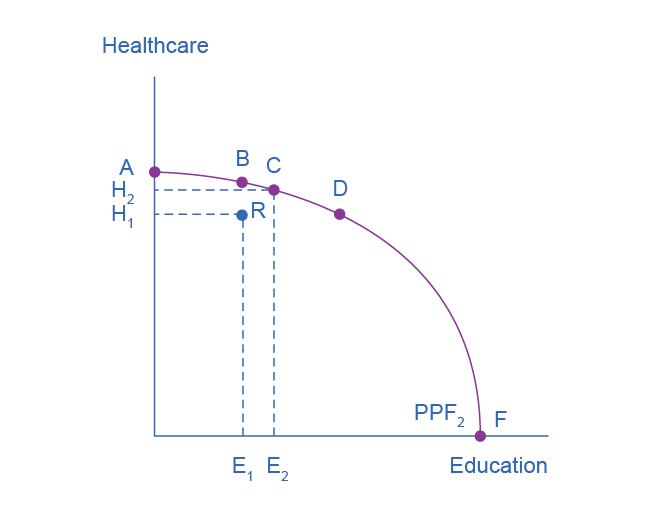
| Diagram | What supply-side success looks like |
|---|---|
| AD–AS | LRAS (and SRAS) shift right; real output rises and the price level falls |
| PPC | The whole curve shifts outward |
The AD–AS diagram is where the argument is won. Show LRAS shifting right with AD unchanged: output rises and the price level falls. Contrast that explicitly with a demand-side expansion, which raises output only by raising the price level. That contrast, drawn and stated, is a strong analytical move.
On the PPC, be careful which movement you draw. A successful supply-side policy shifts the whole frontier outward. Moving from a point inside the curve back onto it is a recovery using idle resources, actual growth, not potential growth, and drawing that instead is a common self-inflicted error.
How supply-side policies serve each objective
| Objective | How supply-side policy helps |
|---|---|
| Economic growth | Raises potential output, so growth is sustainable rather than cyclical |
| Low inflation | LRAS right puts downward pressure on the price level |
| Low unemployment | Attacks structural unemployment through skills and mobility |
| Balance of payments | Lower costs and higher productivity improve export competitiveness |
| Equity | Ambiguous: education and training improve it, deregulation and benefit cuts may worsen it |
That last row is deliberately the odd one out. Supply-side policy is the only category that can improve four objectives at once, which is why it is attractive, and the equity ambiguity is exactly where the evaluation lives.
Evaluation
Strengths
- Address the root cause. They tackle structural unemployment and low productivity directly, which demand-side policy cannot.
- Non-inflationary growth. Raising capacity means output can grow without demand-pull pressure.
- Improve competitiveness, helping exports and the current account.
- Sustainable. Unlike a demand stimulus, the effect is permanent rather than cyclical.
Limitations
- Very long time lags. Education and infrastructure take years, sometimes a generation, to affect capacity. They are no help in a recession that needs a response this year.
- Cost and opportunity cost. Interventionist policies are expensive; the funds have alternative uses, and financing may require borrowing or higher taxes.
- No help with a demand-deficient recession. Raising capacity is useless if the existing capacity is already idle for lack of demand. This is the single most important qualification and is frequently the point a question is testing.
- Distributional effects. Market-based reforms, weaker unions, lower benefits, deregulation, can widen inequality and reduce job security. Whether that is acceptable is a normative question, and saying so is legitimate evaluation.
- Uncertain effectiveness. Whether tax cuts actually raise work effort is empirically contested; the income and substitution effects of a tax cut pull in opposite directions.
- Government failure risk. Industrial policy requires the state to identify which industries deserve support, which invites lobbying and error.
Real-world examples
- The deregulation and privatisation programmes of the 1980s in the UK and elsewhere are the standard market-based case, and a genuinely two-sided one: supporters point to productivity and competition gains, critics to widening inequality and weakened job security. A question asking you to evaluate market-based policy is inviting both halves.
- Germany's dual apprenticeship system is the interventionist counterpart, widely cited for keeping youth unemployment low by matching training closely to employer demand, which is precisely the failure mode that sinks poorly designed retraining schemes.
- Singapore and South Korea illustrate sustained investment in education, infrastructure and industrial policy as a deliberate long-run development strategy, and are useful in Unit 4 as well.
Worked example
An economy suffers persistent structural unemployment: a declining manufacturing region where workers' skills no longer match available jobs, while vacancies go unfilled in services elsewhere.
Why demand-side policy fails here. An expansionary stimulus raises AD, but the unemployed workers lack the skills the vacancies require and live in the wrong region. The vacancies stay unfilled while prices rise, the economy hits capacity constraints in the growing sectors while unemployment persists in the declining one.
The supply-side response.
- A government-funded retraining programme raises the skills of unemployed workers
- the mismatch between available workers and vacancies narrows
- structural unemployment falls
- effective labour supply rises
- LRAS shifts right
- potential output rises with downward pressure on the price level.
Evaluation. Retraining takes years, so unemployment persists meanwhile. It is expensive, with an opportunity cost in other public spending. It may fail if the training does not match actual employer demand, or if workers cannot afford to move to where the jobs are, so it may need pairing with relocation support or infrastructure. And a market-based alternative, cutting benefits to sharpen incentives, would be cheaper and faster, but does nothing about the skills mismatch itself and imposes hardship on people who cannot find suitable work whatever their incentives.
That comparison, ending in a conditional judgement, is what a 15-mark answer is asking for.
A note on the honest answer. The strongest conclusions usually reject the framing that one policy category must win. Here, retraining addresses the cause but arrives late; demand-side support sustains incomes while it works. Supply-side and demand-side policy are complements over different time horizons, and saying so, with the reason, reads as judgement rather than fence-sitting.
Common exam mistakes
- Confusing supply-side policies with SRAS shifts caused by cost changes. A wage rise shifts SRAS, but it is not a supply-side policy.
- Classifying policies wrongly, remember: market-based removes obstacles, interventionist provides directly.
- Claiming supply-side policies fix a recession quickly. Their lags are the longest of any policy.
- Drawing AD shifting right instead of LRAS.
- On the PPC, moving from inside the curve to the frontier and calling it potential growth.
- Ignoring the distributional consequences of market-based reforms.
- Treating tax cuts as certainly raising work effort, ignoring the income effect.
Exam technique
Classify explicitly, say "this is an interventionist supply-side policy", because the syllabus asks for the distinction and it costs one sentence.
Draw LRAS shifting right with AD unchanged, and state the dual outcome: higher output and a lower price level. If the question compares policies, put the demand-side diagram alongside to show the contrast.
Before recommending anything, say whether the problem is cyclical or structural. That one sentence determines whether supply-side policy is the right tool at all, and it is the judgement the question is usually built around.
For evaluation, the reliable routes are: time lags, cost and opportunity cost, whether the problem is actually structural, equity effects, and uncertainty about whether incentives respond as assumed.
Quick revision
- Supply-side policies raise productive capacity: LRAS right, PPC outward.
- Actual growth uses existing capacity; potential growth raises it.
- Uniquely; they can raise output and lower the price level together.
- Market-based: deregulation, privatisation, trade liberalisation, labour reform, tax incentives.
- Interventionist: education, training, infrastructure, R&D, healthcare, industrial policy.
- The interventionist case is a market-failure argument, positive externalities.
- Tax cuts have opposing income and substitution effects on work effort.
- Strengths: address root causes, non-inflationary, sustainable, improve competitiveness.
- Limits: very long lags, costly, useless against demand-deficient recession, can widen inequality.
- Diagnose whether the problem is structural or cyclical before recommending.
Check you have it
Cross-board concept practice · originally a CIE 9708 question, used here because the concept is the same. It is not IB Economics past-paper material.
Question 1
A government decides to borrow from the general public in order to finance its extra spending on apprenticeship training schemes. Which types of macroeconomic policy are being used?
Answer: A.
Take the three in turn against what the government actually did.
Fiscal policy is any deliberate change in government spending or taxation. Here spending rises, so fiscal policy is being used. The fact that it is paid for by borrowing rather than by tax does not change that; borrowing is how the spending is financed, not a separate kind of policy.
Monetary policy means the central bank acting on the interest rate or the money supply. Borrowing from the general public sells bonds to people who already hold the money, so purchasing power is transferred rather than created. No new money enters circulation and the central bank has done nothing, so monetary policy is not being used. This is the step that decides the question, and it is why C and D are wrong: both claim fiscal policy is absent, which cannot be right when government spending has risen.
Supply side policy raises the productive capacity of the economy. Apprenticeship training improves the skills of the workforce, which shifts long run aggregate supply to the right, so supply side policy is being used. B is the trap for anyone who spots the fiscal element and stops there: it treats the training as ordinary spending and misses that what the money buys is productive capacity.
Cross-board concept practice · originally a CIE 9708 question, used here because the concept is the same. It is not IB Economics past-paper material.
Question 2
A government decides to remove fees for higher education provided by the public sector and the private sector.
What is the consequence of this policy?
Answer: A.
Cross-board concept practice · originally a CIE 9708 question, used here because the concept is the same. It is not IB Economics past-paper material.
Question 3
Supply-side policies can be used to correct cost-push inflation. Which policy would best achieve this aim in the long run?
Answer: D.
Explanation:
- Cost-push inflation occurs when the costs of production increase, leading to an increase in prices. Supply-side policies aim to increase the economy's ability to produce goods and services, which can help to reduce inflationary pressures in the long run.
- Increasing productivity through technological advancements and automation can help to reduce the costs of production. By supporting the replacement of labour-manned machines by the use of robots, a country can improve efficiency and reduce labour costs, ultimately lowering the pressure on prices to rise due to increased production costs.
- Allowing trade unions to maintain work practices irrespective of productivity (option A) would not be effective in reducing cost-push inflation as it could prevent necessary changes in the production process to increase efficiency and reduce costs.
- Encouraging workers to work extra hours for extra pay (option B) may not necessarily address the underlying causes of cost-push inflation. It may increase production in the short term but is unlikely to have a significant impact on long-term cost pressures.
- Increasing total labour supply by employing more unskilled workers (option C) may lead to an increase in production but may not address the specific issue of increasing costs contributing to cost-push inflation.
What the syllabus asks for on this topicSyllabus points
Syllabus points
- Explain the aims of supply-side policies.
- Distinguish market-based from interventionist supply-side policies.
- Illustrate their effect using LRAS and PPC diagrams.
- Distinguish actual growth from potential growth.
- Evaluate the strengths and limitations of supply-side policies.
Related IB Economics topics
Not the topic you were looking for? Describe what you are stuck on in your own words and we will take you to the notes that answer it.