What is Economics?
Contents: 13 sections
Scarcity and the fundamental economic problem
Scarcity is the condition that arises because wants are unlimited while resources are finite. It is the starting point of the whole subject.
The fundamental economic problem: how to allocate scarce resources among unlimited and competing wants.
Scarcity is not the same as poverty or shortage. A wealthy country still faces scarcity, because its resources remain finite relative to everything its citizens would like. And a shortage is a temporary market condition, excess demand at a particular price, whereas scarcity is a permanent condition of existence. Confusing the two is a common early error.
Because resources are scarce, every use of them means choosing, and every choice means giving something up.
Opportunity cost
Opportunity cost is the value of the next best alternative forgone when a choice is made.
Two elements of that definition earn marks:
- Next best, not all alternatives added together, and not simply "what you gave up".
- Forgone, meaning it is a real cost even though no money changes hands.
Opportunity cost is not the same as financial cost. A student attending university pays fees, but the opportunity cost also includes the earnings sacrificed by not working, often the larger figure. Equally, a decision can have an opportunity cost of zero if the resources used had no alternative use.
Applied to the three types of decision-maker:
- Individuals: spending money on one good means not spending it on another; time spent studying is time not spent working.
- Firms: capital invested in one project cannot fund another.
- Governments: funding a hospital means not funding a school. Every budget decision is an opportunity cost decision.
Economic goods and free goods
- An economic good is scarce, so producing it has an opportunity cost and it commands a price.
- A free good is not scarce, there is enough for everyone at zero price, so it has no opportunity cost.
Genuine free goods are rare. Air was the standard example, but clean air is now scarce in many places, which converts it into an economic good, and that conversion is precisely why pollution became an economic problem. A good given away at zero price is not a free good if producing it used scarce resources; it is simply a good someone else paid for.
The factors of production
| Factor | What it is | Reward |
|---|---|---|
| Land | All natural resources: soil, minerals, water, forests | Rent |
| Labour | Human physical and mental effort | Wages |
| Capital | Manufactured goods used to produce other goods: machinery, tools, factories | Interest |
| Enterprise | Organising the other three and bearing risk | Profit |
Two distinctions worth holding:
- Capital in economics means physical productive assets, not money. Money is a means of acquiring capital, not capital itself.
- Human capital: the skills, knowledge and health embodied in workers, is a distinct concept and central to development and growth.
The three basic economic questions
Every society, whatever its system, must answer:
- What to produce? Which goods and services, and in what quantities.
- How to produce? Which combination of factors, labour-intensive or capital-intensive methods.
- For whom to produce? How output is distributed among the population. This is the equity question, and it is where economics and value judgements meet most directly.
Economic systems
| System | Who decides | Strengths | Weaknesses |
|---|---|---|---|
| Free market | The price mechanism, through private decisions | Efficient allocation, choice, innovation incentives | Market failure; inequality; under-provision of public and merit goods |
| Planned (command) | Central government | Can pursue equity directly; provides public goods | No price signals, so information is poor; weak efficiency incentives; limited choice |
| Mixed | Both, in varying proportions | Combines market efficiency with government correction of failure | The balance is contested and politically decided |
In practice every real economy is mixed; the interesting question is not which system but where the balance sits and why. Saying that, rather than describing three systems as if they existed in pure form, is the more accurate answer.
The price mechanism answers all three questions in a market system without anyone directing it: prices signal what is wanted, incentivise producers to supply it, and ration scarce goods among buyers.
The nine key concepts
The IB organises the whole course around nine concepts, and examiners reward answers that use them as lenses rather than reciting them. They are worth knowing early, because every later topic is an application of two or three.
| Concept | The question it asks |
|---|---|
| Scarcity | Resources are finite against unlimited wants: the starting point of everything |
| Choice | Given scarcity, what is selected, and what is given up |
| Efficiency | Are resources allocated to their most valued use, and used without waste |
| Equity | Is the distribution of income and opportunity fair: a normative judgement |
| Economic well-being | Are people's living standards and welfare actually improving |
| Sustainability | Can this continue without compromising future generations |
| Change | How markets and economies adjust over time |
| Interdependence | How agents, markets and countries affect one another |
| Intervention | When and how governments should act, and at what cost |
The pairing worth internalising now is efficiency against equity. Most policy questions in this course come down to a trade-off between them, a competitive market can be perfectly efficient and deeply unfair, and correcting the unfairness usually costs some efficiency. Recognising which of the two a question is really about is often the difference between a descriptive answer and an evaluative one.
Illustrating scarcity and choice
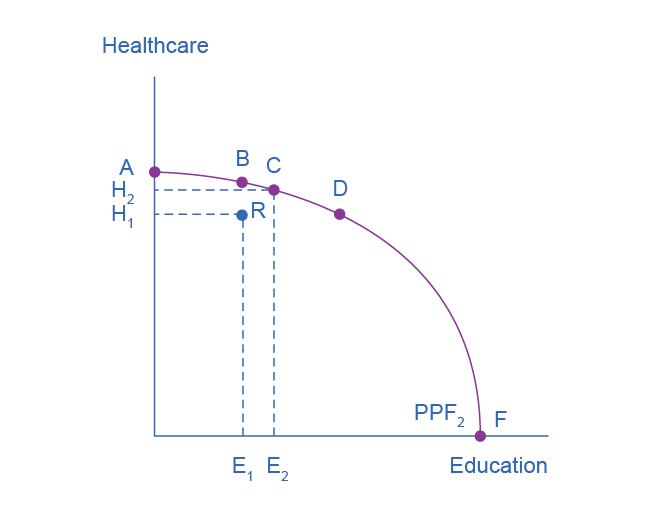
The production possibilities curve is scarcity, choice and opportunity cost in a single diagram, and it is the first model the course introduces.
- Points on the curve use every resource fully, production is efficient.
- Points inside it waste resources, so more of both goods is available without sacrificing anything.
- Points outside it are unattainable with current resources and technology; that is scarcity drawn.
- Moving along the curve means giving up some of one good to get more of the other. The amount given up is the opportunity cost, made visible.
A bowed-out curve shows opportunity cost increasing as more of one good is produced, because resources are not equally suited to both uses. A straight line would mean constant opportunity cost.
Worked example
A government has a fixed budget and must choose between building a hospital and building a school.
- Resources are scarce
- both projects cannot be funded
- a choice must be made
- if the hospital is built, the opportunity cost is the school, being the next best alternative forgone.
This single decision engages all three basic questions: what to produce (healthcare or education), how (capital-intensive construction or labour-intensive community provision), and for whom (which region or group benefits).
Evaluation. The choice depends on which delivers more social benefit, which is genuinely hard to measure, and on the time frame, a school's returns arrive over decades through higher human capital, while a hospital's are more immediate. Distributional questions matter too: who lives near each site. This is why cost–benefit analysis exists, and why its results are contested.
Common exam mistakes
- Confusing scarcity (permanent, universal) with shortage (temporary, market-specific).
- Defining opportunity cost as "what you gave up" rather than the next best alternative forgone.
- Treating money as capital.
- Calling something a free good because its price is zero.
- Describing economic systems as pure types when every real economy is mixed.
- Answering only "what to produce" when asked about the three basic questions.
Exam technique
Definitions in this topic must be precise, because they are the foundation for everything later and examiners test them exactly. Learn "next best alternative forgone" word for word.
When a question asks about a choice, name the opportunity cost specifically, identify the actual alternative in the scenario, not a generic statement that "there is an opportunity cost".
For evaluation, useful angles are: who bears the opportunity cost, the time frame over which benefits arrive, how the benefits are measured, and the equity implications of the "for whom" question.
Quick revision
- Scarcity: unlimited wants, finite resources. Permanent, not a shortage.
- Opportunity cost: the next best alternative forgone.
- Economic goods are scarce; free goods are not, and are rare.
- Factors: land (rent), labour (wages), capital (interest), enterprise (profit).
- Capital means productive assets, not money.
- Three questions: what, how, and for whom to produce.
- Systems: free market, planned, mixed, every real economy is mixed.
- The price mechanism signals, incentivises and rations.
Check you have it
Cross-board concept practice · originally a CIE 9708 question, used here because the concept is the same. It is not IB Economics past-paper material.
Question 1
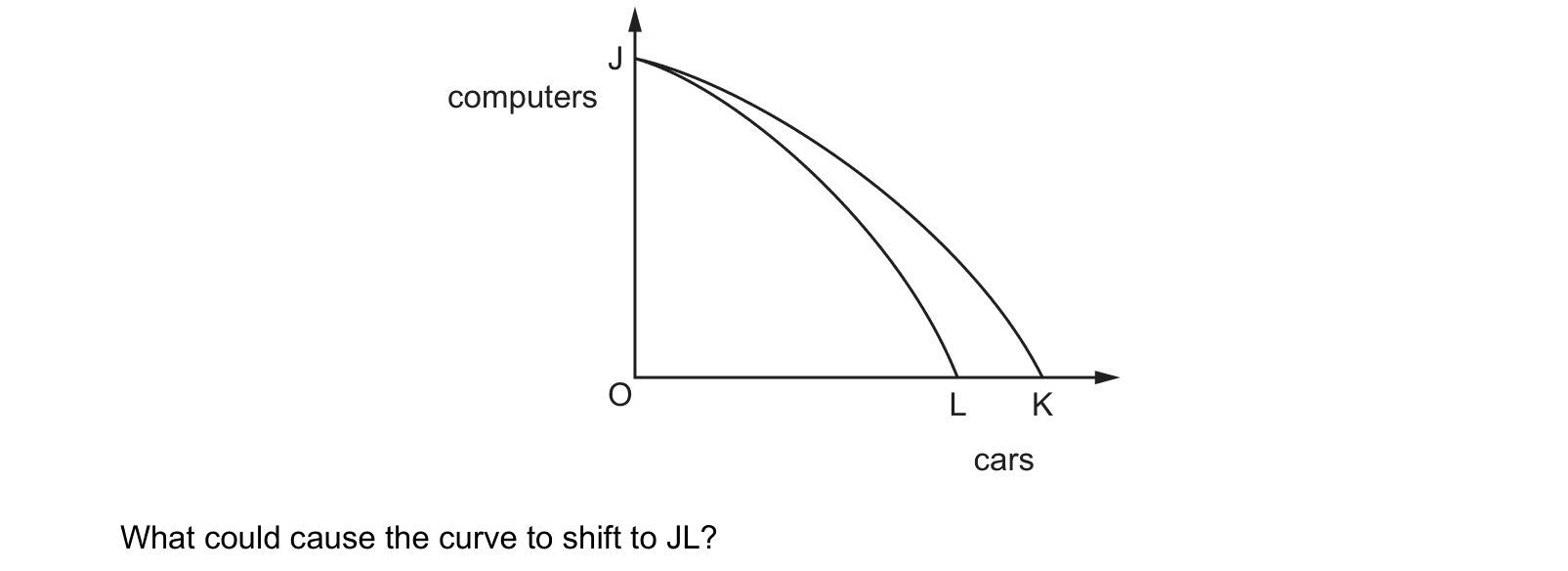
In the diagram JK is the initial production possibility curve for an economy producing computers and cars. J computers O L K cars What could cause the curve to shift to JL?
Answer: A.
Cross-board concept practice · originally a CIE 9708 question, used here because the concept is the same. It is not IB Economics past-paper material.
Question 2
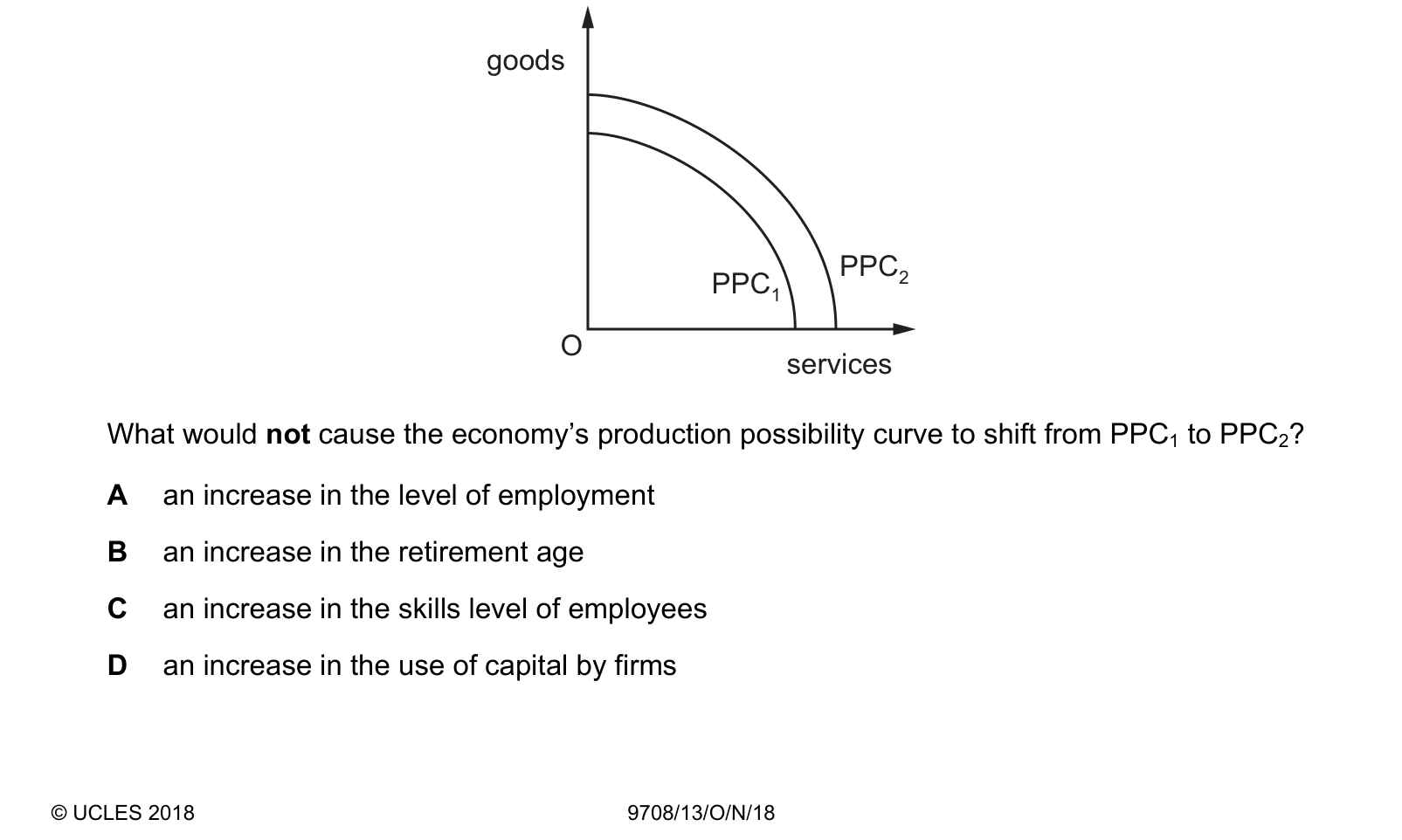
The diagram shows two production possibility curves for goods and services in an economy. What would not cause the economy’s production possibility curve to shift from PPC1 to PPC2?
Answer: A.
Cross-board concept practice · originally a CIE 9708 question, used here because the concept is the same. It is not IB Economics past-paper material.
Question 3
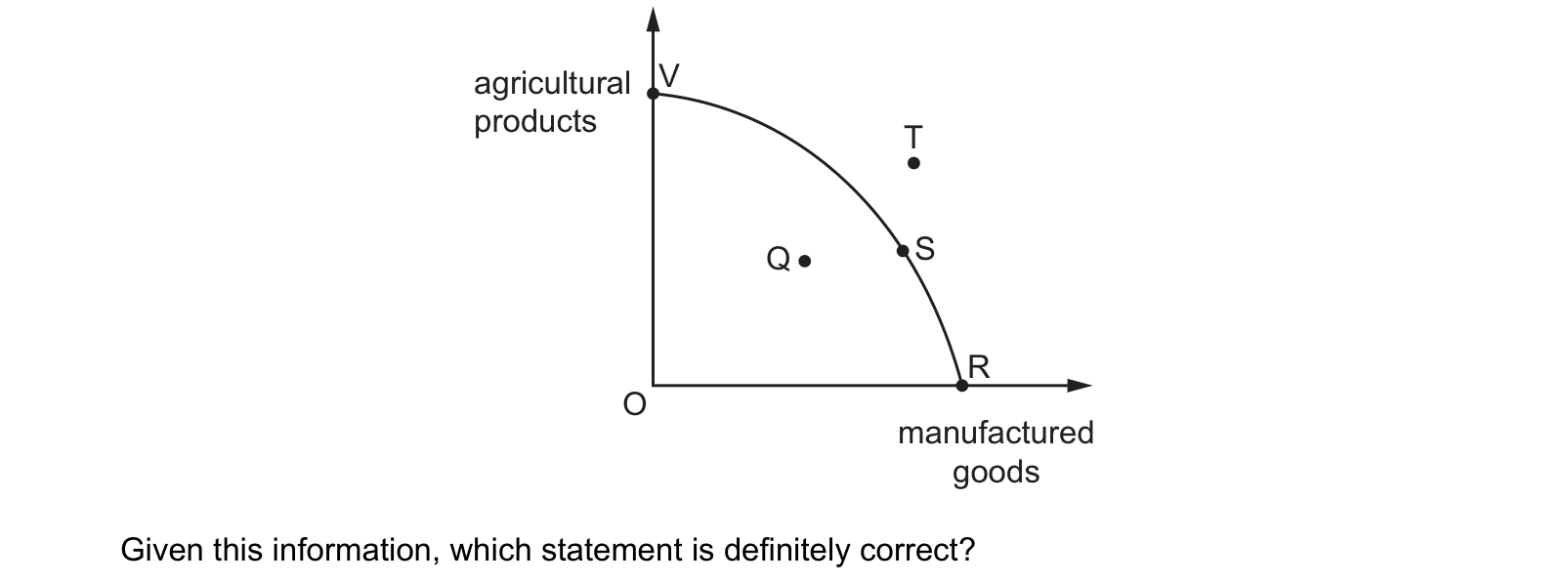
A country can produce manufactured goods and agricultural products as shown in the diagram. agricultural V products T S Q R O manufactured goods Given this information, which statement is definitely correct?
Answer: A.
What the syllabus asks for on this topicSyllabus points
Syllabus points
- Explain scarcity, the fundamental economic problem, and the need for choice.
- Explain the four factors of production and their rewards.
- Distinguish economic goods from free goods.
- Explain the three basic economic questions: what, how and for whom to produce.
- Outline the main economic systems and the role of the market.
Related IB Economics topics
Not the topic you were looking for? Describe what you are stuck on in your own words and we will take you to the notes that answer it.