Market Power
Contents: 9 sections
Market power as market failure
Market power is the ability of a firm to influence the price of its product, to be a price maker rather than a price taker. It arises from barriers to entry: economies of scale, control of an essential resource, legal protection such as patents, high sunk costs, or brand loyalty.
The competitive model's efficiency result depends on firms having no power over price. Remove that assumption and the market no longer allocates resources efficiently, even with perfect information and no externalities.
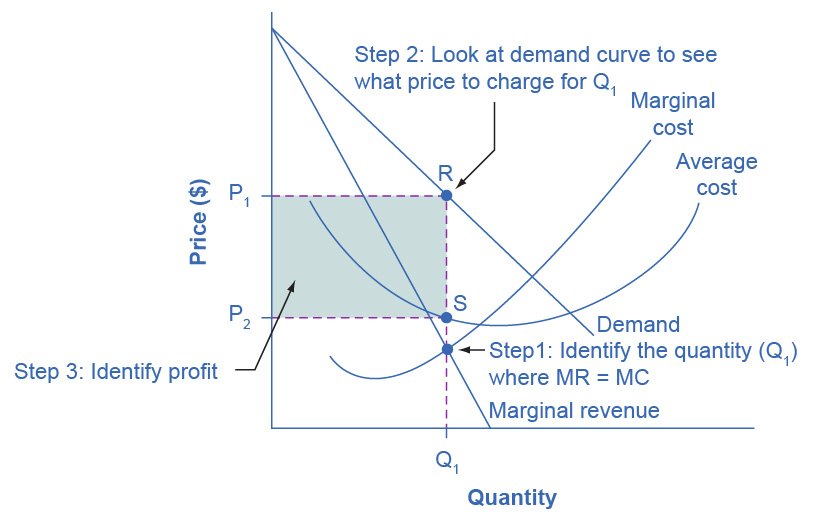
The mechanism is straightforward: a firm facing a downward-sloping demand curve knows that selling an extra unit requires lowering the price, and, for a single-price firm, lowering it on all units. Marginal revenue therefore lies below price. Profit is maximised where MR = MC, but because MR < P, the firm produces where price exceeds marginal cost.
- P > MC means the value consumers place on an extra unit exceeds the cost of producing it
- society would gain from more output
- but the firm restricts output to protect its margin
- allocative inefficiency and welfare loss.
Worth seeing the arithmetic behind MR < P once. A firm selling 4 units at \$20 earns \$80; to sell a fifth it must drop the price to \$19, earning \$95. Marginal revenue is \$15, not \$19, it gained \$19 on the new unit and lost \$1 on each of the four it could have sold dearer. That loss on the earlier units is the entire reason MR falls below price, and therefore the entire reason monopoly restricts output.
Monopoly compared with perfect competition
| Perfect competition | Monopoly | |
|---|---|---|
| Price | Lower, equal to MC | Higher, above MC |
| Output | Higher | Lower (restricted) |
| Allocative efficiency | Yes: P = MC | No: P > MC |
| Productive efficiency | Yes, in the long run: produces at minimum ATC | Not necessarily |
| Long-run profit | Normal profit only (entry competes it away) | Abnormal profit sustained by barriers to entry |
| Consumer surplus | Larger | Smaller: part transferred to producers, part destroyed |
On the diagram, the welfare loss is the triangle between the demand curve and MC, from the monopoly output up to the allocatively efficient output where P = MC.
Note the two distinct things happening to consumer surplus, because questions ask about them separately. Part of it is transferred to the firm as abnormal profit, a distributional change, not a loss to society. Part is destroyed as deadweight loss, output that should have happened and did not. Only the second is inefficiency; the first is an equity question.
Two efficiency concepts are being tested, and mixing them up is costly:
- Allocative efficiency: producing where P = MC, so the last unit's value to consumers equals its cost.
- Productive efficiency: producing at minimum average total cost, so no resources are wasted at whatever output is chosen.
X-inefficiency is a third idea worth naming: without competitive pressure, a protected firm's costs may drift above the minimum possible simply because nobody forces them down.
Worked calculation
A monopolist faces demand P = 120 − 3Q with constant MC = 30.
TR = 120Q − 3Q², so MR = 120 − 6Q (twice as steep as demand)
Set MR = MC: 120 − 6Q = 30 → Q = 15
Price: read up to demand, not MR → P = 120 − 3(15) = \$75
Under perfect competition, price would equal marginal cost:
120 − 3Q = 30 → Q = 30 at a price of \$30
So the monopolist sells half the competitive quantity at two and a half times the price.
Welfare loss = ½ × (75 − 30) × (30 − 15) = \$337.50
The triangle's height is the gap between monopoly price and marginal cost; its base is the output the monopolist withholds. Naming which distance is which is most of the mark.
The case against a blanket condemnation
The syllabus expects balance, and the arguments the other way are genuinely strong:
- Economies of scale. A large firm may produce at lower average cost than many small ones. Where scale economies are substantial, a monopoly's price can be lower than a competitive industry's despite the mark-up. This is the natural monopoly case, water, rail track, electricity grids, where duplicating the network would be wasteful.
- Dynamic efficiency. Abnormal profit can fund research and development. Patents deliberately create temporary monopoly precisely to reward innovation. A perfectly competitive firm earning only normal profit may have neither the funds nor the incentive to innovate.
- Contestability. If entry is genuinely easy, even a sole incumbent may price close to competitive levels for fear of attracting entrants. What matters is the threat of entry, not the current number of firms.
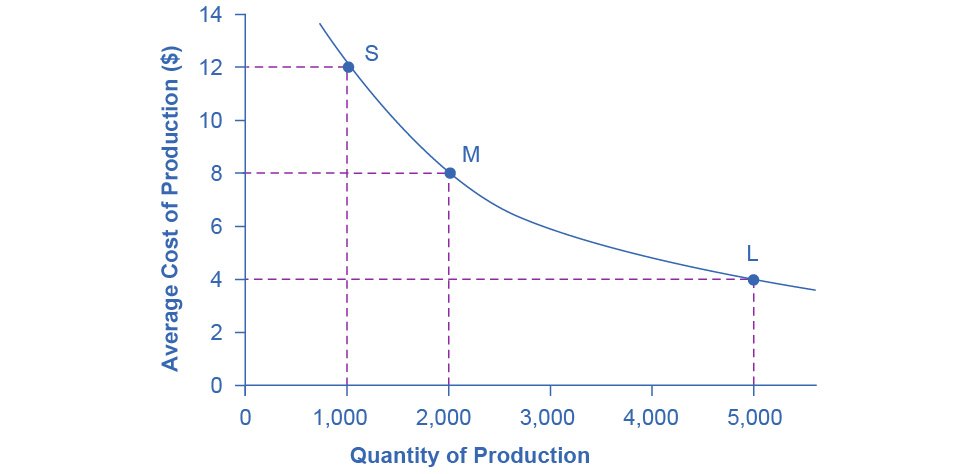
The figure is the natural-monopoly argument in one picture: average cost falling steadily from \$12 to \$4 as output rises. If that decline continues across the whole range the market demands, then one firm serving everyone is genuinely cheaper than several sharing the market, and splitting it up would raise costs for every consumer.
So the judgement is conditional: market power is most damaging where barriers are high, scale economies are modest, and there is no innovation to fund.
Government responses
| Response | How it works | Weakness |
|---|---|---|
| Price regulation (price cap) | Sets a maximum price, often at or near MC or average cost | Setting it at MC may push price below ATC, causing losses a natural monopoly cannot sustain without subsidy; requires accurate cost information the regulator does not have |
| Competition law | Prohibits abuse of dominance, cartels and anti-competitive mergers | Investigation is slow and costly; proving abuse is difficult |
| Breaking up the firm | Splits a monopoly into competing units | Sacrifices economies of scale; disruptive |
| Nationalisation | Public ownership so the firm can price at MC | Weaker efficiency incentives; opportunity cost of public funds |
| Reducing barriers to entry | Deregulation, opening networks to competitors | Ineffective where barriers are technological rather than legal |
Regulatory capture is the risk running through all of these: a regulator dependent on the firm for cost information, and staffed by people from the industry, may come to serve the firm's interests rather than consumers'.
A price cap can raise output, which is the counter-intuitive result worth having ready. Capping a monopolist's price at the level where demand meets MC removes its ability to restrict output to hold price up, so quantity rises towards the efficient level and deadweight loss falls. The same policy that harms a competitive market corrects a monopolised one, which is why identifying the market structure comes before judging the intervention.
Real-world examples
- Utilities: water, electricity transmission, rail infrastructure, are the standard natural monopolies, and almost universally either regulated or publicly owned for exactly the reasons above.
- Pharmaceutical patents are the clearest dynamic-efficiency trade-off: a deliberate temporary monopoly, granting high prices and restricted access now in exchange for the research that produced the drug at all. Whether the bargain is set correctly, how long patents should run, and what happens to access in low-income countries, is a live argument and good evaluation material.
- Large digital platforms are where contestability is most contested. Network effects mean a service becomes more valuable as more people use it, which is a barrier to entry no regulator created and none can easily remove.
Worked example
A single firm supplies piped water to a city, with a network too costly to duplicate.
- The firm faces the market demand curve
- MR lies below price
- it maximises profit where MR = MC
- output is restricted and price set above MC by reading up to the demand curve
- consumers pay more and consume less than is allocatively efficient
- welfare loss.
But this is a natural monopoly. The network has enormous fixed costs and very low marginal costs, so average cost falls across the entire relevant range of output. A single supplier is genuinely cheaper than several duplicating pipes. Breaking it up would raise average costs for everyone.
So regulate rather than fragment. A price cap set at average cost allows the firm to cover its costs including a normal return, while removing abnormal profit. Setting the cap at marginal cost would be allocatively ideal but, with average cost above marginal cost throughout, would guarantee losses, requiring a permanent subsidy.
Evaluation. The regulator needs accurate cost data, which only the firm holds, creating scope for the firm to overstate costs. A cap set too low deters investment in maintaining the network; too high and consumers are exploited. And regulation itself has an administrative cost. The judgement therefore depends on the regulator's information and independence, which is a conditional answer, not a verdict.
Common exam mistakes
- Drawing MR on top of the demand curve. For a straight-line demand curve, MR is twice as steep and lies below it.
- Reading the monopoly price off the MR curve. Find quantity where MR = MC, then read up to the demand curve for price.
- Confusing allocative with productive efficiency.
- Treating the whole loss of consumer surplus as deadweight loss, most of it is transferred, not destroyed.
- Condemning monopoly outright, ignoring economies of scale, dynamic efficiency and contestability.
- Recommending a price cap at MC for a natural monopoly without noting it causes losses.
- Assuming a single firm always has market power, regardless of entry conditions.
Exam technique
Draw demand, MR (below and twice as steep), MC and ATC. Mark the profit-maximising output at MR = MC, take the price up to demand, shade abnormal profit between price and ATC, and shade the welfare loss between demand and MC out to the efficient quantity.
State the efficiency failure precisely: "price exceeds marginal cost, so the market is allocatively inefficient", that sentence is the analysis.
Where the demand function is given, derive MR by doubling the coefficient on Q, solve MR = MC, and take the price from the demand equation. Then the welfare-loss triangle follows from the two quantities and the two prices.
For evaluation, the reliable routes are: economies of scale and whether this is a natural monopoly, dynamic efficiency and innovation, contestability, the regulator's information problem, and regulatory capture.
Quick revision
- Market power = price-making ability, sustained by barriers to entry.
- MR < P for a single-price firm, because cutting price to sell one more loses revenue on all the rest.
- Profit maximisation therefore gives P > MC → allocative inefficiency.
- Welfare loss = triangle between demand and MC, from monopoly output to the efficient output.
- Lost consumer surplus is partly transferred (equity) and partly destroyed (efficiency).
- Allocative efficiency: P = MC. Productive efficiency: minimum ATC. X-inefficiency: costs above the minimum.
- Counter-arguments: economies of scale, dynamic efficiency from R&D, contestability.
- Responses: price caps, competition law, break-up, nationalisation, lowering entry barriers.
- A price cap can raise output in a monopoly, the opposite of its effect in a competitive market.
- Natural monopoly: regulate rather than fragment; a cap at MC means losses.
Check you have it
Cross-board concept practice · originally a CIE 9708 question, used here because the concept is the same. It is not IB Economics past-paper material.
Question 1
In the long run, what is a feature of monopolistic competition, but not of perfect competition?
Answer: B.
Cross-board concept practice · originally a CIE 9708 question, used here because the concept is the same. It is not IB Economics past-paper material.
Question 2
What does not pose a threat to the achievement of allocative efficiency?
Answer: B.
Cross-board concept practice · originally a CIE 9708 question, used here because the concept is the same. It is not IB Economics past-paper material.
Question 3
What is implied by an observation that an industry is contestable?
Answer: D.
What the syllabus asks for on this topicSyllabus points
Syllabus points
- Explain how market power (monopoly) can cause market failure.
- Compare monopoly with perfect competition on price, output and efficiency.
- Evaluate government responses to market power.
Related IB Economics topics
Not the topic you were looking for? Describe what you are stuck on in your own words and we will take you to the notes that answer it.