Exchange Rates
Contents: 11 sections
Key definitions
| Term | Meaning |
|---|---|
| Exchange rate | The price of one currency expressed in terms of another |
| Depreciation | A fall in a currency's value under a floating system |
| Appreciation | A rise in a currency's value under a floating system |
| Devaluation | A deliberate reduction of a fixed exchange rate by the authorities |
| Revaluation | A deliberate increase of a fixed exchange rate by the authorities |
| Managed float | A floating rate that the central bank intervenes in periodically |
Depreciation and appreciation happen through the market; devaluation and revaluation are policy decisions under a fixed regime. Using the wrong pair is the most common error in this topic and is easily avoided: ask whether the market moved the rate or the government did.
How a floating rate is determined
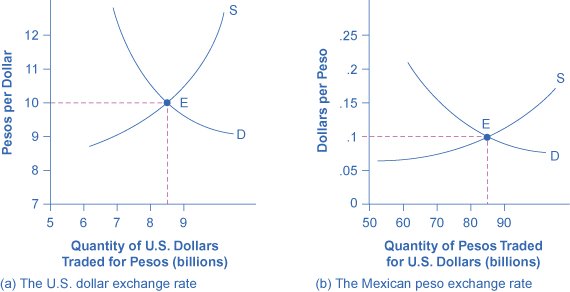
In a floating system the rate settles where demand for the currency equals supply. The key to getting the diagram right is being clear whose currency the market is for, then labelling the axes accordingly: the vertical axis is the price of that currency in terms of another, the horizontal axis is the quantity of that currency.
Demand for a currency comes from anyone who needs it:
- foreigners buying the country's exports
- inward foreign direct investment and portfolio inflows
- speculators expecting the currency to rise
- tourists visiting the country
- remittances sent home by workers abroad
Supply of a currency comes from anyone selling it to obtain another:
- domestic residents buying imports
- outward investment
- speculative outflows
- domestic tourists travelling abroad
What shifts the curves
- Relative interest rates. Higher domestic rates attract capital inflows seeking better returns → demand for the currency rises → it appreciates. This is the mechanism that links monetary policy to the exchange rate, and it appears constantly in exam questions.
- Relative inflation rates. Higher domestic inflation makes exports less competitive → export demand falls → the currency depreciates.
- Relative growth rates. Faster domestic growth raises import demand → supply of the currency rises → depreciation.
- Speculation. Expectations are self-fulfilling in the short run: if traders expect a fall, they sell now, causing the fall.
- Current account position and long-run competitiveness.
Consequences of a depreciation
A depreciation makes exports cheaper abroad and imports dearer at home. Trace it as a chain rather than asserting the outcome:
- The currency depreciates
- domestic goods become cheaper in foreign-currency terms
- foreign demand for exports rises
- export revenue rises, provided foreign demand is sufficiently price elastic.
Effects to weigh:
- Exports become more price competitive, so volumes may rise.
- Imports become more expensive, so volumes may fall, but imported raw materials and components now cost domestic firms more, raising production costs.
- Net exports (X − M) may improve, raising AD, output and employment.
- Inflation may rise from two directions at once: cost-push through dearer imports, and demand-pull through stronger AD.
- Foreign-currency debt becomes more expensive to service in domestic-currency terms, a serious issue for developing economies that borrow in dollars.
The Marshall–Lerner condition and the J-curve
Whether a depreciation improves the current account is not automatic. It improves only if the combined price elasticities of demand for exports and imports are sufficiently large, the Marshall–Lerner condition (PEDx + PEDm > 1).
In the short run those elasticities are low: contracts are already signed, supply chains cannot be re-routed, and consumers have habits. So volumes barely move while the import bill rises immediately in domestic-currency terms, and the trade balance worsens before it improves. Plotted over time this traces the J-curve.
This is the single strongest evaluation point in the topic, because it converts "a depreciation helps exporters" into a conditional, time-dependent judgement.
Consequences of an appreciation
The mirror image, and worth rehearsing separately because questions ask for it and answers tend to reverse the depreciation paragraph carelessly.
- The currency appreciates
- domestic goods become dearer in foreign-currency terms
- export volumes fall
- and imports become cheaper at home
- import volumes rise
- net exports fall
- AD shifts left, reducing output and employment.
But an appreciation is not simply bad:
- Imported inputs become cheaper, lowering firms' costs and shifting SRAS right.
- Inflationary pressure falls from both directions, cheaper imports directly, and weaker AD indirectly. A central bank fighting inflation may welcome it.
- Foreign-currency debt becomes easier to service.
- Purchasing power rises for consumers and for travellers.
So the standard judgement is that a depreciation supports output and employment at the cost of inflation, while an appreciation does the reverse. Which is preferable depends entirely on which problem the economy currently has, and saying that, rather than declaring one direction good, is the evaluation.
How a fixed rate is actually maintained
The mechanism is examinable and frequently skipped.
If the currency is under downward pressure (supply exceeds demand at the fixed rate), the central bank must raise demand for it:
- Buy its own currency using foreign exchange reserves
- demand shifts right
- the rate is held. It may also raise interest rates to attract capital inflows, and impose exchange controls.
If the currency is under upward pressure; it does the reverse: sells its own currency, accumulating reserves.
The asymmetry matters. Defending against depreciation is limited by the reserves available, and reserves are finite, which is why speculative attacks target currencies believed to be running low. Defending against appreciation can continue indefinitely, since a central bank can always create more of its own currency, though at the cost of imported inflation.
The deeper constraint is that monetary policy becomes the exchange-rate policy. A country defending a peg during a recession may have to raise interest rates precisely when its economy needs them cut. That is the autonomy the table below is about.
Fixed versus floating: evaluation
| Advantages | Disadvantages | |
|---|---|---|
| Floating | Self-correcting; needs no reserves; monetary policy stays free for domestic goals (inflation, unemployment) | Volatile; vulnerable to speculation; uncertainty deters trade and investment |
| Fixed | Certainty for traders and investors; imposes inflation discipline; anchors expectations | Requires large reserves; monetary policy is tied to defending the rate; vulnerable to speculative attack; can leave the currency misaligned |
The honest summary is that the choice is a trade-off between certainty and autonomy. A fixed rate buys predictability at the price of giving up independent monetary policy; a floating rate keeps that policy freedom at the price of volatility. Many economies choose a managed float to get some of each.
Worked example
A currency depreciates from $1.50 to $1.20 per unit.
For exporters: a domestic good priced at 100 units cost foreign buyers $150 before, and now costs $120, a 20% fall in the foreign-currency price, making it more competitive.
For importers: an import invoiced at $300 cost 200 units before, and now costs 250 units, a 25% rise in domestic-currency cost, feeding directly into cost-push inflation.
The judgement. Whether this improves the current account depends on how much export volumes actually rise and import volumes actually fall. If demand on both sides is inelastic in the short run, the higher import bill dominates and the balance worsens first. If the economy also has spare capacity, exporters can meet the extra demand; if it is at full capacity; they cannot, and the extra demand leaks into prices instead.
Common exam mistakes
- Using "devaluation" for a market-driven fall; that is a depreciation.
- Assuming a depreciation always improves the current account. It depends on elasticities (Marshall–Lerner) and on the time frame (J-curve).
- Forgetting that a depreciation raises imported input costs for domestic firms, so exporters are not simply winners.
- Mislabelling the axes, or not stating which currency the market is for.
- Ignoring supply-side capacity: cheaper exports achieve nothing if firms cannot produce more.
- Treating exchange-rate changes as affecting only trade, and forgetting foreign-currency debt.
Exam technique
Draw the foreign-exchange diagram with the market named ("market for pesos"), the vertical axis as the price of that currency in another, and the horizontal axis as its quantity. Shift one curve, state the cause, and mark the new rate.
State the direction explicitly, "the currency depreciates", before explaining consequences. Then build one full chain from the rate change to the macroeconomic outcome.
For evaluation, the reliable routes here are: elasticities (Marshall–Lerner), time (J-curve), spare capacity, the inflation trade-off, and foreign-currency debt. A conditional judgement using two of these will outperform a list of six generic advantages.
Quick revision
- Floating rates are set by demand and supply; fixed rates by the authorities.
- Depreciation/appreciation are market moves; devaluation/revaluation are policy.
- Higher relative interest rates → capital inflows → appreciation.
- Depreciation → cheaper exports, dearer imports, higher cost-push inflation.
- Marshall–Lerner: the current account improves only if PEDx + PEDm > 1.
- J-curve: the trade balance worsens before it improves.
- Fixed versus floating is a trade-off between certainty and monetary autonomy.
Check you have it
Cross-board concept practice · originally a CIE 9708 question, used here because the concept is the same. It is not IB Economics past-paper material.
Question 1
Why might a government wish to increase the value of its foreign exchange rate when the sum of the price elasticity of demand for imports and exports is greater than 1?
Answer: D.
Cross-board concept practice · originally a CIE 9708 question, used here because the concept is the same. It is not IB Economics past-paper material.
Question 2
Following a long period of depreciation of the US$, both the US and UK monetary authorities raised their domestic interest rate. What will happen to the value of the exchange rate of the US$ in terms of UK£?
Answer: D.
Cross-board concept practice · originally a CIE 9708 question, used here because the concept is the same. It is not IB Economics past-paper material.
Question 3
A country has a floating exchange rate.
An increase in which variable within that country can cause its exchange rate to appreciate?
Answer: C.
What the syllabus asks for on this topicSyllabus points
Syllabus points
- Define an exchange rate and distinguish floating from fixed systems.
- Explain how a floating exchange rate is determined by demand and supply.
- Distinguish depreciation/appreciation from devaluation/revaluation.
- Evaluate the consequences of exchange-rate changes.

Related IB Economics topics
Not the topic you were looking for? Describe what you are stuck on in your own words and we will take you to the notes that answer it.