Role of Government in Microeconomics
Contents: 10 sections
Why governments intervene
Free markets can fail to deliver outcomes society wants: too much of a good with negative externalities, too little of one with positive externalities, prices some households cannot afford, or incomes distributed in ways judged unfair.
Intervention has four main aims: correcting market failure, raising revenue, promoting equity, and supporting particular producers or consumers.
Every intervention creates winners and losers, and the syllabus asks explicitly about effects on stakeholders, consumers, producers, the government, and third parties. Identifying who gains and who loses is usually where the marks are.
Price controls
Maximum price (price ceiling)
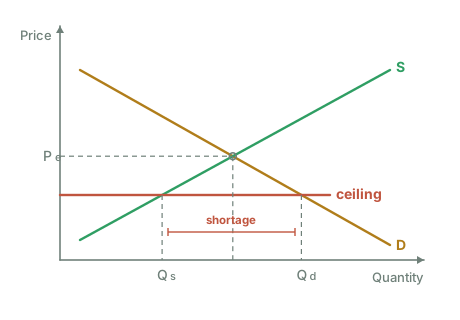
A legal maximum, set to make a good more affordable. It has an effect only if set below the equilibrium price; a ceiling above equilibrium is non-binding and changes nothing. That condition is the most commonly missed mark in the topic.
- Price held below equilibrium
- quantity demanded rises and quantity supplied falls
- excess demand (a shortage)
- the good must be rationed by some non-price method.
Consequences:
- Shortages, with queues, waiting lists, or allocation by favouritism.
- Black markets, where the good sells above the legal price, often above the original equilibrium.
- Falling producer revenue and incentives, so supply may shrink further over time.
- Welfare loss, because mutually beneficial transactions no longer happen.
- Some consumers gain (those who buy at the low price); others get nothing at all.
The rationing point deserves emphasis. Price is the market's rationing device, so removing it does not remove the need to ration, it replaces price with something else: queuing, waiting lists, seniority, or the seller's discretion. Those alternatives have costs of their own, and they are frequently less equitable than price, because the well-connected do better out of discretion than out of an auction.
Examples: rent controls, caps on food staples or energy prices.
Minimum price (price floor)
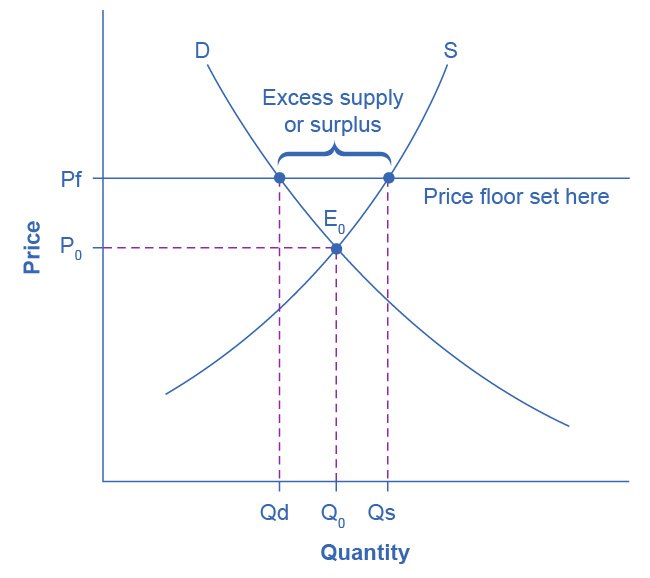
A legal minimum, set to support producer incomes or discourage consumption. It binds only if set above equilibrium.
- Price held above equilibrium
- quantity supplied rises and quantity demanded falls
- excess supply (a surplus).
Consequences:
- Surpluses, which the government may have to buy and store at cost.
- Producers gain on what they sell; consumers lose.
- Resource misallocation, as resources are drawn into producing goods nobody wants at that price.
- Welfare loss.
Examples: agricultural price supports, and the minimum wage, where the surplus takes the form of unemployment.
Note that both controls reduce the quantity actually traded below equilibrium, which is why both destroy welfare, but for opposite reasons. A ceiling cuts trade because less is supplied; a floor cuts it because less is demanded. Getting that the right way round is a discriminating detail.
Indirect taxes
An indirect tax is levied on expenditure and paid to the government by the seller. It raises firms' costs, shifting supply up and left by the amount of the tax.
- Specific tax: a fixed amount per unit; supply shifts up in parallel.
- Ad valorem tax: a percentage of price; the gap widens as price rises, so the curve pivots.
Effects: the price consumers pay rises, the price producers keep falls, quantity traded falls, the government gains revenue, and a welfare loss arises from transactions that no longer occur.
Tax incidence
Who actually bears the tax is decided by relative elasticity, not by who hands the money over:
The burden falls more heavily on whichever side of the market is more inelastic, because that side has fewer alternatives and cannot escape the tax by changing behaviour.
If demand is inelastic, consumers bear most of it, which is precisely why governments tax tobacco, alcohol and fuel: the revenue is large and predictable. The corollary is that such taxes are regressive, taking a larger share of income from poorer households.
Worked calculation
A market is in equilibrium at \$10 with 1,000 units traded. The government imposes a \$3 per-unit tax. The new consumer price is \$12, producers keep \$9, and quantity falls to 800.
Government revenue = \$3 × 800 = \$2,400
Consumer burden = (\$12 − \$10) × 800 = \$1,600
Producer burden = (\$10 − \$9) × 800 = \$800
Welfare loss = ½ × \$3 × (1,000 − 800) = \$300
Check the burdens sum to the revenue: \$1,600 + \$800 = \$2,400. They must, because every dollar collected comes out of one side or the other. If your two burdens do not add up, one of the prices has been read off the wrong curve.
Consumers bear two-thirds of the burden, so demand is the more inelastic side of this market. Note also that the consumer price rose by \$2, not by the full \$3, a price rise equal to the whole tax happens only when demand is perfectly inelastic.
The welfare loss triangle has the tax per unit as its height and the fall in quantity as its base. That is the value destroyed by the 200 transactions that were worth more to buyers than they cost to produce, and which now do not happen.
Subsidies
A subsidy is a payment to producers that lowers costs and raises output, shifting supply down and right by the subsidy per unit.
Effects: the price consumers pay falls, the effective price producers receive rises, quantity traded rises, and the government incurs a cost equal to the subsidy per unit times the new quantity.
Aims: encouraging goods with positive externalities, supporting strategic industries, keeping essentials affordable, improving competitiveness.
Costs: the opportunity cost of public funds, the risk of protecting inefficiency, and the political difficulty of removing a subsidy once recipients depend on it. As with taxes, elasticity decides who benefits, with inelastic demand, most of the subsidy is captured by producers rather than passed on.
A subsidy also creates a welfare loss where no externality exists, because output is pushed beyond the allocatively efficient quantity: units are produced whose cost exceeds their value to buyers. Where the subsidy corrects a genuine positive externality, it removes a welfare loss instead. Saying which case applies is the difference between a description and an evaluation.
Direct provision
The government produces and supplies the good itself, usually free at the point of use, healthcare, education, policing, roads.
Advantages: guarantees provision of goods markets under-provide; can be universal, promoting equity; captures positive externalities.
Disadvantages: high opportunity cost; funded by taxation with its own distortions; weaker efficiency incentives without a profit motive; and at a zero price, demand may exceed supply, requiring rationing by waiting.
Worked example
A government caps rents below the market level.
- The ceiling is below equilibrium
- quantity of housing demanded rises while landlords withdraw properties, so quantity supplied falls
- a shortage appears
- housing is rationed by waiting lists, landlord discretion, or informal payments.
Stakeholders. Tenants who secure a controlled tenancy gain. Tenants who cannot find one lose, and may be worse off than before, since less housing is available. Landlords lose revenue and may under-maintain properties or convert them to other uses. Sub-letting black markets appear.
Evaluation. The policy improves affordability for some while reducing the quantity and quality of housing overall, and the losers are often exactly the people it was meant to help, namely new entrants. Because housing supply is highly inelastic in the short run, the shortage worsens over time as landlords exit. Pairing the control with supply-side measures, building or subsidising construction, addresses the underlying scarcity rather than only its price symptom.
The judgement. Whether the policy is justified depends on what the alternative is and over what horizon. Over a year, a cap protects existing tenants at little visible cost. Over a decade, supply contracts and the shortage becomes the dominant effect. A conclusion that distinguishes the short run from the long run, and names who bears the cost in each, is what the top band asks for.
Common exam mistakes
- Drawing a maximum price above equilibrium (or a minimum below it) and then claiming a shortage or surplus.
- Assuming whoever pays the tax to the government bears its burden.
- Saying the consumer price rises by the full amount of the tax.
- Forgetting that an indirect tax shifts supply, not demand.
- Shifting supply by an arbitrary distance rather than by the tax or subsidy per unit.
- Drawing an ad valorem tax as a parallel shift, it pivots.
- Forgetting that a subsidy also creates a welfare loss unless it is correcting an externality.
- Assuming removing price as a rationing device removes the need to ration.
- Ignoring stakeholders the question names, especially government and third parties.
- Presenting intervention as costless.
Exam technique
Always mark the control price relative to equilibrium, and label the shortage or surplus as the horizontal gap between the curves at that price.
For taxes and subsidies, show the vertical distance between the two supply curves as the amount per unit, then shade government revenue or cost as a rectangle and welfare loss as a triangle. Label both areas, an unlabelled shape earns nothing.
In calculations, find the two prices and the two quantities first, then compute revenue, each burden, and the triangle. Finish by checking that the burdens sum to the revenue.
Structure evaluation by stakeholder, then by elasticity (which decides how the burden or benefit is shared), then by time frame (supply is more elastic in the long run).
Quick revision
- A maximum price binds only below equilibrium
- shortage, black markets, non-price rationing.
- A minimum price binds only above equilibrium
- surplus, storage costs.
- Both cut quantity traded, a ceiling because less is supplied, a floor because less is demanded.
- Indirect tax shifts supply left by the tax per unit; a subsidy shifts it right.
- Specific tax = parallel shift; ad valorem = pivot.
- Incidence falls on the more inelastic side; the price rise is less than the full tax.
- Revenue = tax × new quantity; welfare loss = ½ × tax × fall in quantity; burdens sum to revenue.
- Taxes on inelastic necessities are regressive.
- Direct provision ensures access but carries opportunity cost and weaker efficiency incentives.
- Always identify winners and losers.
What the syllabus asks for on this topicSyllabus points
Syllabus points
- Explain price controls: maximum and minimum prices.
- Explain indirect taxes and subsidies and their effects.
- Calculate tax incidence, government revenue and welfare loss.
- Explain direct provision and the effects of intervention on stakeholders.
Related IB Economics topics
Not the topic you were looking for? Describe what you are stuck on in your own words and we will take you to the notes that answer it.