The Market's Inability to Achieve Equity
Contents: 10 sections
Equity versus equality
- Equality means everyone receives the same.
- Equity means the distribution is fair, which need not mean equal.
Most people accept that some inequality is equitable, rewarding longer training, greater effort, or the bearing of risk. Complete equality would remove the incentive to do any of those things. So equity is a normative judgement about where acceptable difference ends and unfairness begins, and reasonable people disagree.
This is why equity is treated as a distinct kind of market failure. The other failures in Unit 2 are about efficiency, the market produces the wrong quantity. Here the market may be perfectly efficient and still produce an outcome society judges unacceptable.
A market can be allocatively efficient and deeply inequitable at the same time. Efficiency says nothing about who gets what.
That sentence is the whole topic. Externalities, public goods and asymmetric information all describe a market producing the wrong amount of something. This one describes a market producing the right amount and distributing it in a way many people reject, which is why it needs a separate justification for intervention.
Why the market produces inequitable outcomes
The price mechanism distributes income according to what people own and what it can earn, not according to need or desert.
- Unequal ownership of factors of production. Income from land and capital flows to those who already own assets. Since wealth is highly concentrated and largely inherited, the starting point is unequal before anyone works at all.
- Differences in human capital. Higher skills earn higher wages, but access to the education that builds them depends heavily on family income, so advantage is transmitted across generations.
- Wealth begets wealth. Assets generate income, which can be saved to buy more assets. This feedback loop widens gaps over time without anyone acting unfairly.
- Market power in labour markets. Employers may have wage-setting power where workers have few alternatives, particularly for low-skilled labour.
- Discrimination by gender, ethnicity, age or disability, which produces unequal pay for equivalent work.
- No income for those who cannot supply factors. The market allocates nothing to children, the elderly, the sick, or the disabled who cannot work. It is not that the market treats them unfairly; it has no mechanism to consider them at all.
- Technological change and globalisation, raising returns to high-skilled workers while reducing demand for routine labour.
The final point is the most fundamental: the market answers "for whom to produce?" with "for those who can pay". That is a coherent answer, and for many people an unacceptable one.
Consequences of inequity
- Poverty, with consequences for nutrition, health, housing and life expectancy.
- Reduced social mobility, so talent is wasted, an efficiency loss as well as an equity one, and a strong point because it shows the two goals are not always in conflict.
- Under-investment in human capital, since poorer families cannot fund education, lowering long-run growth.
- Lower aggregate demand, because poorer households have a higher marginal propensity to consume; income concentrated at the top is more likely to be saved.
- Social and political instability, deterring investment.
The minimum wage
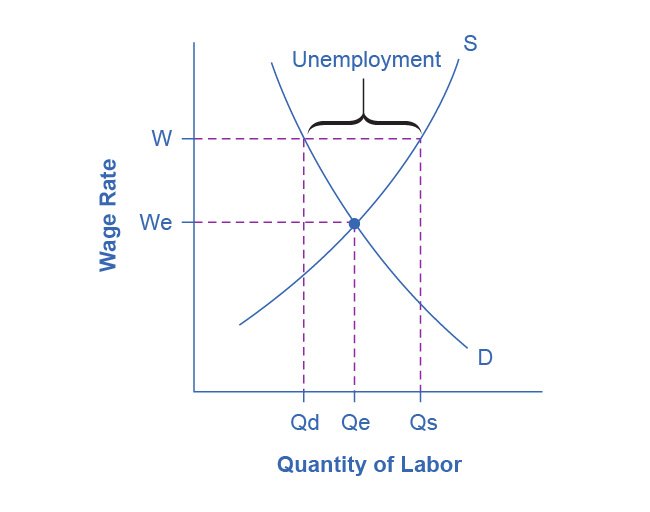
A minimum wage is a price floor in the labour market, and it is the clearest single example of an equity intervention with an efficiency cost attached.
The diagram is an ordinary price floor with relabelled axes: the vertical axis is the wage, the horizontal axis the quantity of labour. Set above the equilibrium wage, it produces:
Quantity of labour supplied rises (more people want to work at the higher wage) while quantity demanded falls (firms hire fewer) → the gap between them is excess supply of labour, which is unemployment.
The case for it: it raises the incomes of the lowest-paid who remain in work, reduces poverty among working households, may raise productivity through better motivation and lower staff turnover, and counters employer wage-setting power. It also raises the incomes of households with a high marginal propensity to consume, supporting aggregate demand.
The case against it: it causes unemployment among exactly the low-skilled workers it aims to help, raises firms' costs which may be passed on as higher prices, and helps only those in work; it does nothing for the unemployed or the economically inactive.
Where the evidence complicates the theory. If employers have wage-setting power, a minimum wage set carefully can raise both the wage and employment, because it removes the employer's incentive to restrict hiring to hold wages down. That is why the empirical effect of moderate minimum wages on employment is genuinely contested rather than settled, and why "a minimum wage causes unemployment" is a claim to be qualified rather than asserted. The size and the starting point both matter: a floor slightly above equilibrium behaves very differently from one far above it.
Government responses
| Response | Mechanism | Limitation |
|---|---|---|
| Progressive taxation | Average tax rate rises with income, narrowing post-tax differences | Possible disincentives; avoidance and evasion |
| Transfer payments | Benefits, pensions and child support raise the lowest incomes | Cost; steep withdrawal rates can create a poverty trap |
| Minimum wage | Sets a wage floor above the market rate | May cause unemployment if set well above equilibrium; helps only those in work |
| State provision of education and healthcare | Equalises opportunity and raises human capital | Expensive; takes a generation to show results |
| Wealth and inheritance taxes | Address the stock rather than only the flow | Hard to value assets; capital can relocate |
| Anti-discrimination law | Removes an unfair source of wage differences | Enforcement is difficult |
The trade-off usually cited is between equity and efficiency: redistribution may reduce incentives to work, save and take risks. The size of that effect is empirically contested, and a good answer says so rather than assuming it is large.
But the trade-off is not universal. Spending on education and healthcare improves equity and raises productive capacity. Reducing discrimination improves equity and allocates talent better. Where a policy does both, presenting it as a sacrifice of efficiency is simply wrong.
Choosing between responses is usually the real question. The useful axes are: does it address income or wealth; does it work fast or durably; does it reach those in work only or everyone; and does it treat the symptom or the cause. A minimum wage is fast and reaches only the employed; education is slow, durable, and addresses the cause; transfers are fast and universal but change nothing underlying. Most governments use several precisely because no single instrument scores well on every axis.
Worked example
In a purely free-market economy, a household in which the adults are long-term sick receives no market income at all.
- The household owns no capital and cannot supply labour
- it has nothing to exchange
- the price mechanism allocates it nothing
- no market failure in the efficiency sense has occurred, because no transaction was mispriced. The market has simply produced an outcome most people judge unacceptable.
The response. Transfer payments funded from progressive taxation provide income directly. State-provided healthcare gives access to treatment independent of ability to pay, which may also restore the adults' capacity to work.
Evaluation. Transfers are effective and fast, but carry a fiscal cost and, if withdrawn steeply as earnings rise, can create a poverty trap where working more leaves a household barely better off. Healthcare provision is slower and more expensive but addresses the underlying cause rather than only the symptom, and raises long-run productive capacity. The judgement depends on whether the aim is immediate relief or durable improvement, and in practice most governments use both, for exactly that reason.
Note what a minimum wage would not do here. It is the wrong instrument for this household entirely: it raises the pay of people in work, and this household has nobody in work. Matching the instrument to the actual cause of the low income, rather than reaching for the most familiar policy, is the discriminating step.
Common exam mistakes
- Treating equity and equality as synonyms.
- Claiming the market "fails" here in the same sense as with externalities. This is a distributional failure, not an efficiency one.
- Confusing income (a flow) with wealth (a stock).
- Confusing progressive with proportional taxation, progressive means the average rate rises with income.
- Stating flatly that a minimum wage causes unemployment, without qualifying for its size or for employer wage-setting power.
- Recommending a minimum wage for households with nobody in employment.
- Asserting a large efficiency cost to redistribution as if it were settled.
- Listing policies without evaluating any of them.
Exam technique
Define equity as a normative concept early. It signals that you understand this topic involves value judgements alongside analysis, which is exactly what the syllabus is testing.
Be explicit that this failure is different in kind from the others in Unit 2: the market may be efficient and still inequitable. Making that point clearly is often the difference between a competent and a strong answer.
For a minimum wage question, draw the labour market with axes labelled wage and quantity of labour, mark the equilibrium wage. Draw the minimum above it, and bracket the gap between quantity supplied and quantity demanded as the excess supply.
For evaluation: the equity–efficiency trade-off and its contested size, whether a policy targets income or wealth, the time frame (transfers are fast, education is durable), the poverty trap risk, and the fact that some policies improve both goals at once.
Quick revision
- Equality = the same; equity = fair. Equity is normative.
- A market can be efficient and inequitable simultaneously, this failure is distributional, not allocative.
- Causes: unequal asset ownership, inherited wealth, unequal access to education, discrimination, and no income for those unable to supply factors.
- The market answers "for whom?" with "for those who can pay".
- Consequences: poverty, low mobility, under-investment in human capital, lower AD.
- Minimum wage = a price floor in the labour market; excess supply of labour is the unemployment.
- Its employment effect is contested, and depends on its size and on employer wage-setting power.
- Responses: progressive tax, transfers, minimum wage. State provision, wealth taxes, anti-discrimination law.
- The equity–efficiency trade-off is real but contested, and education and anti-discrimination improve both.
Check you have it
Cross-board concept practice · originally a CIE 9708 question, used here because the concept is the same. It is not IB Economics past-paper material.
Question 1
What is necessary to achieve Pareto efficiency?
Answer: C.
What the syllabus asks for on this topicSyllabus points
Syllabus points
- Distinguish equity from equality.
- Explain why the free market may produce an inequitable distribution of income.
- Explain how a minimum wage affects the labour market.
- Outline government responses to promote equity.
Related IB Economics topics
Not the topic you were looking for? Describe what you are stuck on in your own words and we will take you to the notes that answer it.