Market Power: five questions to try now
Real questions, the answer key from the mark scheme, and the explanation that goes with it. No account needed to answer them.
Cross-board concept practice · originally a CIE 9708 question, used here because the concept is the same. It is not IB Economics past-paper material.
Question 1
The diagram shows the cost and revenue curves of a profit-maximising monopolist. What measures the total monopoly profit made by the firm?
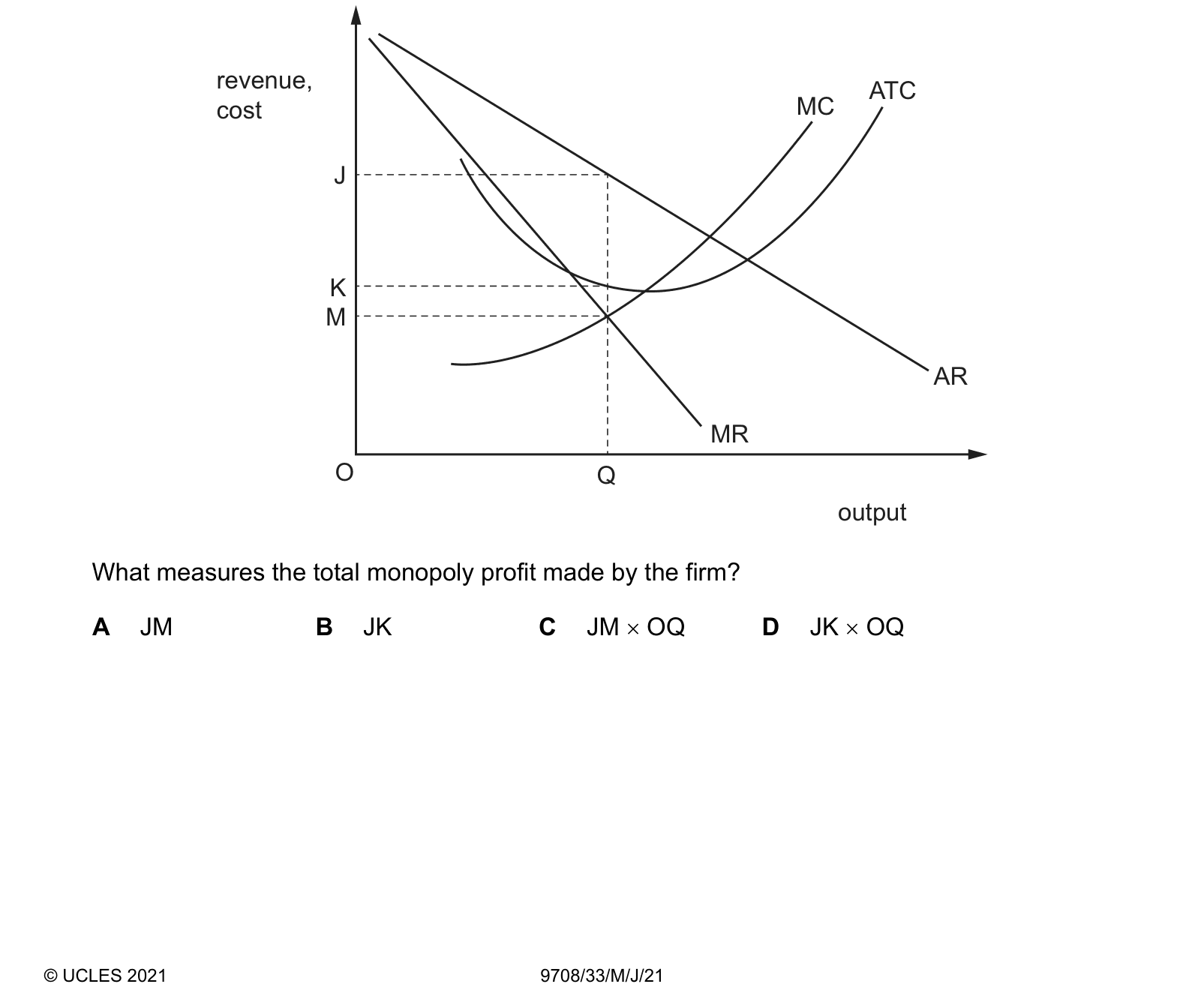
Answer: D.
Cross-board concept practice · originally a CIE 9708 question, used here because the concept is the same. It is not IB Economics past-paper material.
Question 2
Two firms selling the same type of product find it more efficient to merge.
Which combination describes how the merged firm’s average costs of production and demand curve are expected to change?
Answer: B.
Two consequences follow from the merger.
Average costs fall. The merged firm is larger, so it can exploit economies of scale, bulk purchasing, specialised management, spreading fixed costs and indivisible capital over more output. The question states the merger is "more efficient", which is the cost side of that.
Demand becomes more inelastic. The two firms sold the same type of product, so they were substitutes for each other. After merging, one of the closest substitutes has disappeared from the market: a consumer unhappy with the price can no longer switch to the rival. Fewer substitutes means demand responds less to price, so the demand curve becomes steeper, and the merged firm gains market power it can use to raise price.
Why the other options are wrong:
- A gets costs right but claims demand becomes more elastic. Removing a substitute cannot make consumers more price-sensitive; this is the standard error in the question.
- C and D claim average costs rise. That contradicts "more efficient" and ignores economies of scale. (Diseconomies of scale are possible in a very large merged firm, but the question rules that out.)
Cross-board concept practice · originally a CIE 9708 question, used here because the concept is the same. It is not IB Economics past-paper material.
Question 3
The market structure of an industry changed from being an oligopoly to monopolistic competition. What is most likely to have increased?
Answer: D.
Cross-board concept practice · originally a CIE 9708 question, used here because the concept is the same. It is not IB Economics past-paper material.
Question 4
A construction firm estimates that the price elasticity of supply in building a nuclear power plant is +0.1.
What might explain this?
Answer: C.
A price elasticity of supply of +0.1 is very inelastic: a 10% price rise would raise quantity supplied by only 1%. Something must be preventing the firm from responding, and the scarcity of a specialised input is exactly such a constraint. Nuclear construction needs nuclear engineers, specialist welders and licensed inspectors, people who take years to train and cannot be recruited at short notice however attractive the price becomes.
Why the other options are wrong:
- A, easily available land, would make supply more elastic by removing a constraint on expansion.
- B, competition from many other construction firms, concerns market structure. It affects the price the firm can charge, not its physical ability to increase output.
- D, a lack of close substitutes for nuclear power, is a determinant of price elasticity of demand. Few substitutes make demand inelastic, which is a statement about buyers, not about the firm's capacity to build.
Cross-board concept practice · originally a CIE 9708 question, used here because the concept is the same. It is not IB Economics past-paper material.
Question 5
Which explains why, in long-run equilibrium in monopolistic competition, firms make only normal profits?
Answer: D.
What this practice covers
These questions are drawn from past Cambridge papers, mapped across to this topic because the concept is the same. You answer, you find out immediately whether you were right, and you get the reasoning for the correct option and for each distractor. Wrong answers go to a mistakes locker so you can come back to exactly those.
Practice is free. You need an account only so your progress and your mistakes are still there next time.
What examiners see students get wrong here
These are the errors that cost marks on market power, taken from our own topic notes. Read them before you practise and you will recognise the traps in the questions.
- Drawing MR on top of the demand curve. For a straight-line demand curve, MR is twice as steep and lies below it.
- Reading the monopoly price off the MR curve. Find quantity where MR = MC, then read up to the demand curve for price.
- Confusing allocative with productive efficiency.
- Treating the whole loss of consumer surplus as deadweight loss, most of it is transferred, not destroyed.
- Condemning monopoly outright, ignoring economies of scale, dynamic efficiency and contestability.
- Recommending a price cap at MC for a natural monopoly without noting it causes losses.
- Assuming a single firm always has market power, regardless of entry conditions.
Revise it first
If any of the above is unfamiliar, work through the notes before practising: Market Power revision notes.