Fiscal Policy: three questions to try now
Real questions, the answer key from the mark scheme, and the explanation that goes with it. No account needed to answer them.
Cross-board concept practice · originally a CIE 9708 question, used here because the concept is the same. It is not IB Economics past-paper material.
Question 1
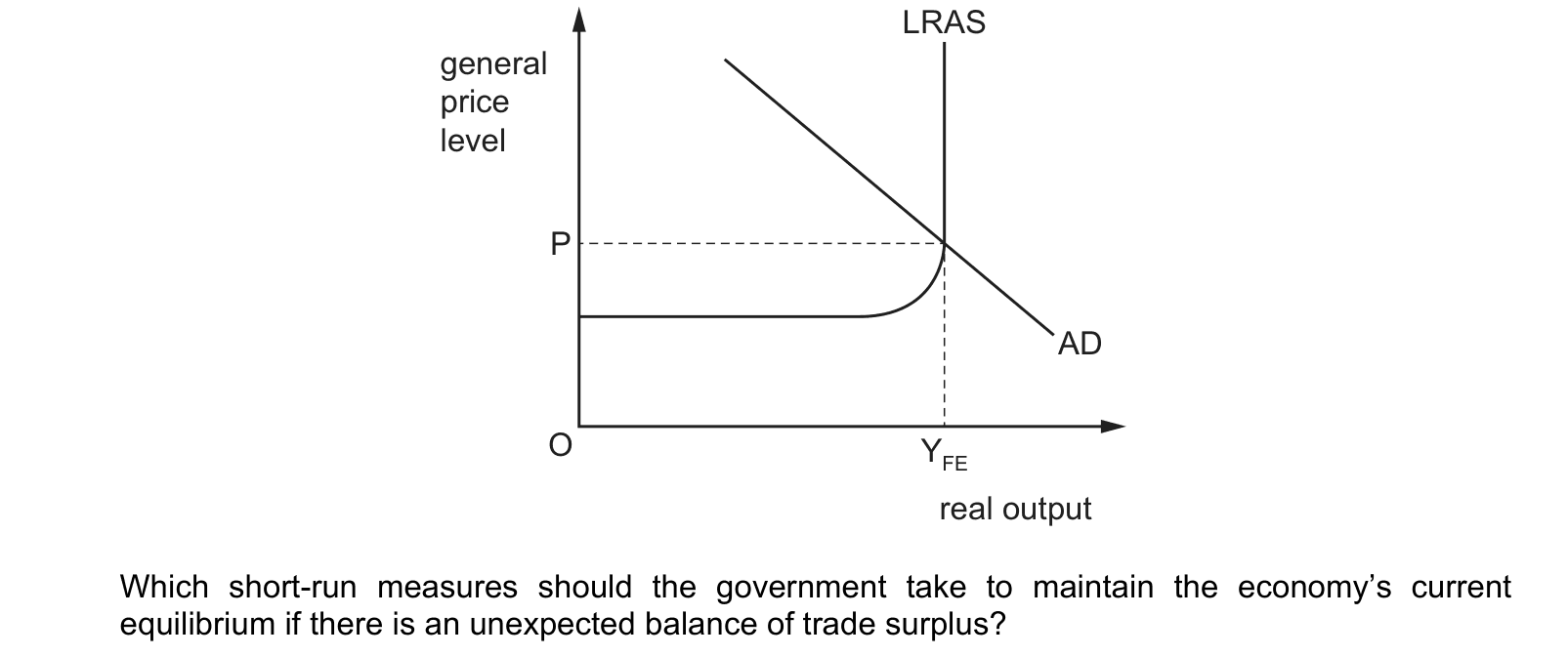
The diagram shows an economy at full employment equilibrium. general price level real output O LRAS AD P YFE Which short-run measures should the government take to maintain the economy’s current equilibrium if there is an unexpected balance of trade surplus?
Answer: B.
To hold the current equilibrium the government must offset that injection with an equal withdrawal, which means a CONTRACTIONARY fiscal stance: higher direct taxation with spending unchanged, running a budget surplus: B.
- A raises spending and taxation together. A balanced-budget change is mildly expansionary, not contractionary, because government spending injects the full amount while higher taxes cut consumption by less than the full amount, part comes out of saving.
- C and D are both expansionary, so each adds to the very pressure that needs offsetting.
Cross-board concept practice · originally a CIE 9708 question, used here because the concept is the same. It is not IB Economics past-paper material.
Question 2
Why are higher interest rates together with increased taxation on expenditure likely to cause domestic deflation?
Answer: B.
Cross-board concept practice · originally a CIE 9708 question, used here because the concept is the same. It is not IB Economics past-paper material.
Question 3
What is an example of contractionary fiscal policy?
Answer: B.
What this practice covers
These questions are drawn from past Cambridge papers, mapped across to this topic because the concept is the same. You answer, you find out immediately whether you were right, and you get the reasoning for the correct option and for each distractor. Wrong answers go to a mistakes locker so you can come back to exactly those.
Practice is free. You need an account only so your progress and your mistakes are still there next time.
What examiners see students get wrong here
These are the errors that cost marks on fiscal policy, taken from our own topic notes. Read them before you practise and you will recognise the traps in the questions.
- Confusing fiscal policy (government, tax and spending) with monetary policy (central bank, interest rates).
- Counting transfer payments as part of G.
- Confusing the budget deficit (a flow) with national debt (a stock).
- Assuming a widening deficit proves policy has loosened, when the cause may be cyclical.
- Asserting crowding out will occur without considering spare capacity.
- Ignoring time lags, which are far longer for fiscal than for monetary policy.
- Forgetting that capital spending affects both AD and LRAS.
- (HL) Shifting AD by the initial injection rather than the multiplied amount.
Revise it first
If any of the above is unfamiliar, work through the notes before practising: Fiscal Policy revision notes.