Three practice questions are below. Answer on the page: each one is marked the moment you pick, the correct option is shown whether or not you found it, and the full explanation opens either way.
IB Economicsconcept drillsFree account
Measuring Development: three questions to try now
Real questions, the answer key from the mark scheme, and the explanation that goes with it. No account needed to answer them.
Cross-board concept practice · originally a CIE 9708 question, used here because the concept is the same. It is not IB Economics past-paper material.
Question 1
Which indicator is least likely to be used when measuring the comparative economic development of a country?
Answer: D.
Development indicators try to capture how well people live, not how many of them there are. Adult literacy, life expectancy at birth and real GNP per head are all measures of the average person's education, health or material standard of living, and they are the three dimensions the Human Development Index is built from, so each is squarely a development indicator. The size of the population says nothing about living standards on its own: very large countries and very small ones are found at every level of development, and a country's population can grow while its people become better or worse off. That makes D the least likely to be used. Note that population enters the comparison only as a DIVISOR, which is why the useful figure is GNP per head rather than total GNP, and per head is already option C.
Cross-board concept practice · originally a CIE 9708 question, used here because the concept is the same. It is not IB Economics past-paper material.
Question 2
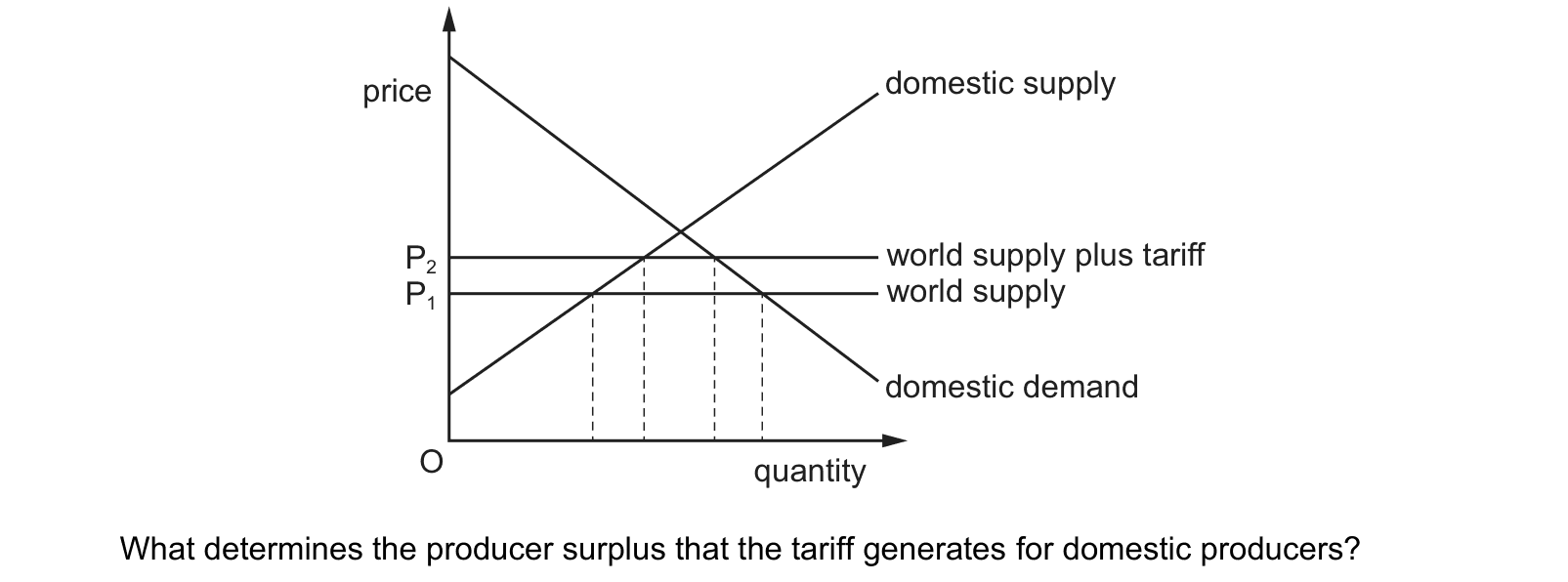
The diagram shows the effect of introducing a tariff on a product. price P2 P1 O quantity domestic supply domestic demand world supply plus tariff world supply What determines the producer surplus that the tariff generates for domestic producers?
Answer: D.
Producer surplus is the area above the supply curve and below the price received, so the extra surplus a tariff creates is the band between the world price P1 and the protected price P2, running from the vertical axis across to the domestic supply curve. Its height is set by the tariff rate, since that is how far the price has been lifted, and its width is set by how much extra domestic output the higher price calls forth, which is the price elasticity of domestic supply. Where home supply is elastic, firms expand a long way and the surplus gained is large; where it is inelastic, output barely moves and the tariff enriches producers much less than its size suggests. The elasticity of domestic demand determines something else entirely, namely how far total consumption contracts and therefore how much the import gap narrows, so the two options that fold demand elasticity into the answer are measuring the wrong area. Any answer that omits the tariff rate fails immediately, because without the height of the price rise the band has no size at all.
Cross-board concept practice · originally a CIE 9708 question, used here because the concept is the same. It is not IB Economics past-paper material.
Question 3
A developing country experiences economic growth. The economic growth is most likely to lead to economic development when it
Answer: D.
Growth becomes development only when the extra output reaches ordinary people as jobs, incomes and services, so the test is how widely the gains are spread. Labour-intensive expansion spreads them by construction, because such an industry grows precisely by taking on more workers and the wages go to households right across the workforce. B fails that test, since mineral extraction is capital-intensive, employs relatively few people, and its revenues often accrue to foreign owners or a narrow domestic elite. C states the concentration outright, because rewards flowing mainly to entrepreneurs is exactly what growth without development looks like. A is not a benefit in the form described, since rapid rural to urban migration typically outruns housing, sanitation and transport and produces slums and congestion.
These questions are drawn from past Cambridge papers, mapped across to this topic because the concept is the same. You answer, you find out immediately whether you were right, and you get the reasoning for the correct option and for each distractor. Wrong answers go to a mistakes locker so you can come back to exactly those.
Practice is free. You need an account only so your progress and your mistakes are still there next time.
These are the errors that cost marks on measuring development, taken from our own topic notes. Read them before you practise and you will recognise the traps in the questions.
Quoting GDP per capita as a development measure without noting that it is a mean and says nothing about distribution.
Describing the HDI without naming its three dimensions: health, education and income.
Forgetting purchasing power parity when comparing incomes across countries, which overstates the gap between rich and poor economies.
Treating any single composite index as sufficient, when the point of having several is that each misses something.
Listing limitations generically rather than tying them to the data in front of you.