Measuring Economic Activity: five questions to try now
Real questions, the answer key from the mark scheme, and the explanation that goes with it. No account needed to answer them.
Cross-board concept practice · originally a CIE 9708 question, used here because the concept is the same. It is not IB Economics past-paper material.
Question 1
Which source of income is not included in measuring real GDP?
Answer: A.
A state pension is a transfer payment: money is paid with nothing produced in return. GDP measures the value of goods and services produced, so transfers are excluded, including them would double-count, since the value is recorded again when the pensioner spends the money on actual goods and services.
Why the other options are included in GDP:
- B, profits made by firms, is the return to enterprise, a factor of production. It is part of the income generated by producing output.
- C, rent paid to landlords, is the return to land, again a factor payment arising from production.
- D, wages paid to nurses, is the return to labour and represents the value of a healthcare service actually delivered.
Note that a workplace pension paid out of a fund built from past contributions raises the same issue for the same reason: the productive activity was recorded when the contributions were earned, not when the pension is drawn.
Cross-board concept practice · originally a CIE 9708 question, used here because the concept is the same. It is not IB Economics past-paper material.
Question 2
The diagram shows an economy’s aggregate supply curve. What is likely to cause the curve to shift to the left?
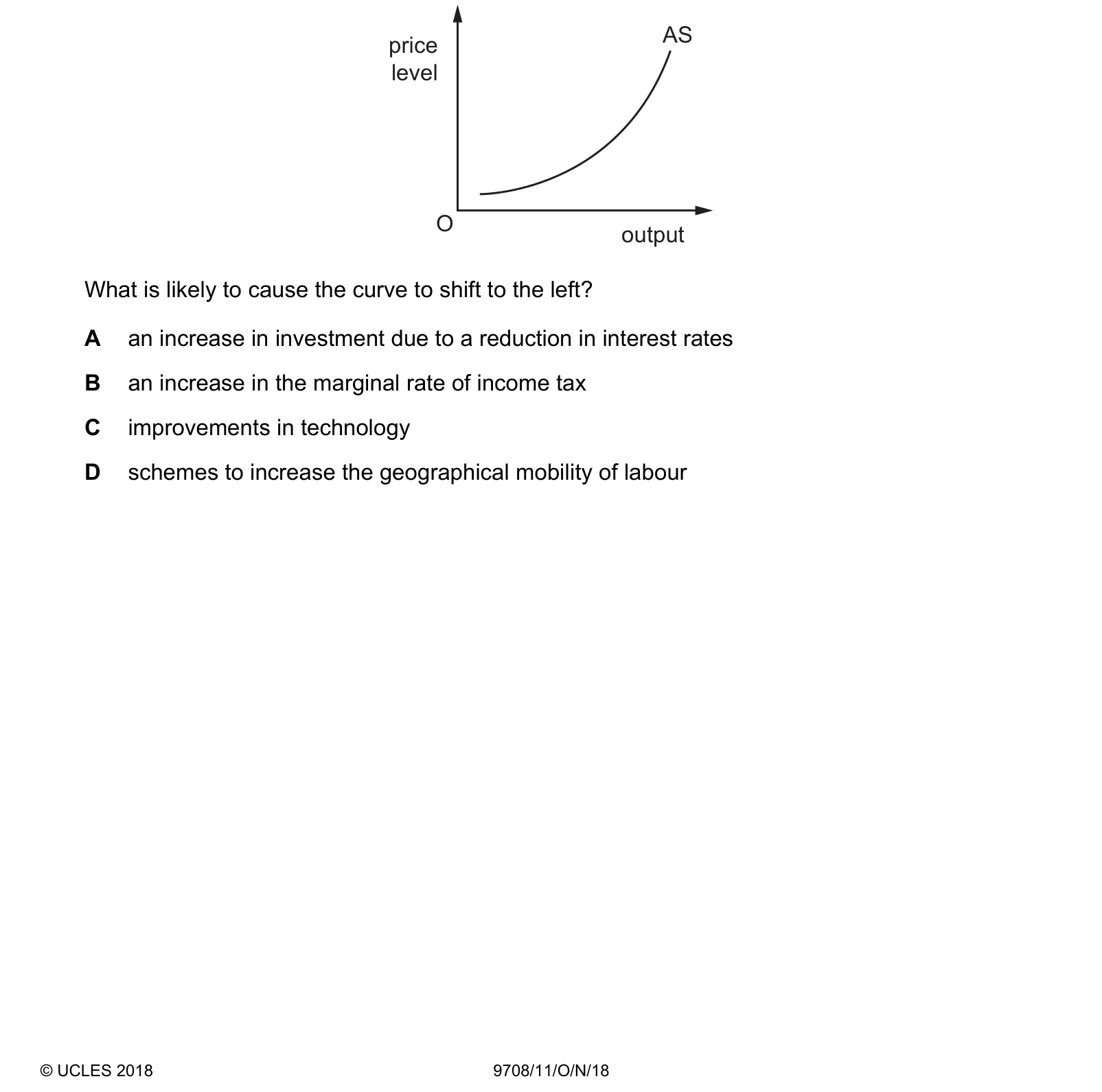
Answer: B.
Explanation:
- Aggregate supply (AS) represents the total level of goods and services that an economy can produce at a given price level.
- When the aggregate supply curve shifts to the left, it means that the economy is able to produce less output at every price level.
- An increase in the marginal rate of income tax would lead to a decrease in the incentives for individuals and businesses to work and invest, resulting in a decrease in overall economic activity and productivity.
- This decrease in economic activity would lead to a leftward shift in the aggregate supply curve, indicating a lower level of output being produced at any given price level.
- A: an increase in investment due to a reduction in interest rates
- This would likely lead to an increase in economic activity and production, causing the aggregate supply curve to shift to the right rather than to the left.
- C: improvements in technology
- Technological advancements usually lead to an increase in productivity and efficiency, causing the aggregate supply curve to shift to the right as the economy can produce more output at the same price level.
- D: schemes to increase the geographical mobility of labour
- Increasing the geographical mobility of labour may lead to a more efficient allocation of resources and potentially increase productivity, which would likely cause the aggregate supply curve to shift to the right rather than to the left.
Cross-board concept practice · originally a CIE 9708 question, used here because the concept is the same. It is not IB Economics past-paper material.
Question 3
What would cause estimates of the money value of the ‘Measure of Economic Welfare’ for a country to be greater than the value of ‘Gross National Product’?
Answer: D.
Cross-board concept practice · originally a CIE 9708 question, used here because the concept is the same. It is not IB Economics past-paper material.
Question 4
A government increases the rate of income tax. What is the effect, in the short run, on the aggregate demand curve or the aggregate supply curve?
Answer: A.
Explanation:
When the government increases the rate of income tax, it essentially reduces the disposable income of consumers. This reduction in disposable income leads to a decrease in consumer spending, which is a component of aggregate demand. As a result, the aggregate demand curve shifts to the left.
Additionally, higher income taxes can also impact businesses. They may have less after-tax profits to reinvest in their businesses or may face higher costs due to increased taxes on their business activities. This can also lead to a decrease in investment spending, which is another component of aggregate demand.
On the other hand, changes in income tax rates do not directly impact the aggregate supply curve in the short run. The aggregate supply curve is primarily affected by factors such as production costs, technological advancements, and resource availability.
Cross-board concept practice · originally a CIE 9708 question, used here because the concept is the same. It is not IB Economics past-paper material.
Question 5
When making comparisons of living standards between different countries, what is not a reason why they may be misleading?
Answer: B.
What this practice covers
These questions are drawn from past Cambridge papers, mapped across to this topic because the concept is the same. You answer, you find out immediately whether you were right, and you get the reasoning for the correct option and for each distractor. Wrong answers go to a mistakes locker so you can come back to exactly those.
Practice is free. You need an account only so your progress and your mistakes are still there next time.
What examiners see students get wrong here
These are the errors that cost marks on measuring economic activity, taken from our own topic notes. Read them before you practise and you will recognise the traps in the questions.
- Treating nominal GDP growth as economic growth.
- Confusing GDP (territory) with GNI (residents), or getting the adjustment backwards.
- Including intermediate goods, double-counting output.
- Comparing countries at market exchange rates rather than PPP.
- Assuming higher GDP per capita means higher living standards for everyone.
- Forgetting population when interpreting a growth figure.
- Listing GDP's limitations without saying what would be a better measure.
- Describing HDI as covering the environment or inequality, it covers income, health and education.
Revise it first
If any of the above is unfamiliar, work through the notes before practising: Measuring Economic Activity revision notes.