Types of Trade Protection: three questions to try now
Real questions, the answer key from the mark scheme, and the explanation that goes with it. No account needed to answer them.
Cross-board concept practice · originally a CIE 9708 question, used here because the concept is the same. It is not IB Economics past-paper material.
Question 1
The following are four conditions sometimes attached to IMF loans to developing countries. Which condition would conflict with the ‘infant industry’ argument?
Answer: A.
Explanation:
The infant industry argument is an economic rationale for protectionist trade policies to shield developing industries from international competition so they can grow and become competitive in the future. This argument suggests that without protection, these industries could be driven out of the market by more established competitors.
If a country is following the infant industry argument, it would typically want to impose trade barriers like tariffs or quotas to protect its domestic industries. Free trade, on the other hand, advocates for the removal of such barriers to promote international trade and specialisation in production, which could potentially put the infant industries at a disadvantage due to increased competition.
Therefore, the condition the need to allow free trade goes against the concept of protecting infant industries and promoting their growth, making it incompatible with the infant industry argument and potentially conflicting with the objectives of developing countries seeking to protect their domestic industries through trade restrictions.
Cross-board concept practice · originally a CIE 9708 question, used here because the concept is the same. It is not IB Economics past-paper material.
Question 2
The following are four conditions sometimes attached to IMF loans to low-income countries.
Which condition would conflict with the ‘infant industry’ argument?
Answer: A.
The infant industry argument holds that a newly established domestic industry cannot yet compete with established foreign producers, because it has not reached the scale at which unit costs fall or accumulated experience. Temporary protection, a tariff or quota, is said to shelter it until it can compete unaided. A loan condition requiring free trade removes exactly that protection, exposing the infant industry to full foreign competition before it has matured. The two positions are in direct conflict.
Why the other options are wrong:
- B, controlling inflation, is compatible with protecting a young industry, and low inflation actually helps competitiveness. It concerns the price level, not trade barriers.
- C, contractionary fiscal policy, reduces government spending or raises taxes. It may squeeze demand generally and could reduce subsidies, but it does not address whether imports face barriers.
- D, privatisation, changes who owns firms. A privately owned infant industry can still be protected by tariffs, so ownership and protection are separate questions.
Cross-board concept practice · originally a CIE 9708 question, used here because the concept is the same. It is not IB Economics past-paper material.
Question 3
The diagram shows the change in the supply curve of imports, S–S1 to curve S–S2, after the introduction by the government of a trade protection measure. price of imports O quantity of imports S S1 S2 What is the form of protection?
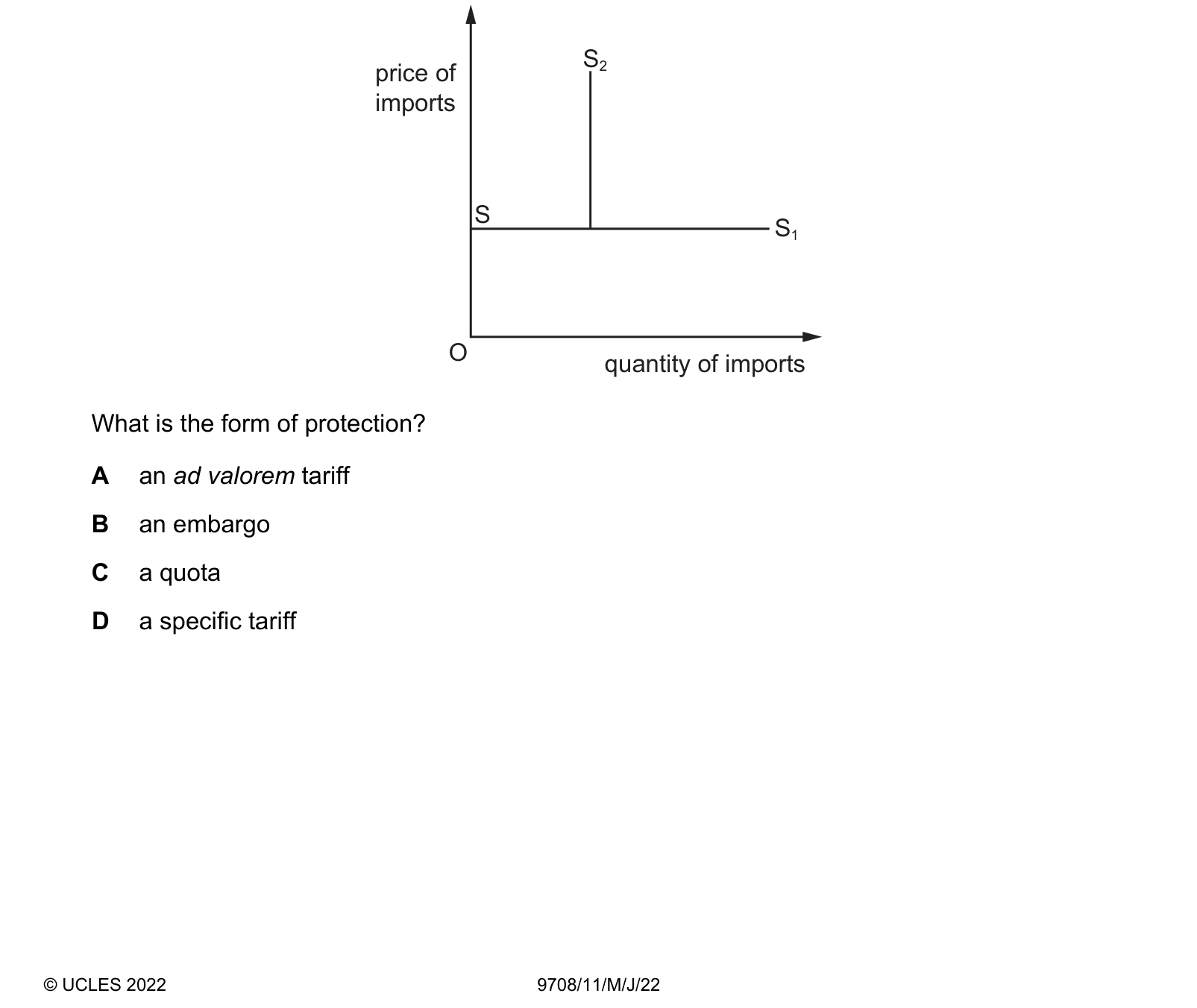
Answer: C.
What this practice covers
These questions are drawn from past Cambridge papers, mapped across to this topic because the concept is the same. You answer, you find out immediately whether you were right, and you get the reasoning for the correct option and for each distractor. Wrong answers go to a mistakes locker so you can come back to exactly those.
Practice is free. You need an account only so your progress and your mistakes are still there next time.
What examiners see students get wrong here
These are the errors that cost marks on types of trade protection, taken from our own topic notes. Read them before you practise and you will recognise the traps in the questions.
- Confusing a quota (a quantity limit) with a tariff (a tax), and so mislabelling who receives the revenue. A tariff raises government revenue; a quota transfers that area to whoever holds the import licence.
- Omitting the two welfare-loss triangles when analysing a tariff, which is where the efficiency argument lives.
- Treating a subsidy to domestic producers as a tariff. It lowers domestic cost rather than raising import price, so the domestic price is unchanged and consumers are not directly harmed.
- Forgetting administrative barriers and voluntary export restraints, which are on the syllabus and are the forms most used in practice.
Revise it first
If any of the above is unfamiliar, work through the notes before practising: Types of Trade Protection revision notes.