Open Economy: International Trade and Finance
Contents: 9 sections
The balance of payments
Two accounts, and every transaction lands in one of them:
Current account, trade in goods and services, investment income, and transfers. Financial (capital) account, purchases and sales of assets: foreign direct investment, portfolio investment, and central bank reserves.
The test for placing a transaction: is money changing hands for goods, services or income (current), or for an asset (financial)?
A distinction worth having ready: buying a foreign factory is a financial account entry, but the profits it sends home each year afterwards are current account entries, as investment income. The asset moves once; the income it throws off recurs.
The two accounts must offset each other: current account + financial account = 0.
A current account deficit must be financed by a financial account surplus, the country is buying more goods than it sells and covering the difference by selling assets or borrowing from abroad. This identity is the backbone of the unit, and stating it explicitly is one of the clearest ways to show understanding.
It also reframes what a deficit is: not simply "bad", but a country consuming more than it produces and financing the gap with foreign capital. Whether that is a problem depends on what the borrowed capital does. Foreign capital that builds factories raises future output and can service itself; foreign capital financing current consumption leaves a repayment obligation with nothing to show for it.
The foreign exchange market
The most heavily tested graph in AP Macro, and most lost points are labelling errors rather than economics.
Always name the market. "The market for pesos", then:
- Vertical axis: the price of that currency in terms of another (e.g. dollars per peso).
- Horizontal axis: the quantity of that currency.
- Demand for a currency comes from foreigners buying its exports and its assets.
- Supply of a currency comes from its residents buying foreign goods and foreign assets.
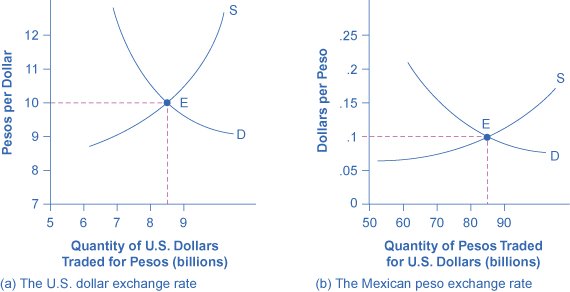
Read the two panels together, because they are the same event seen twice. The dollar is worth 10 pesos; the peso is worth 0.1 dollars. 10 and 1/10 are reciprocals, which is precisely why one currency cannot appreciate without the other depreciating.
Vocabulary: under floating rates a currency appreciates or depreciates. Devaluation and revaluation are deliberate policy actions under a fixed regime. Do not use them for market movements.
A crucial pairing: if the dollar appreciates against the peso, the peso depreciates against the dollar. Two markets, one event. AP frequently asks for the graph of the other currency, and the shift must be consistent. A reliable habit: draw the market you are asked for, then check that the story you have told would produce the mirror-image shift in the other panel.
Exchange-rate regimes
Floating. The rate is set by supply and demand with no official intervention. Most major currencies float. The advantage is that the exchange rate adjusts automatically towards balance, and monetary policy stays free to target domestic goals; the cost is volatility.
Fixed (pegged). The government commits to a rate and defends it. The mechanism is examinable:
If the currency is under downward pressure, the central bank buys its own currency using its foreign exchange reserves, raising demand for it, and may raise interest rates to attract capital inflows. If it is under upward pressure, it sells its own currency, accumulating reserves.
The constraint is that defending a peg consumes reserves and ties monetary policy to the exchange rate rather than to domestic conditions. A country defending a peg during a recession may have to raise rates precisely when its economy needs lower ones.
Managed float. Broadly market-determined, with occasional intervention to smooth volatility. Most real-world regimes sit somewhere on this spectrum rather than at either extreme.
Interest rates, capital flows and the exchange rate
This is the chain that connects Unit 6 back to Unit 4, and it appears in FRQs constantly:
- The domestic real interest rate rises
- domestic assets offer better returns
- financial capital flows in
- foreigners must buy the domestic currency
- demand for it rises
- the currency appreciates
- exports become more expensive abroad and imports cheaper
- net exports fall
- AD falls.
Note the tension this creates: contractionary monetary policy reduces AD directly through investment and indirectly through a stronger currency and weaker net exports. Both channels pull the same way, which is why the exchange-rate channel is worth naming.
The fiscal version has a twist worth knowing. A budget deficit raises the real interest rate through the loanable funds market, which attracts capital inflows, appreciates the currency and reduces net exports. So expansionary fiscal policy is partly self-defeating in an open economy: the stimulus to AD is offset by falling net exports. This is sometimes called crowding out through the exchange rate, and it is a strong evaluation point.
Determinants of exchange rates:
| Change | Effect on the domestic currency | Why |
|---|---|---|
| Domestic real interest rates rise | Appreciates | Capital inflow raises demand for the currency |
| Domestic income rises | Depreciates | More imports → more currency supplied |
| Foreign income rises | Appreciates | More exports → more currency demanded |
| Domestic inflation above foreign | Depreciates | Goods less competitive; purchasing power falls |
| Expectation of future appreciation | Appreciates now | Speculators buy ahead of the move |
| Preference for domestic goods rises | Appreciates | More export demand |
Note that it is the real interest rate that drives capital flows, and the relative rate that matters, a rise in domestic rates has no effect if foreign rates rise by as much.
Effects on net exports and AD
- Depreciation → exports cheaper abroad, imports dearer at home → net exports rise → AD shifts right.
- Appreciation → the reverse → AD shifts left.
Consequences of depreciation to weigh: it supports domestic output and employment, but raises the domestic-currency cost of imported inputs, feeding cost-push inflation, and makes foreign-currency debt harder to service.
Consequences of appreciation: cheaper imported inputs and lower inflationary pressure, but a loss of competitiveness for exporters and downward pressure on output and employment. Neither direction is simply good or bad, and questions asking whether a country "should want" a weaker currency are asking for exactly this two-sided treatment.
Worked example
The US Federal Reserve raises interest rates. Show the effect on the market for the Mexican peso and on Mexico's economy.
Step 1, the foreign exchange graph. Label it the market for pesos, vertical axis dollars per peso, horizontal axis quantity of pesos.
- Higher US rates make US assets more attractive
- investors move capital from Mexico to the US
- they sell pesos to buy dollars
- the supply of pesos increases (and demand for pesos falls)
- the peso depreciates against the dollar.
Step 2, the effect on Mexico.
- A cheaper peso makes Mexican goods less expensive to US buyers
- Mexican exports rise
- and US goods become dearer in Mexico
- imports fall
- net exports rise
- AD shifts right in Mexico
- real output and employment rise, with upward pressure on the price level.
Step 3, the accounts. Capital leaving Mexico is a financial account outflow, matched by the improvement in the current account. The two offset, as they must.
Step 4, the mirror image. In the market for dollars, the same event raises demand for dollars and the dollar appreciates. US exports become dearer and imports cheaper, so US net exports fall and US AD shifts left, reinforcing the contractionary effect the rate rise was intended to have.
One qualification. Mexico's imported inputs now cost more in pesos, so cost-push pressure partly offsets the gain, and any dollar-denominated debt becomes harder to service. A depreciation that helps exporters can still hurt an economy that borrows in a foreign currency.
Second worked example: reading a current account deficit
A country runs a persistent current account deficit of 4% of GDP.
By the identity; it must be running a financial account surplus of the same size: it is a net seller of assets to, or net borrower from, the rest of the world.
Is this a problem? The examinable answer is that it depends on two things:
- What the capital finances. Borrowing that funds investment in productive capital raises future output, from which the obligation can be met. Borrowing that funds current consumption does not.
- Whether it is sustainable. Foreign investors must remain willing to hold the country's assets. If confidence falls, capital inflows stop, the currency depreciates sharply, and the adjustment is forced rather than chosen.
Note also what the deficit implies domestically: a current account deficit means domestic saving is less than domestic investment, with the gap filled by foreign saving. That framing connects the unit straight back to the loanable funds market.
Common exam mistakes
- Not stating which currency's market the graph shows.
- Putting the wrong currency on the axes, or labelling the vertical axis "price" without units.
- Shifting demand when the correct answer is a shift in supply (or both).
- Using "devaluation" for a market-driven fall; that is depreciation.
- Forgetting that one currency's appreciation is another's depreciation.
- Placing FDI in the current account. Asset flows go in the financial account; the income they later generate goes in the current account.
- Using the nominal rather than the real interest rate to explain capital flows.
- Forgetting that only the relative interest rate matters.
- Concluding a depreciation is simply good, ignoring imported input costs and foreign-currency debt.
- Treating a current account deficit as self-evidently bad without asking what the borrowing finances.
Exam technique
Write the market name above the graph, and put units on the vertical axis ("dollars per peso"). These are cheap points that are lost constantly.
Trace the full chain in words alongside the graph: interest rate → capital flow → currency demand/supply → exchange rate → net exports → AD. Every arrow is a step a reader can credit, and rubrics usually award them separately.
When the question spans two countries, be explicit about which country each effect applies to, many answers lose marks by drifting between them. Naming the country at the start of every sentence is clumsy prose but reliable marking.
If you are unsure whether an event shifts demand or supply in a currency market, ask who is acting. Foreigners buying the currency shift demand; residents selling it to buy foreign assets or goods shift supply.
Quick revision
- Current account: goods, services, income, transfers. Financial account: assets.
- The accounts offset: a current account deficit implies a financial account surplus.
- A current account deficit also means domestic investment exceeds domestic saving.
- Label the forex market by currency, with units on the vertical axis.
- The two panels are reciprocals: 10 pesos per dollar is 0.1 dollars per peso.
- Appreciation/depreciation = market; revaluation/devaluation = policy under a fixed rate.
- Defending a peg costs reserves and constrains domestic monetary policy.
- Higher domestic real rates → capital inflow → appreciation → net exports fall → AD falls.
- Depreciation → net exports rise → AD rises, but imported input costs rise too.
- One currency appreciating means the other depreciates.
Check you have it
Cross-board concept practice · originally a CIE 9708 question, used here because the concept is the same. It is not AP Economics past-paper material.
Question 1
The introduction of the euro as the common currency of much of Western Europe created a powerful economic group. What is least likely to have been the intention?
Answer: D.
This is the least likely intention of introducing the euro as the common currency. The primary goal of the euro was to facilitate economic integration within the eurozone countries and promote internal trade and economic growth among the member states. The focus was on creating a larger and more stable single market through the elimination of currency exchange costs and fluctuations, which in turn was expected to lead to increased trade among eurozone countries.
Enhanced international trade with non-members was not the immediate goal of introducing the euro. While a stronger eurozone might indirectly benefit its members in their international trade relations, the main aim was to boost economic activity within the region itself. Additionally, the euro's impact on international trade with non-members could be influenced by various other factors such as global economic conditions, trade agreements, and competitiveness of the eurozone economies, rather than solely relying on the introduction of the euro as the common currency.
Cross-board concept practice · originally a CIE 9708 question, used here because the concept is the same. It is not AP Economics past-paper material.
Question 2
What is an example of primary income in the current account of the balance of payments of Pakistan?
Answer: C.
Primary income records cross-border returns to factors of production. Two conditions must both hold: the payment must be a return on land, labour or capital, and it must cross the border between a resident and a non-resident. Rent on an overseas property satisfies both, a Pakistani resident owns an asset abroad and receives income from foreign tenants, so foreign currency flows into Pakistan as a credit in the primary income account.
Why the other options are wrong:
- A is a dividend from a domestic firm. Both parties are Pakistani residents, so no cross-border transaction occurs and nothing enters the balance of payments at all.
- B is the profit of exporting businesses. The export sale itself is recorded in trade in goods; the profit is a domestic income, not a separate cross-border factor payment.
- D is a salary paid by a foreign-owned firm operating in Pakistan to a Pakistani engineer. This is the sharpest trap: the employer is foreign-owned, which makes the payment look international. But the firm's operation in Pakistan is treated as resident there, so a resident is paying a resident, a domestic transaction. Compensation of employees enters primary income only when the worker and employer are in different economies, for example a Pakistani engineer working abroad.
Cross-board concept practice · originally a CIE 9708 question, used here because the concept is the same. It is not AP Economics past-paper material.
Question 3
The African Union consists of 55 developing countries. They agree to adopt a free-trade model to boost trade between member countries.
In theory what do free-trade models tend to ignore?
Answer: D.
What the syllabus asks for on this topicWhat this unit covers
What this unit covers
- The balance of payments: current and financial accounts.
- Foreign exchange markets and exchange-rate determination.
- Exchange-rate regimes: floating, fixed and managed.
- The link between interest rates, capital flows and the exchange rate.
- How exchange rates affect net exports and AD.
This unit is 10–13% of the multiple-choice section, the smallest weighting of the six, but it appears disproportionately often in the free-response section, because it chains so naturally onto monetary and fiscal policy. The foreign exchange graph is also the one where the most marks are lost to pure labelling error.
Related AP Economics topics
Not the topic you were looking for? Describe what you are stuck on in your own words and we will take you to the notes that answer it.