38 past-paper questions on this unit. Five of them are below. Answer on the page: each one is marked the moment you pick, the correct option is shown whether or not you found it, and the full explanation opens either way.
CIE 0654 Co-ordinated SciencesPaper 1 and Paper 2 MCQsFree account
Chemistry of the environment: five questions to try now
Real past-paper questions, the answer key from the mark scheme, and the explanation that goes with it. No account needed to answer them.
Question 1
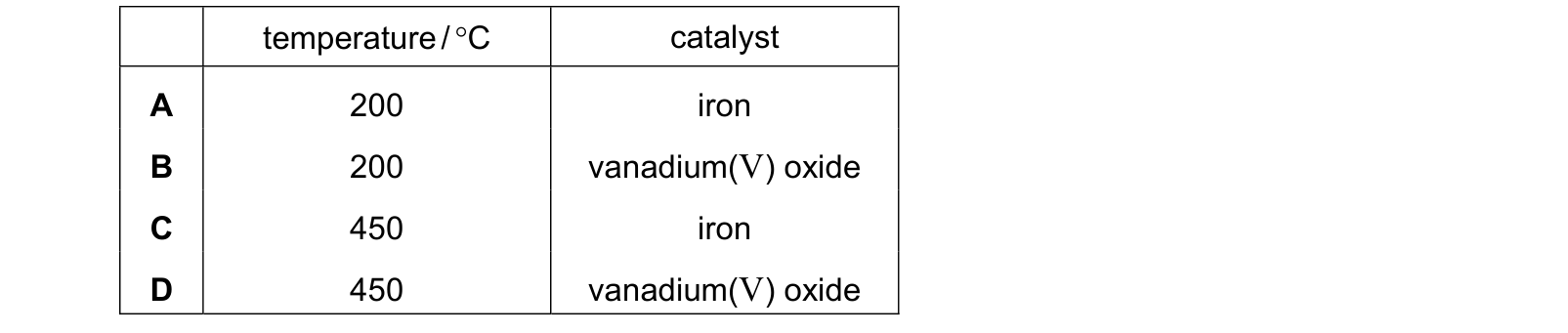
Which row describes conditions for the conversion of sulfur dioxide to sulfur trioxide in the Contact process? Each answer gives, in order: temperature / °C; catalyst.
Answer: D.
In the Contact process sulfur dioxide is oxidised to sulfur trioxide over a vanadium oxide catalyst at about 450 degrees C, a temperature chosen as a compromise because the forward reaction is exothermic and a lower temperature would give a better yield but far too slowly to be useful. Iron is the tempting catalyst, because it is the catalyst for the Haber process, which is taught alongside this one and which also runs at around 450 degrees C, so the temperature is no help in telling the two apart and the catalyst is the detail that distinguishes them. A temperature of 200 degrees C would push the equilibrium further towards the product but leave the rate so slow that the plant would be uneconomic. The catalyst does not shift the position of the equilibrium at all; it only lets the mixture reach it faster.
Question 2
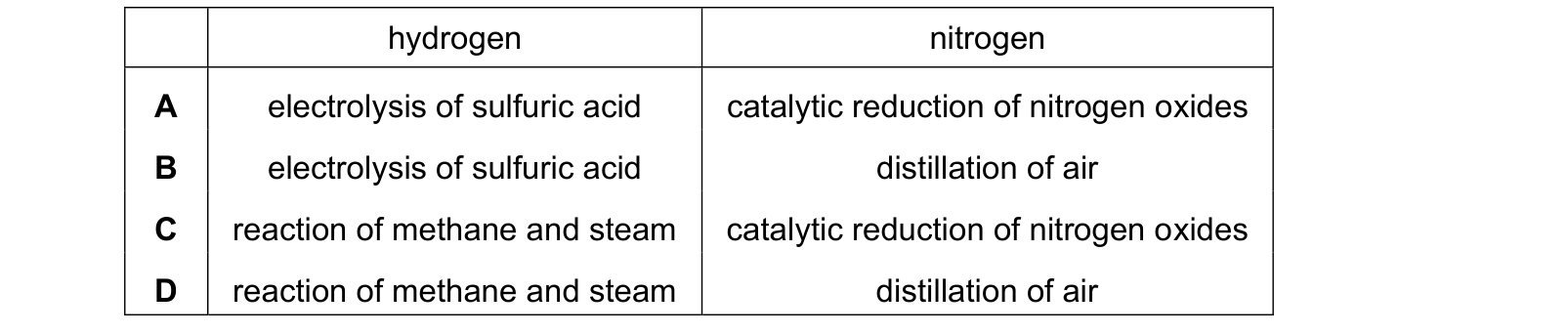
Which row describes how hydrogen and nitrogen are obtained for use in the Haber process? hydrogen nitrogen Use the source image for S23 Paper 21, question 23.
Answer: D.
The Haber process combines nitrogen and hydrogen to make ammonia, and both raw materials have to be cheap enough to use by the tonne. Nitrogen comes from the air, which is roughly four fifths nitrogen, separated by cooling the air until it liquefies and then distilling it. Hydrogen comes from reacting the methane in natural gas with steam, which is far cheaper than any electrolysis, so D pairs the two correctly. A and B name the electrolysis of sulfuric acid, a laboratory scale method that swallows large amounts of electricity for a small yield of gas. A and C name the catalytic reduction of nitrogen oxides, which is what a catalytic converter does to the exhaust of a car rather than a source of nitrogen for a chemical plant.
Question 3
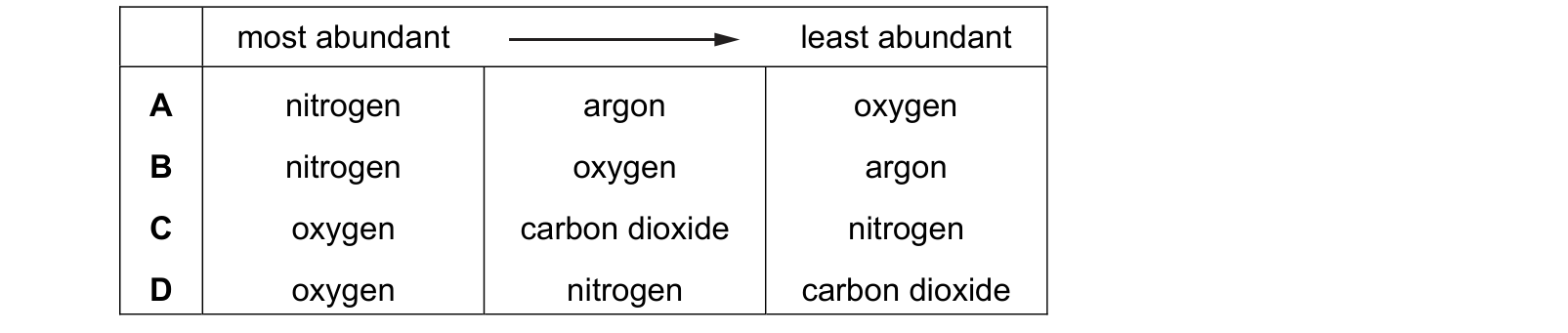
Which row shows the relative abundance of the gases in clean air? most abundant least abundant Use the source image for W22 Paper 12, question 25.
Answer: B.
Clean dry air is about 78 per cent nitrogen, about 21 per cent oxygen and roughly 1 per cent argon, with carbon dioxide at only about four hundredths of one per cent. The order from most to least abundant is therefore nitrogen, then oxygen, then argon, which is B. A keeps nitrogen first but promotes argon above oxygen, whereas oxygen accounts for about a fifth of the air and argon for barely a hundredth. C and D both place oxygen first, and C even puts nitrogen last, although nitrogen alone accounts for roughly four fifths of every breath. Remembering the four fifths and one fifth split for nitrogen and oxygen settles most questions of this kind.
Question 4
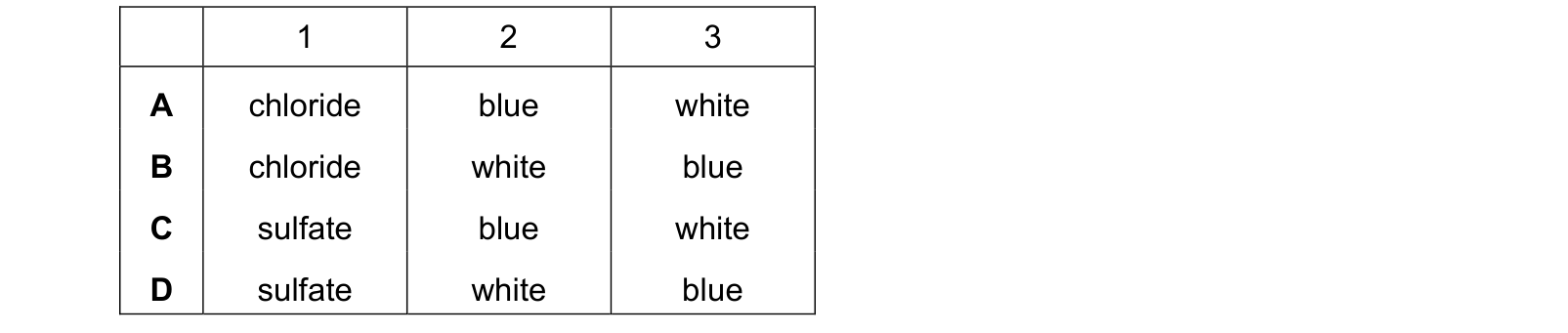
In a test for water, water turns anhydrous copper(II) ......1...... from ......2...... to ......3...... . Which words complete gaps 1, 2 and 3? 1 2 3 Use the source image for W24 Paper 21, question 25.
Answer: D.
The two standard tests for water are anhydrous copper(II) sulfate, which is white and turns blue, and anhydrous cobalt(II) chloride, which is blue and turns pink. This question names copper(II), so gap 1 is sulfate and the change runs from white to blue, which is D. A and B name chloride, yet the chloride test belongs to cobalt rather than copper. A and C give the change as blue to white, which is the reverse, the change seen when hydrated copper sulfate is heated and its water is driven off. Naming the dry solid together with its colour keeps the direction straight.
Question 5
Four equations are listed. 1 H2S2O7 + H2O → H2SO4 + SO3 + H2O 2 2S + 3O2 → 2SO3 3 H2SO4 + SO3 → H2S2O7 4 2SO2 + O2 → 2SO3 Which equations represent reactions that are involved in the Contact process?
Answer: D.
The Contact process burns sulfur to sulfur dioxide, oxidises that to sulfur trioxide over a catalyst, absorbs the trioxide into concentrated sulfuric acid to make oleum, then dilutes the oleum with water. Equations 4 and 3 are the second and third of those stages, which is why they form the correct pair. Equation 2 is the tempting one because it looks like a perfectly sensible combustion, but burning sulfur in air gives sulfur dioxide rather than sulfur trioxide, and reaching the trioxide directly would make the whole catalysed stage pointless. Equation 1 also collapses on inspection, since it has water on both sides and returns sulfur trioxide as a product, whereas diluting oleum with water gives two molecules of sulfuric acid and nothing else.
These questions are drawn from past CIE 0654 Co-ordinated Sciences papers and filtered to chemistry of the environment. You answer, you find out immediately whether you were right, and you get the reasoning for the correct option and for each distractor. Wrong answers go to a mistakes locker so you can come back to exactly those.
Practice is free. You need an account only so your progress and your mistakes are still there next time.
These are the errors that cost marks on chemistry of the environment, taken from our own topic notes. Read them before you practise and you will recognise the traps in the questions.
Saying anhydrous copper(II) sulfate turns from blue to white when water is added. That is the test running backwards.
Confusing the cobalt chloride and copper sulfate tests, or mixing one colour from each.
Saying a positive water test proves the liquid is pure water. It proves only that water is present.
Saying chlorine purifies the water supply. It makes it safe.
Saying filtration removes dissolved impurities.
Saying oxides of nitrogen come from nitrogen in the fuel.
Saying sulfur dioxide comes from the air rather than from sulfur in the fuel.
Saying a catalytic converter removes sulfur dioxide.