17 past-paper questions on this unit. Five of them are below. Answer on the page: each one is marked the moment you pick, the correct option is shown whether or not you found it, and the full explanation opens either way.
CIE 0654 Co-ordinated SciencesPaper 1 and Paper 2 MCQsFree account
Stoichiometry: five questions to try now
Real past-paper questions, the answer key from the mark scheme, and the explanation that goes with it. No account needed to answer them.
Question 1
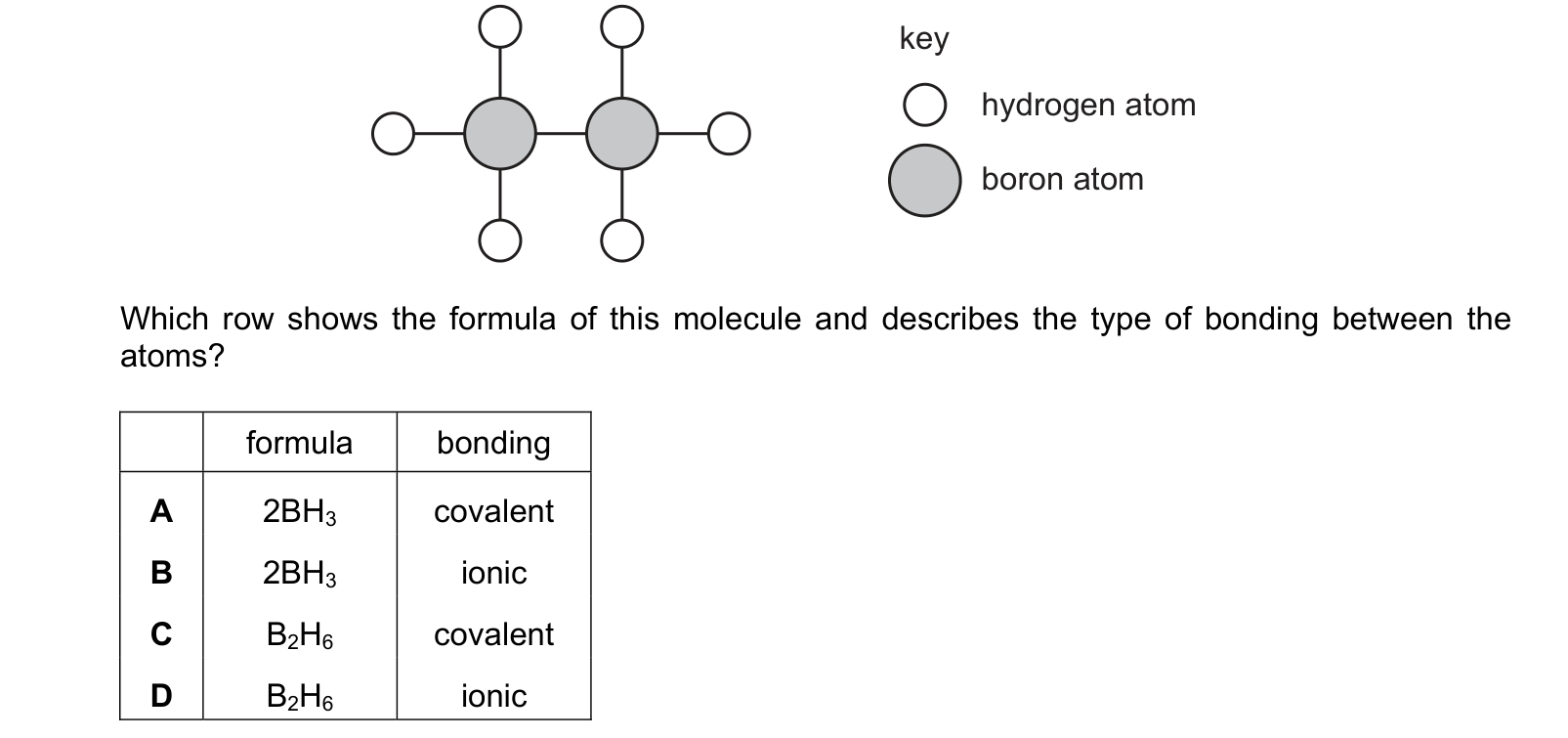
A model of a molecule is shown. Which row shows the formula of this molecule and describes the type of bonding between the atoms? Each answer gives, in order: formula; bonding.
Answer: C.
Counting the model gives two boron atoms and six hydrogen atoms held together in one molecule, so its formula is B2H6, and boron and hydrogen are both non-metals, so they bond by sharing electrons, which is covalent. C pairs those two facts and is correct. A and B write 2BH3, and putting a number in front means two separate BH3 molecules rather than the single joined molecule the model shows, since the two boron atoms are linked through shared hydrogens. B and D call the bonding ionic, but ionic bonding needs electrons to move from a metal to something else, and neither element here is a metal.
Question 2
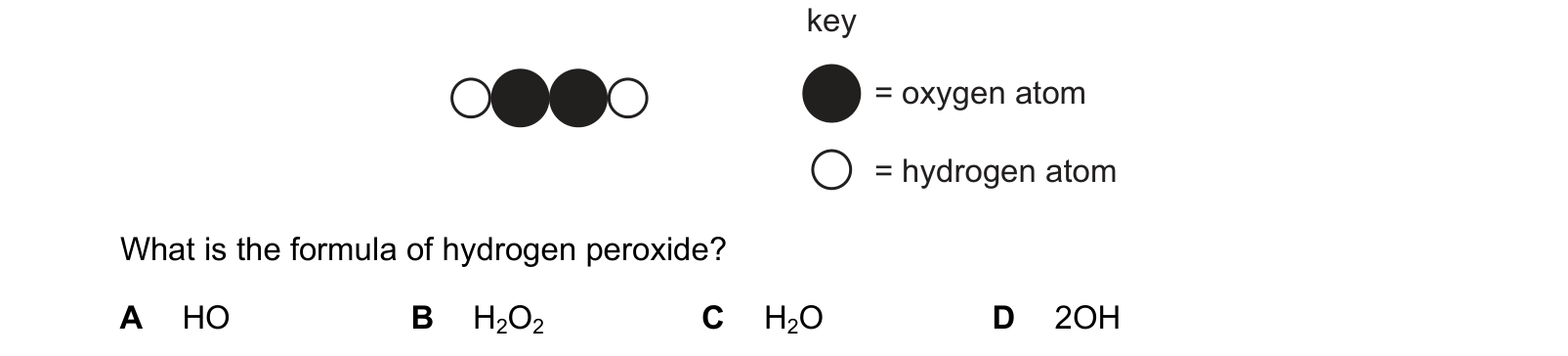
Hydrogen peroxide is a compound. A molecule of hydrogen peroxide can be represented as shown. key What is the formula of hydrogen peroxide?
Answer: B.
The drawing shows four atoms in one molecule, two oxygen atoms joined in the middle with one hydrogen atom attached at each end, so the molecule holds two hydrogen atoms and two oxygen atoms and its formula is H2O2, which is B. A, HO, gives the simplest whole number ratio of the atoms rather than the number actually present, and a molecular formula must count the real atoms in the molecule. C, H2O, is water, which has only one oxygen atom and is a different compound with different properties. D writes 2OH, which would mean two separate OH units rather than one molecule, and a formula uses subscripts after each symbol rather than a number in front of a group.
Question 3
The formula of an ammonium ion is NH4 +. The formula of a phosphate ion is PO4 3–. What is the formula of ammonium phosphate?
Answer: A.
An ionic formula must have no overall charge, so the numbers of each ion are chosen to make the positive and negative charges cancel exactly. An ammonium ion carries a single positive charge and a phosphate ion carries a charge of three minus, so three ammonium ions are needed for every one phosphate ion, and the three is written outside a bracket because the ammonium ion is a group of atoms that must be tripled as a whole. Writing the two ions side by side with no numbers is the tempting answer, because that is exactly how sodium chloride is written, but that shortcut only works when the two charges are equal in size, and here it would leave an overall charge of two minus. Putting the three on the phosphate instead makes the imbalance far worse, since it triples the ion that was already the more heavily charged of the two.
Question 4
When dilute sodium hydroxide is added to aqueous iron(II) sulfate, insoluble iron(II) hydroxide and aqueous sodium sulfate are formed. What is the ionic equation for this reaction?
Answer: A.
An ionic equation shows only the particles that actually change, so any ion that appears in the same form on both sides is a spectator and is left out. Here the iron(II) ions and the hydroxide ions combine to form the insoluble iron(II) hydroxide, while the sodium ions and the sulfate ions stay dissolved and unchanged throughout, so the equation reduces to the iron(II) ion reacting with two hydroxide ions to give solid iron(II) hydroxide. The equation listing every ion present is the tempting one, because it looks the most complete and it is perfectly balanced, but writing the sodium and sulfate ions on both sides is exactly what an ionic equation exists to strip away. The equation written entirely in formulae is the ordinary balanced equation rather than an ionic one, and the equation showing only sodium and sulfate describes nothing happening at all.
Question 5
Hydrogen reacts with oxygen to produce water. What is the balanced equation for this reaction?
Answer: D.
An equation is balanced by putting numbers in front of formulae until every element has the same number of atoms on each side, and the formulae themselves must never be altered. Writing 2H2 plus O2 gives 2H2O puts 4 hydrogen atoms and 2 oxygen atoms on each side, so it balances. The version reading H2 plus O2 gives 2H2O is the tempting one, because the 2 in front of the water makes the oxygen balance at 2 atoms on each side, but it leaves 2 hydrogen atoms on the left facing 4 on the right. The version written with a single O on the left does balance the atoms, yet it does so by rewriting the formula of oxygen, and oxygen exists as O2 molecules, so that equation describes a substance that was never there.
These questions are drawn from past CIE 0654 Co-ordinated Sciences papers and filtered to stoichiometry. You answer, you find out immediately whether you were right, and you get the reasoning for the correct option and for each distractor. Wrong answers go to a mistakes locker so you can come back to exactly those.
Practice is free. You need an account only so your progress and your mistakes are still there next time.
These are the errors that cost marks on stoichiometry, taken from our own topic notes. Read them before you practise and you will recognise the traps in the questions.
Leaving out the brackets in Cu(OH)₂ or Mg(NO₃)₂.
Writing the negative ion first in an ionic formula.
Balancing an equation by changing a formula, for instance writing O instead of O₂ or H₂O₂ instead of H₂O.
Counting only one element and declaring an equation balanced.
Writing every ion on both sides of an "ionic" equation instead of cancelling the spectators.
Giving a precipitate the state symbol (aq).
Forgetting to multiply the contents of brackets when calculating an Mr.