Demand: three questions to try now
Real questions, the answer key from the mark scheme, and the explanation that goes with it. No account needed to answer them.
Cross-board concept practice · originally a CIE 9708 question, used here because the concept is the same. It is not IB Economics past-paper material.
Question 1
The diagrams show initial equilibrium positions at Y1P1. Which diagram reflects the impact on an economy of higher unit wage costs and an improvement in the balance of trade?
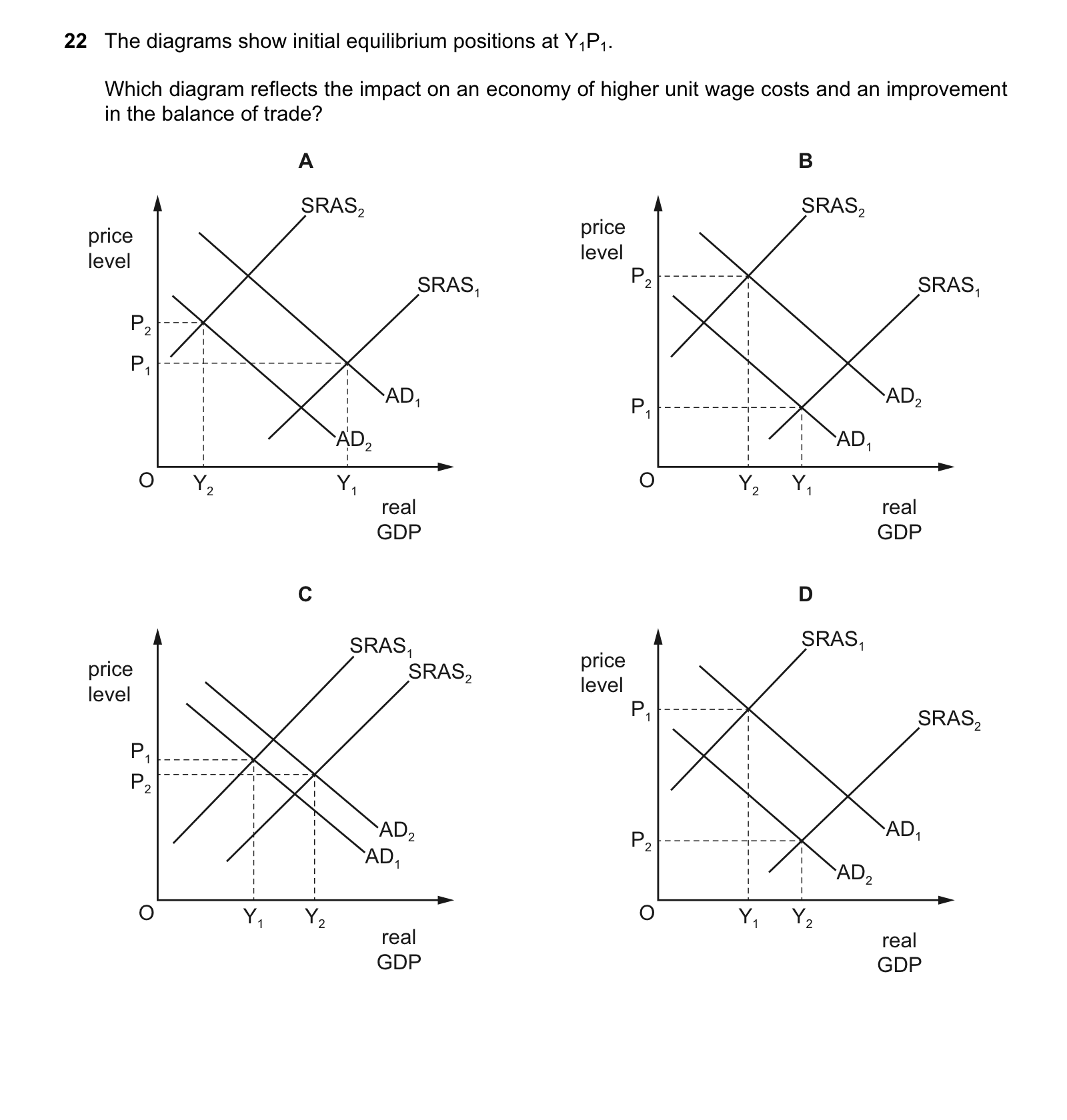
Answer: B.
Explanation:
- An improvement in the balance of trade means that the country is exporting more than it is importing, leading to an increase in net exports and ultimately boosting the aggregate demand (AD) curve.
- Higher unit wage costs would lead to an increase in production costs for firms, shifting the short-run aggregate supply (SRAS) curve to the left as they would need to increase prices to maintain profit margins.
- The combination of an upward shift in the AD curve and a leftward shift in the SRAS curve would lead to an increase in the price level (from P1 to P2) and a decrease in real GDP (from Y1 to Y2), which is depicted in diagram B.
Cross-board concept practice · originally a CIE 9708 question, used here because the concept is the same. It is not IB Economics past-paper material.
Question 2
The diagram shows an industry’s demand and supply curves. The industry increases supply from S1 to S2. Which area shows the total gain in society’s economic welfare?
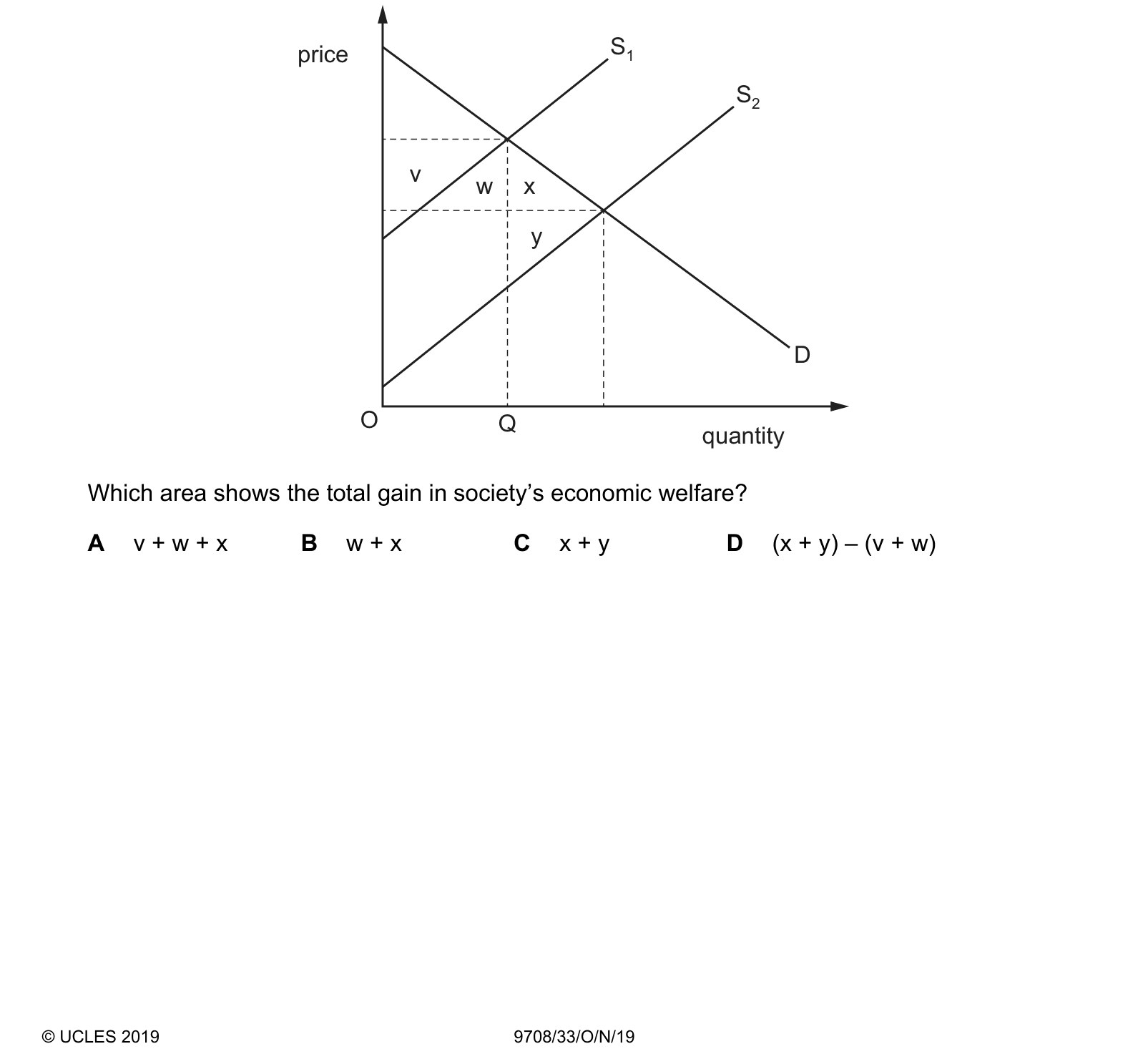
Answer: C.
Cross-board concept practice · originally a CIE 9708 question, used here because the concept is the same. It is not IB Economics past-paper material.
Question 3
The diagram shows the short-run equilibrium for a firm operating in a monopolistically competitive market. What is not likely to occur at the long-run equilibrium?
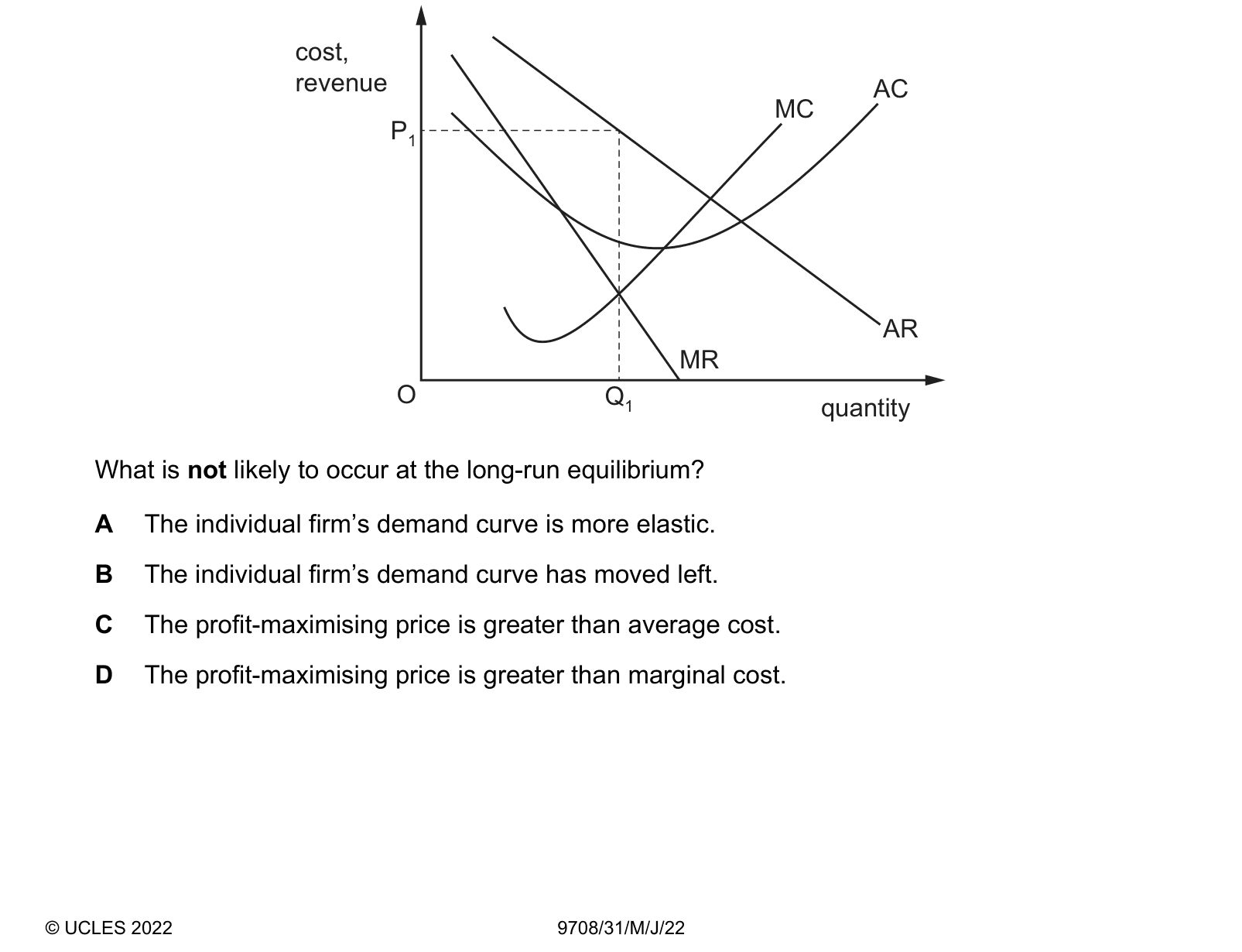
Answer: C.
What this practice covers
These questions are drawn from past Cambridge papers, mapped across to this topic because the concept is the same. You answer, you find out immediately whether you were right, and you get the reasoning for the correct option and for each distractor. Wrong answers go to a mistakes locker so you can come back to exactly those.
Practice is free. You need an account only so your progress and your mistakes are still there next time.
What examiners see students get wrong here
These are the errors that cost marks on demand, taken from our own topic notes. Read them before you practise and you will recognise the traps in the questions.
- Calling a shift a "movement", or vice versa.
- Writing that a price change "increases demand", it changes quantity demanded.
- Forgetting to state ceteris paribus when explaining the law of demand.
- Explaining the downward slope with only one of the income and substitution effects.
- Confusing an inferior good (negative income effect) with a cheap or low-quality good.
- Shifting demand for a good when its own price changed.
- (HL) Reading a as a price or b as an elasticity; they are the intercept and the slope parameter.
Revise it first
If any of the above is unfamiliar, work through the notes before practising: Demand revision notes.