Elasticity of Demand (PED & YED): three questions to try now
Real questions, the answer key from the mark scheme, and the explanation that goes with it. No account needed to answer them.
Cross-board concept practice · originally a CIE 9708 question, used here because the concept is the same. It is not IB Economics past-paper material.
Question 1
The diagram shows the relationship between the price and the total expenditure on a good.
price
O total expenditure
Which statement is correct?

Answer: C.
Cross-board concept practice · originally a CIE 9708 question, used here because the concept is the same. It is not IB Economics past-paper material.
Question 2
The diagram shows the demand curve for a product. If the rectangle OLMN is equal in area to the rectangle OPQR, which statement is correct?
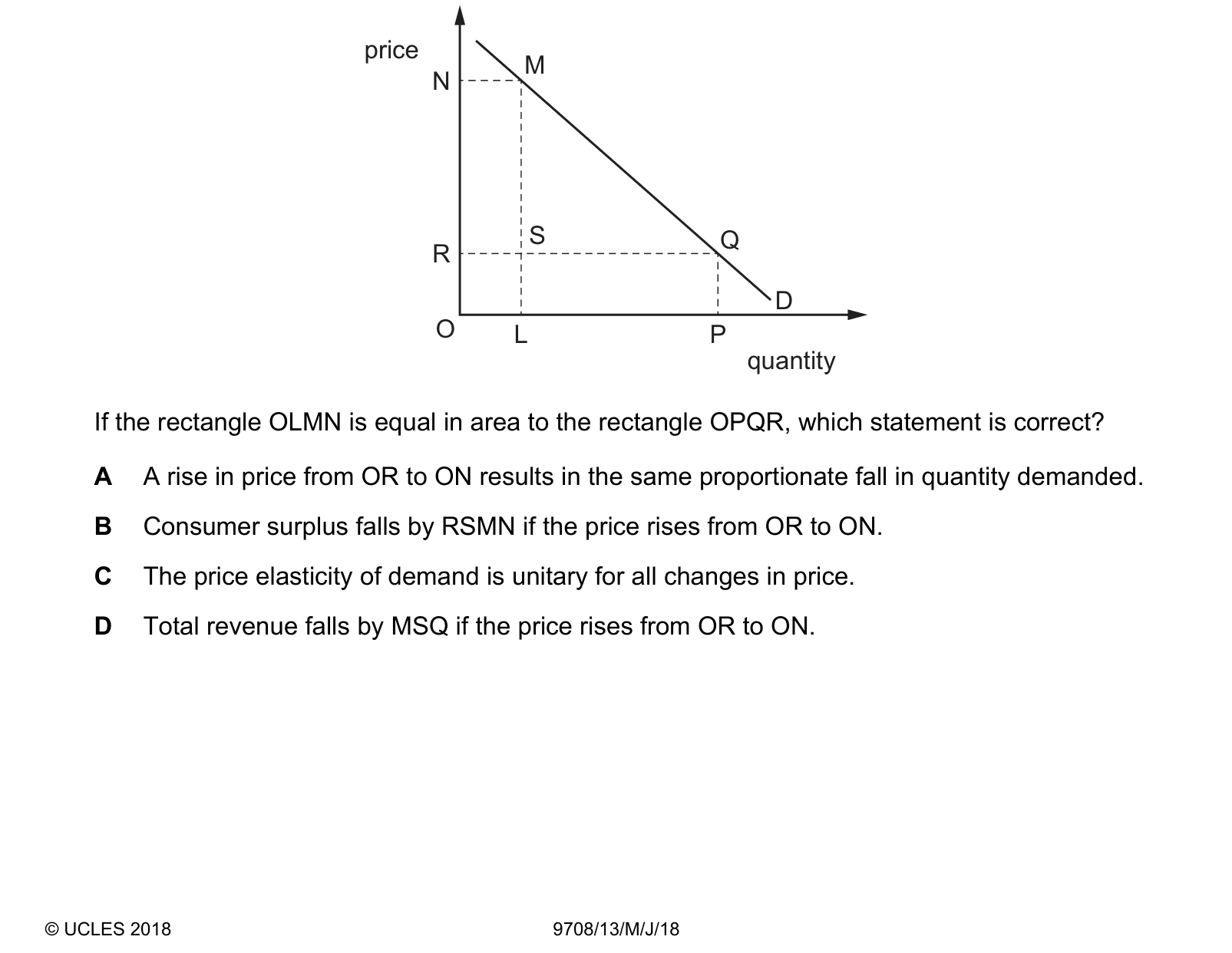
Answer: A.
Cross-board concept practice · originally a CIE 9708 question, used here because the concept is the same. It is not IB Economics past-paper material.
Question 3
The price elasticity of the supply of yoghurt is estimated to be +1.5.
If the demand for yoghurt rises and price rises by 20%, how much more will be supplied to the market?
Answer: D.
Price elasticity of supply is the percentage change in quantity supplied divided by the percentage change in price. Rearranging, the percentage change in quantity supplied equals PES multiplied by the percentage change in price: 1.5 × 20% = 30%. Because PES is greater than 1, supply is elastic, so quantity responds proportionately more than price, which is why the answer must be larger than 20%.
Why the other options are wrong:
- A, 0.3%, and B, 3.0%, come from misplacing a decimal point, multiplying 1.5 by 0.2 and then reading the result as a percentage rather than as a proportion of the original percentage.
- C, 13.3%, comes from dividing 20 by 1.5 instead of multiplying. This is the most common error in elasticity calculations, and it is easy to catch: since supply is elastic, the quantity change must exceed the price change, so any answer below 20% cannot be right.
What this practice covers
These questions are drawn from past Cambridge papers, mapped across to this topic because the concept is the same. You answer, you find out immediately whether you were right, and you get the reasoning for the correct option and for each distractor. Wrong answers go to a mistakes locker so you can come back to exactly those.
Practice is free. You need an account only so your progress and your mistakes are still there next time.
What examiners see students get wrong here
These are the errors that cost marks on elasticity of demand (ped & yed), taken from our own topic notes. Read them before you practise and you will recognise the traps in the questions.
- Reporting PED with the minus sign and then misclassifying by sign instead of absolute value.
- Saying a price rise "always" raises revenue, it depends entirely on elasticity.
- Confusing PED (movement along the curve) with YED (a shift of the curve).
- Treating a whole demand curve as having one elasticity.
- Applying the demand rule to supply, a straight-line supply curve through the origin has PES = 1 throughout.
- Assuming whoever pays the tax to the government bears it.
- Treating revenue as profit.
- Calculating correctly and stopping. The number is worth little until it is interpreted.
Revise it first
If any of the above is unfamiliar, work through the notes before practising: Elasticity of Demand (PED & YED) revision notes.