Three practice questions are below. Answer on the page: each one is marked the moment you pick, the correct option is shown whether or not you found it, and the full explanation opens either way.
IB Economicsconcept drillsFree account
Elasticity of Supply (PES): three questions to try now
Real questions, the answer key from the mark scheme, and the explanation that goes with it. No account needed to answer them.
Cross-board concept practice · originally a CIE 9708 question, used here because the concept is the same. It is not IB Economics past-paper material.
Question 1
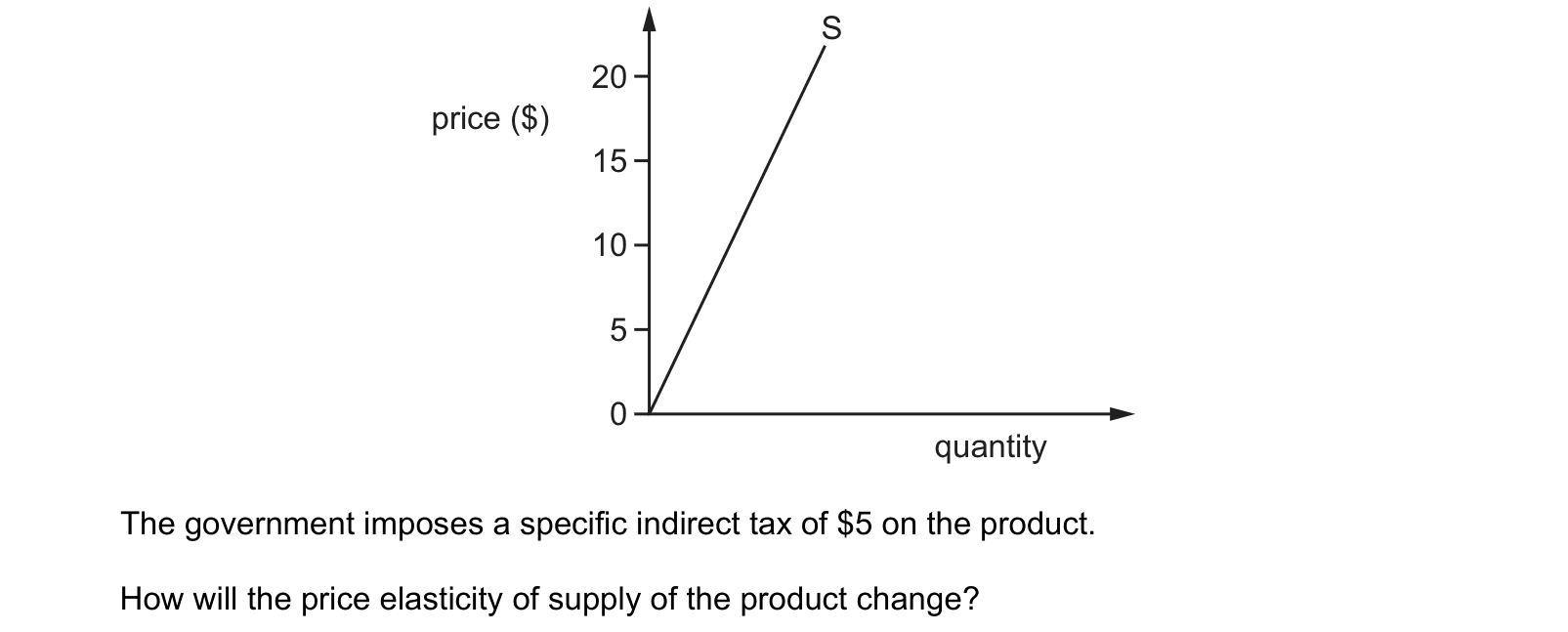
The diagram shows the supply curve of a product. The government imposes a specific indirect tax of $5 on the product. How will the price elasticity of supply of the product change?
Answer: D.
The original supply curve is a straight line drawn from the origin, and any straight supply line through the origin has a price elasticity of supply of exactly 1, price and quantity always change in the same proportion. That is the starting point. A specific tax of $5 is a fixed amount per unit, so it lifts the whole curve vertically by $5 without changing its slope. The new line is parallel to the old one but now meets the PRICE axis at $5 instead of passing through the origin, and a straight supply line that cuts the price axis is elastic, greater than 1, at every point along it. So elasticity goes from unitary to elastic. The rule worth remembering is that for straight supply curves it is the intercept, not the steepness, that decides: through the origin gives 1, cutting the price axis gives more than 1, cutting the quantity axis gives less than 1.
Cross-board concept practice · originally a CIE 9708 question, used here because the concept is the same. It is not IB Economics past-paper material.
Question 2
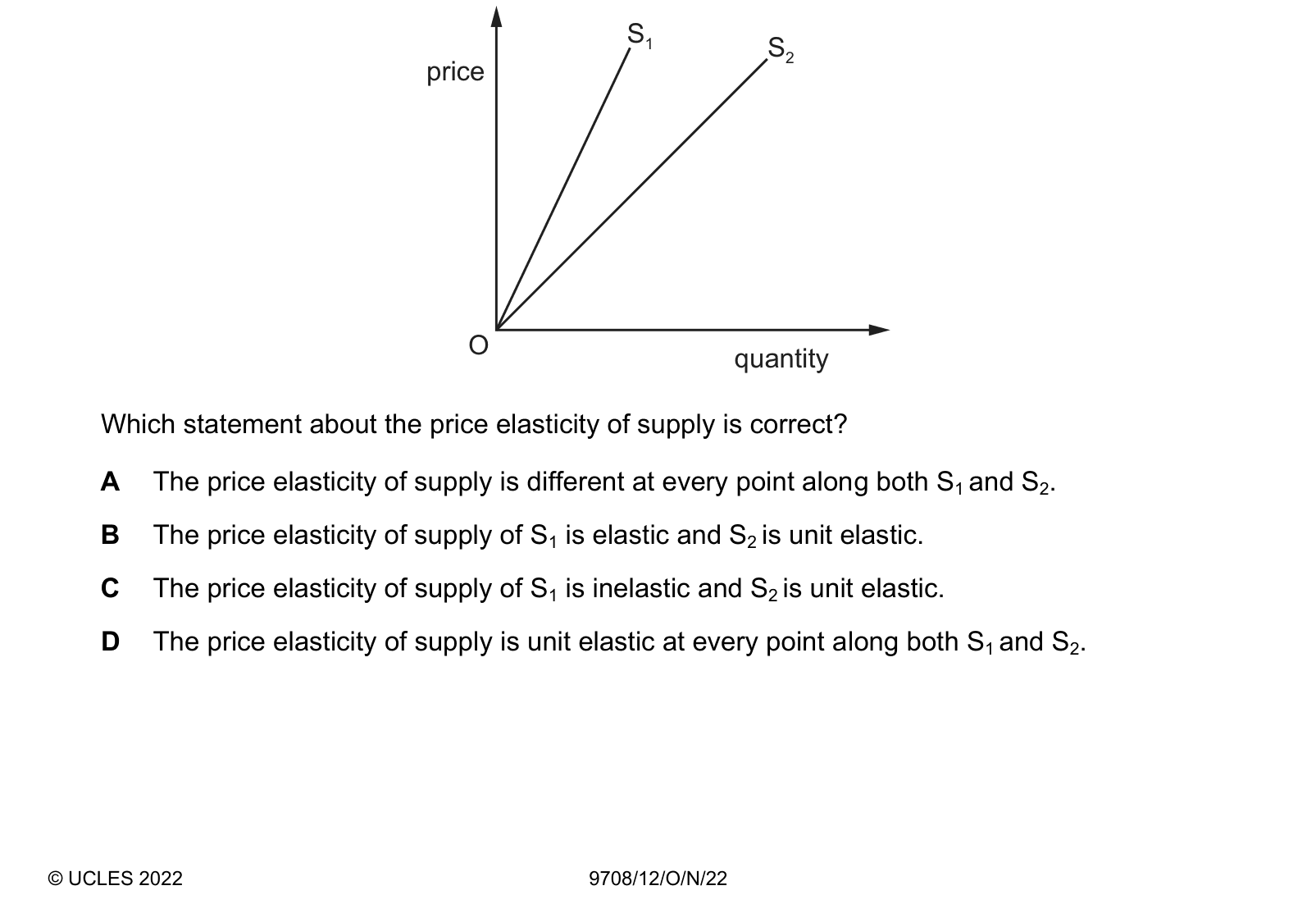
The diagram shows two linear supply curves labelled S1 and S2, where S2 is a 45° line. Which statement about the price elasticity of supply is correct?
Answer: D.
Both lines are straight and both start at the origin, and that is the whole answer. Any straight supply curve drawn through the origin has a price elasticity of supply of exactly 1 at every point along it, no matter how steep or shallow it looks, because price and quantity always rise in the same proportion, double the price and you double the quantity. S1 being steeper than S2 changes the units, not the elasticity, which is why B and C are wrong to read the slopes as elastic and inelastic. A is wrong for the same reason: elasticity is constant along each of these lines, not varying. That constancy is special to lines through the origin, a straight supply curve that cuts the price axis instead is elastic throughout, and one cutting the quantity axis is inelastic throughout.
Cross-board concept practice · originally a CIE 9708 question, used here because the concept is the same. It is not IB Economics past-paper material.
Question 3
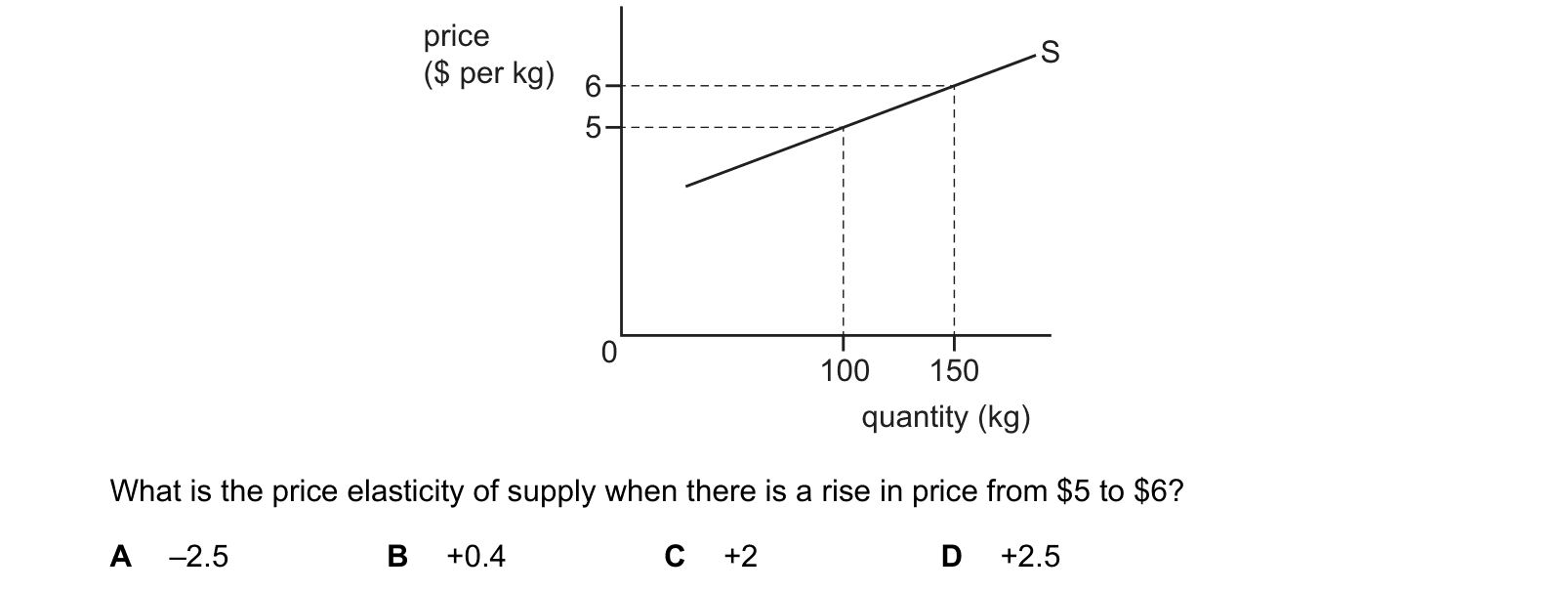
The diagram shows the supply curve for bananas. What is the price elasticity of supply when there is a rise in price from $5 to $6?
Answer: D.
Work in percentages, not in the raw numbers. The price rises from $5 to $6, which is $1 on $5, or 20%. Quantity supplied rises from 100 kg to 150 kg, which is 50 on 100, or 50%. Price elasticity of supply is the percentage change in quantity divided by the percentage change in price, so it is 50 ÷ 20 = 2.5. Supply is elastic here, and the answer is positive because supply curves slope upwards, price and quantity move together, so the sign can never be negative. That rules out A immediately without any arithmetic. C is what you get by dividing the raw changes, 50 ÷ 1 rescaled, rather than the percentages.
These questions are drawn from past Cambridge papers, mapped across to this topic because the concept is the same. You answer, you find out immediately whether you were right, and you get the reasoning for the correct option and for each distractor. Wrong answers go to a mistakes locker so you can come back to exactly those.
Practice is free. You need an account only so your progress and your mistakes are still there next time.
These are the errors that cost marks on elasticity of supply (pes), taken from our own topic notes. Read them before you practise and you will recognise the traps in the questions.
Giving PES a negative sign. It is normally positive, because supply slopes upward.
Confusing PES with PED, or applying the "total revenue test" to PES, that test belongs to PED.
Ignoring the time period. "Supply is inelastic" is incomplete without saying over what horizon.
Judging elasticity from the steepness of a straight-line supply curve rather than from where it cuts an axis.
Treating spare capacity and stocks as the same thing. Capacity is about the ability to produce more; stocks are about releasing what already exists.
Calculating PES correctly and never interpreting it.
Saying primary products have inelastic supply without explaining why (fixed land, long production periods, weather).
Presenting buffer stocks as straightforwardly effective.