Public Goods: five questions to try now
Real questions, the answer key from the mark scheme, and the explanation that goes with it. No account needed to answer them.
Cross-board concept practice · originally a CIE 9708 question, used here because the concept is the same. It is not IB Economics past-paper material.
Question 1
A government decides to replace a private company with its own company to collect household waste.
Why could such action be justified?
Answer: D.
A profit-maximising firm has an incentive to cut costs in ways that reduce service quality, collecting less frequently, refusing to serve remote or unprofitable streets, skimping on recycling. Waste collection also generates significant externalities: uncollected rubbish creates health hazards and environmental damage borne by the whole community, not just by the household concerned. A private firm has no reason to weigh those third-party costs, so state provision can be justified as a way of putting social benefit ahead of profit.
Why the other options are wrong:
- A calls waste collection a public good. It is not: collection from a particular household is both rival (the crew's time and truck capacity are finite) and excludable (service can be withheld from non-payers). It is a service with strong externalities, which is a different justification.
- B claims costs are "bound to be" lower if funded from local taxes. The funding method does not determine the cost of collecting rubbish, and "bound to be" is far too strong.
- C claims private companies are "always" less efficient. This is indefensible as a generalisation, private firms are often more cost-efficient, which is the argument for contracting out.
Cross-board concept practice · originally a CIE 9708 question, used here because the concept is the same. It is not IB Economics past-paper material.
Question 2
Public transport in an economy has an income elasticity of demand of –0.36.
What does this mean about public transport?
Answer: D.
Cross-board concept practice · originally a CIE 9708 question, used here because the concept is the same. It is not IB Economics past-paper material.
Question 3
D1D1 shows an individual’s initial demand curve for public transport. quantity of public transport O price of public transport D1 D2 D1 What would cause the demand curve to shift to D2D1?
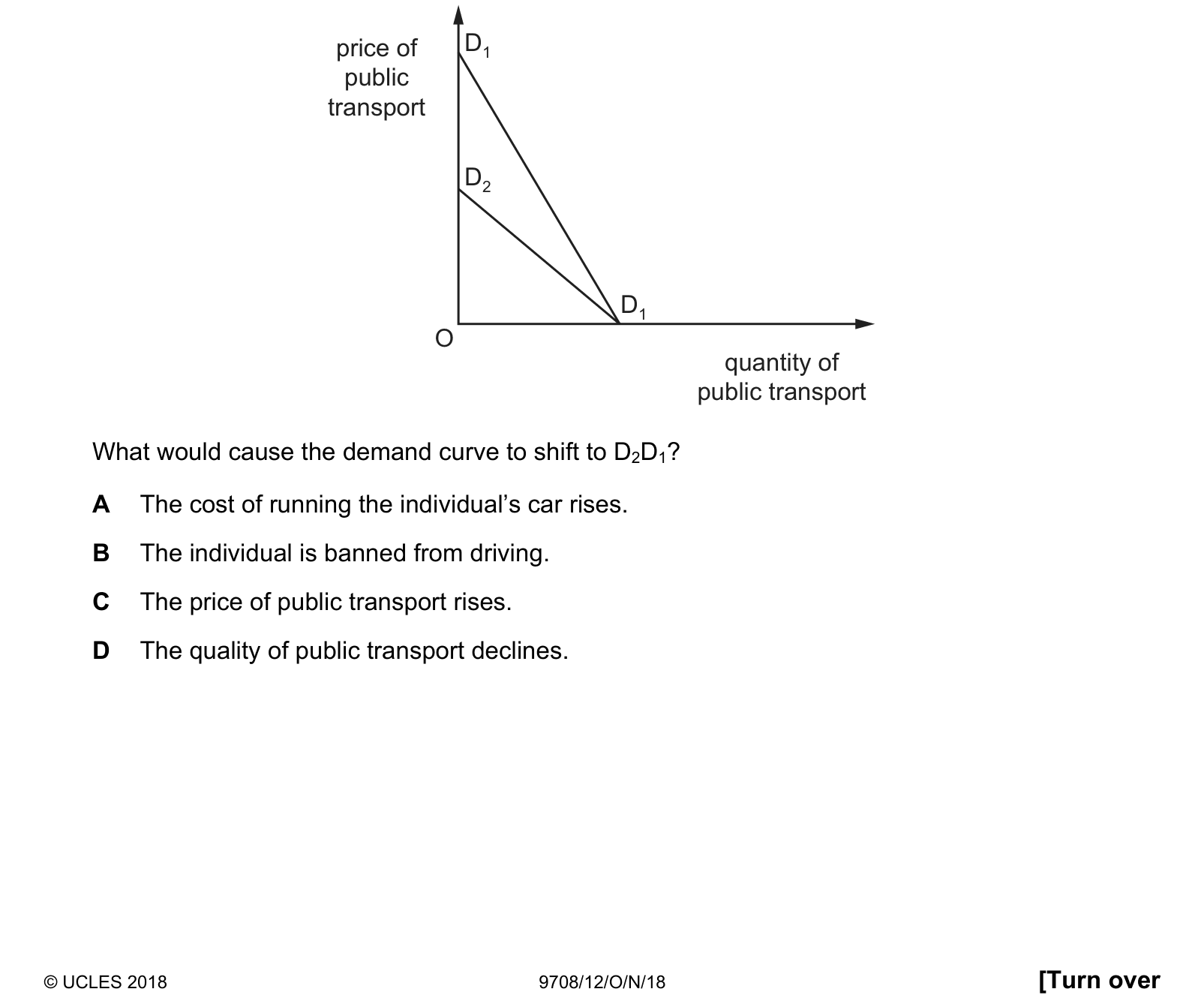
Answer: D.
Cross-board concept practice · originally a CIE 9708 question, used here because the concept is the same. It is not IB Economics past-paper material.
Question 4
Along which axis can the market demand curve be aggregated from individual demand curves?
Answer: B.
Cross-board concept practice · originally a CIE 9708 question, used here because the concept is the same. It is not IB Economics past-paper material.
Question 5
What is most likely to cause the demand curve of an inferior good to shift to the right?
Answer: B.
An inferior good is one whose demand falls as income rises, and rises as income falls. Higher income tax reduces households' disposable income, so consumers switch back towards cheaper alternatives, own-brand food, public transport, second-hand goods. Demand for the inferior good therefore shifts right.
Why the other options are wrong:
- A, a rise in consumers' incomes, moves demand for an inferior good the other way: consumers trade up to preferred substitutes, so demand shifts left. This is the direct trap, and getting it right depends on remembering that the income relationship is inverted for inferior goods.
- C, a rise in sales tax, raises the price of the good itself. A change in a good's own price causes a movement along the demand curve, not a shift of it.
- D, a rise in the price of a complement, raises the total cost of consuming the pair, so demand for this good shifts left. (A rise in the price of a substitute would shift it right.)
What this practice covers
These questions are drawn from past Cambridge papers, mapped across to this topic because the concept is the same. You answer, you find out immediately whether you were right, and you get the reasoning for the correct option and for each distractor. Wrong answers go to a mistakes locker so you can come back to exactly those.
Practice is free. You need an account only so your progress and your mistakes are still there next time.
What examiners see students get wrong here
These are the errors that cost marks on public goods, taken from our own topic notes. Read them before you practise and you will recognise the traps in the questions.
- Defining a public good as "a good provided by the government".
- Giving only one of the two characteristics. Both non-rivalry and non-excludability are required.
- Confusing public goods with merit goods (rival and excludable, under-consumed), the single most common error here.
- Confusing public goods with common pool resources (rival, non-excludable, over-used).
- Saying the market under-provides a public good when for a pure public good it provides none.
- Treating the classification as fixed, when congestion or new technology can change it.
- Treating government provision as free of cost or of difficulty.
- Presenting cost–benefit analysis as objective.
Revise it first
If any of the above is unfamiliar, work through the notes before practising: Public Goods revision notes.