Supply: three questions to try now
Real questions, the answer key from the mark scheme, and the explanation that goes with it. No account needed to answer them.
Cross-board concept practice · originally a CIE 9708 question, used here because the concept is the same. It is not IB Economics past-paper material.
Question 1
The diagram shows an industry’s demand and supply curves. The industry increases supply from S1 to S2. Which area shows the total gain in society’s economic welfare?
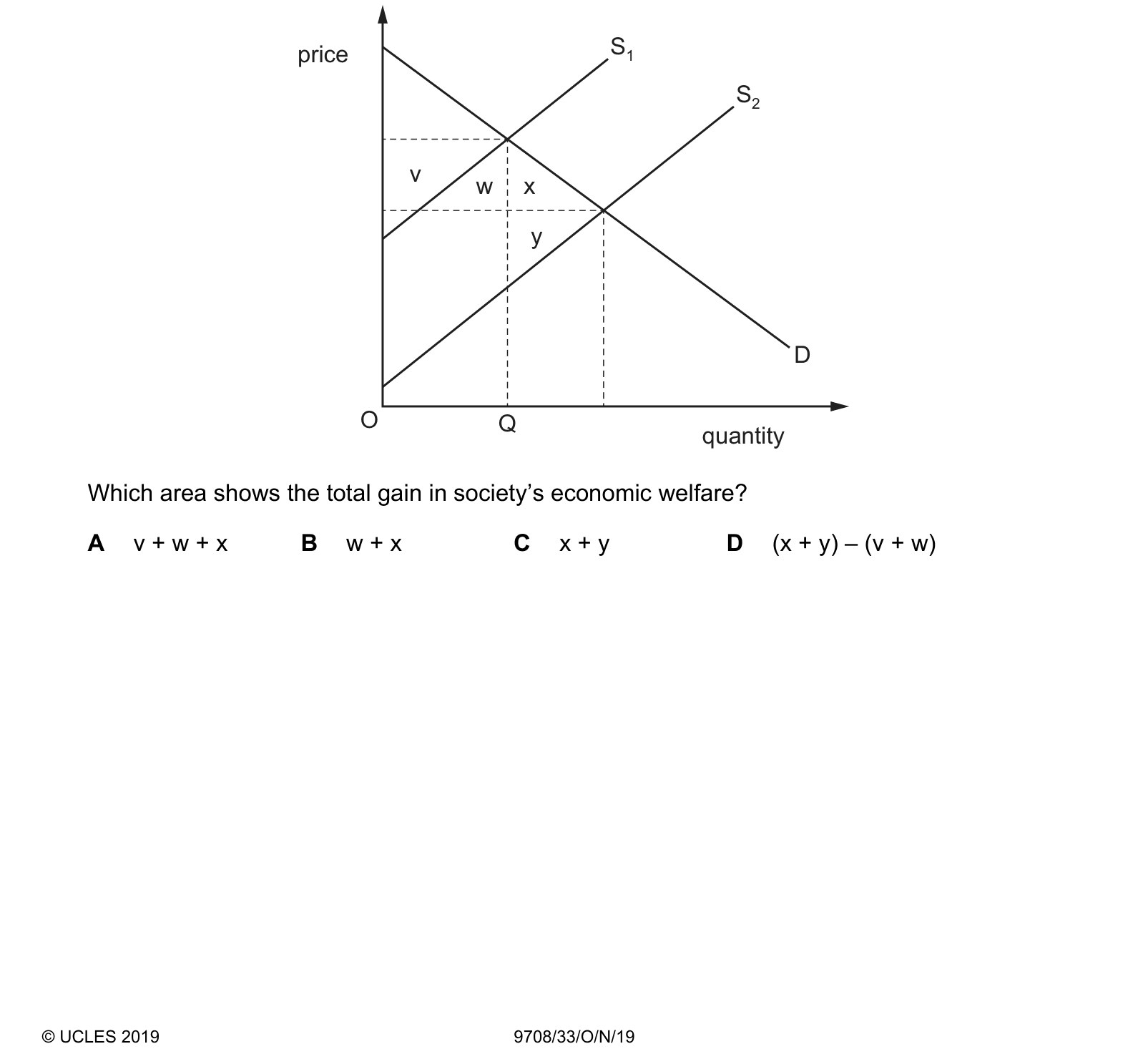
Answer: C.
Cross-board concept practice · originally a CIE 9708 question, used here because the concept is the same. It is not IB Economics past-paper material.
Question 2
In the diagram, Q1 is the quantity produced of a good as the result of market forces. (private cost) S2 (social cost) Q1 D Which concept is present at output Q1?
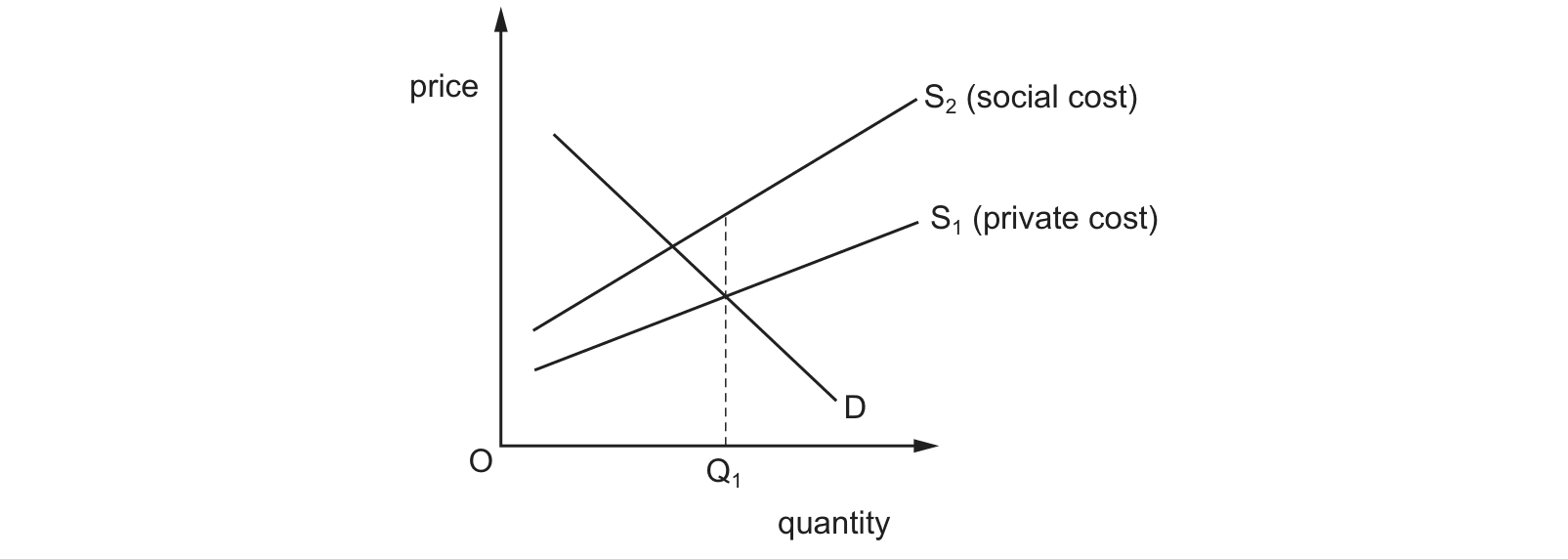
Answer: B.
The other options would each look different on the diagram. A subsidy (A) or a positive externality (C) would put the social curve BELOW the private one. A specific tax (D) shifts the private supply curve itself rather than opening a gap between two separate curves.
Cross-board concept practice · originally a CIE 9708 question, used here because the concept is the same. It is not IB Economics past-paper material.
Question 3
In the diagram, S1 is the original supply curve and D is the original demand curve. If supply shifts to S2, which area represents the change in consumer surplus?
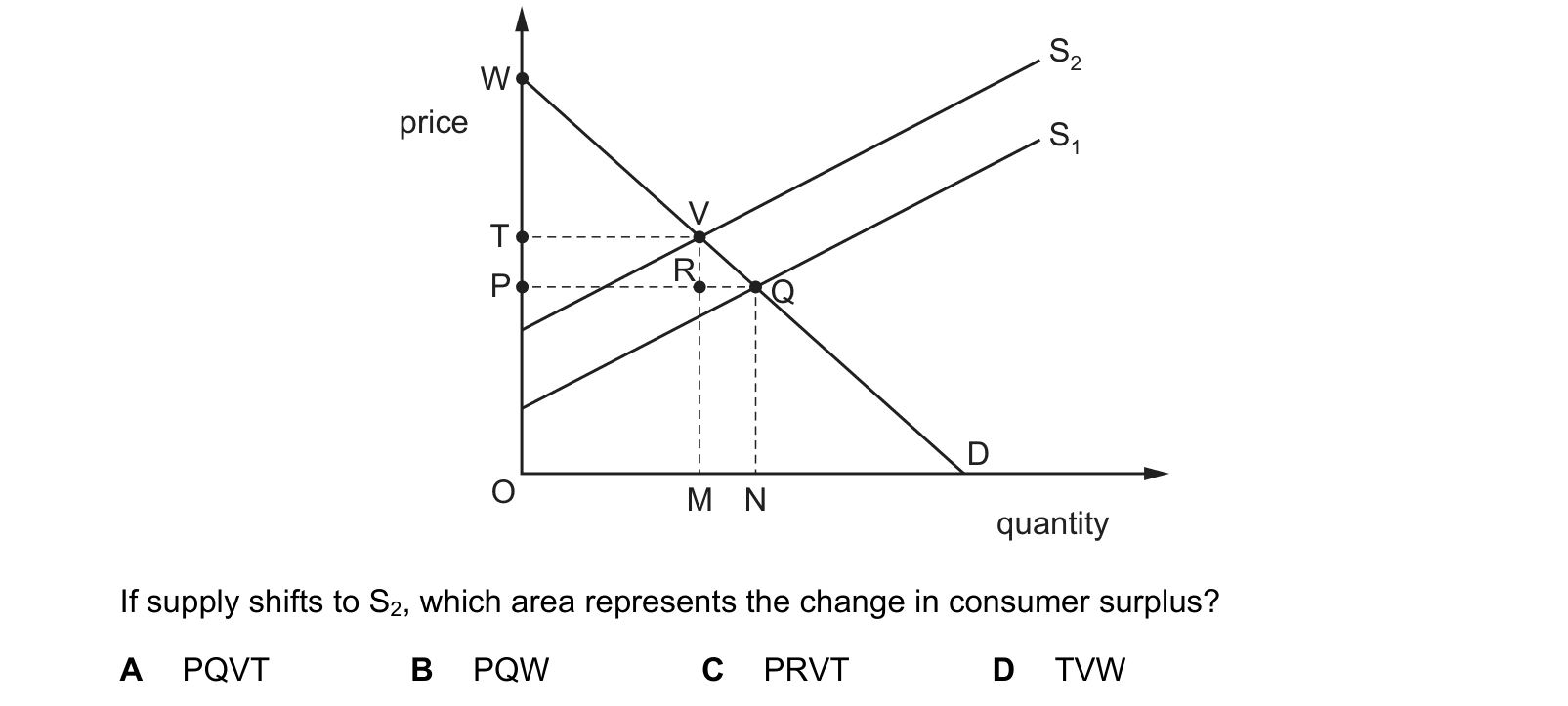
Answer: A.
Explanation:
- Consumer surplus is the area between the price that consumers are willing to pay (D curve) and the actual price (P). When supply shifts from S1 to S2, the new equilibrium price will decrease from P to P2, leading to a lower price for consumers.
- The change in consumer surplus after the shift in supply can be calculated by comparing the original consumer surplus (triangle above P and under D) and the new consumer surplus after the shift (triangle above P2 and under D).
- In the given options, area PQVT represents the change in consumer surplus after the shift in supply from S1 to S2. This area captures the decrease in consumer surplus due to the decrease in price (from P to P2) resulting from the increase in supply.
- Choice B (PQW) does not represent the change in consumer surplus accurately after the shift in supply. It only captures a portion of the original consumer surplus and does not account for the full decrease in consumer surplus due to the shift.
- Choices C (PRVT) and D (TVW) are also incorrect as they do not accurately represent the change in consumer surplus after the shift in supply.
- The correct area to represent the change in consumer surplus must consider the overall decrease in consumer surplus resulting from the decrease in price caused by the increase in supply.
What this practice covers
These questions are drawn from past Cambridge papers, mapped across to this topic because the concept is the same. You answer, you find out immediately whether you were right, and you get the reasoning for the correct option and for each distractor. Wrong answers go to a mistakes locker so you can come back to exactly those.
Practice is free. You need an account only so your progress and your mistakes are still there next time.
What examiners see students get wrong here
These are the errors that cost marks on supply, taken from our own topic notes. Read them before you practise and you will recognise the traps in the questions.
- Confusing a shift (cost, technology, tax) with a movement along (own-price change).
- Treating an indirect tax as a demand-side change. It raises firms' costs and shifts supply.
- Writing that a price rise "increases supply", it increases quantity supplied.
- Shifting supply for a change in consumer incomes or tastes, which are demand factors.
- Unlabelled diagrams, or shifting the curve without marking the new equilibrium.
- Forgetting that a per-unit tax shifts supply vertically by the tax amount, not by an arbitrary distance.
- Claiming price rises by the full amount of a per-unit tax.
- (HL) Extending the supply curve below the price at which Qs = 0, into negative quantities.
Revise it first
If any of the above is unfamiliar, work through the notes before practising: Supply revision notes.