Nature of Economics
Contents: 11 sections
Economics as a social science
Economics studies human behaviour, so it cannot run controlled laboratory experiments. Instead it builds models, deliberate simplifications that isolate the relationship being examined.
Every model relies on _ceteris paribus_, "other things being equal". When we say a rise in price causes a fall in quantity demanded, we hold income, tastes and the prices of other goods constant. In reality they do not stay constant, which is why economic predictions are conditional rather than certain. The exam reward is for knowing which assumption is doing the work, and what happens when it fails.
Positive and normative statements
| Positive | Normative | |
|---|---|---|
| Nature | Objective, factual | Subjective, opinion |
| Testable? | Yes, against evidence | No |
| Signal words | "is", "will", "causes" | "should", "ought", "unfair", "too high" |
| Example | "A rise in the minimum wage raises youth unemployment." | "The minimum wage should be raised." |
A positive statement can be wrong and still be positive, what matters is that evidence could in principle settle it.
Value judgements underlie normative economics, and they explain why economists who agree entirely on the analysis still disagree on the policy: they weigh present against future, or equity against efficiency, differently.
The economic problem
Human wants are unlimited but resources are scarce, which forces choice, and every choice carries an opportunity cost.
- **Scarcity
- choice
- opportunity cost.**
| Term | Definition |
|---|---|
| Scarcity | Finite resources cannot satisfy unlimited wants |
| Opportunity cost | The value of the next best alternative forgone |
| Factors of production | Land, labour, capital and enterprise |
| Renewable / non-renewable | Resources that replenish naturally, versus finite stocks |
Opportunity cost is the next best alternative, not the sum of all alternatives, and it includes non-monetary costs such as time. It applies to consumers (spend or save), producers (which goods to make) and governments (which services to fund).
Production possibility frontiers
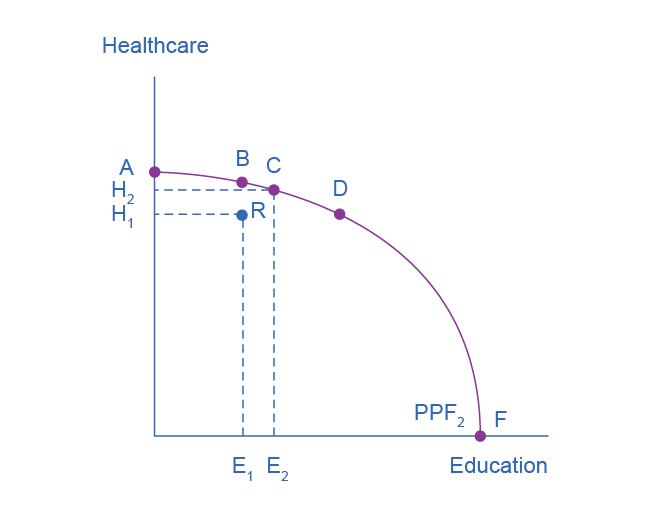
A PPF shows the maximum combinations of two goods an economy can produce when all resources are fully and efficiently employed.
| Position | Meaning |
|---|---|
| On the curve | Productively efficient: output of one good cannot rise without the other falling |
| Inside the curve | Inefficient: unemployed or misallocated resources |
| Outside the curve | Currently unattainable |
- Movement along the curve shows opportunity cost.
- An outward shift shows economic growth, more or better resources, or improved technology.
- The curve is drawn concave to the origin because resources are not equally suited to both uses, so shifting them into an unsuitable use means giving up progressively more of the other good: increasing opportunity cost.
Edexcel frequently uses the PPF to distinguish capital goods from consumer goods: moving resources towards capital goods sacrifices consumption now but shifts the PPF outward later.
Specialisation and the division of labour
Specialisation is concentrating on a narrow range of tasks or products. The division of labour is specialisation applied to workers within a production process, Adam Smith's pin factory.
Advantages: higher output per worker through repetition and practice; less time lost switching tasks; cheaper training because it is narrow; and it makes machinery and economies of scale viable.
Disadvantages: boredom and demotivation lowering quality; workers become occupationally immobile if the industry declines; interdependence means one break halts the whole chain; and mass production offers less variety.
Applied to countries, specialisation is the basis of international trade (Theme 4).
The functions of money follow directly, because specialisation requires exchange and barter needs a double coincidence of wants:
- A medium of exchange: accepted in payment, so trade need not be barter.
- A measure of value (unit of account): prices can be compared.
- A store of value: purchasing power can be held over time, though inflation erodes this.
- A method of deferred payment: debts can be denominated and settled later.
Economic systems
| System | Allocation | Strengths | Weaknesses |
|---|---|---|---|
| Free market | Price mechanism; private ownership | Efficiency, choice, innovation, consumer sovereignty | Market failure, inequality, no public goods |
| Command | Central planning; state ownership | Can prioritise equity and public goods | No price signals, inefficiency, weak innovation incentives, restricted choice |
| Mixed | Both | Combines market efficiency with correction of market failure | Risk of government failure; the right balance is contested |
Edexcel expects reference to Adam Smith (the invisible hand and the case for markets), Friedrich Hayek (the impossibility of central planners holding the dispersed knowledge that prices convey), and Karl Marx (the critique of market capitalism and its distribution of income). Almost every real economy is mixed; the debate is over where the boundary sits.
Worked example
A government reallocates resources from consumer goods towards capital goods, machinery, infrastructure and equipment.
- Resources move along the PPF towards capital goods
- consumption falls today, which is the opportunity cost
- but the extra capital raises productive capacity
- in later years the PPF shifts outward
- both consumption and capital output can then be higher than before.
Evaluation.
- The lost consumption falls on today's households while the gain accrues later, an intergenerational trade-off, and a normative question about how much present welfare to sacrifice.
- The gain depends on the capital being productive. Infrastructure chosen for political reasons may not shift the PPF at all.
- If the economy was operating inside the PPF, output of both goods could have risen with no sacrifice, so the trade-off only bites at full employment.
- The time horizon matters: over five years the sacrifice dominates; over twenty-five the capacity gain does.
Judgement: the reallocation is justified if the discounted future gain exceeds the consumption forgone, but whether that trade is worth making is a value judgement, not a positive result.
Common exam mistakes
- Confusing positive and normative, look for "should" and "ought".
- Assuming a positive statement must be true; it only has to be testable.
- Treating a point inside the PPF as unattainable rather than inefficient.
- Saying resources are unlimited; it is wants that are unlimited.
- Defining opportunity cost as all forgone alternatives rather than the next best.
- Listing the functions of money without connecting them to specialisation and exchange.
- Describing a command economy without explaining why it is inefficient, the absence of price signals.
Exam technique
Define terms in Edexcel's exact wording, especially "next best alternative forgone", the knowledge marks turn on precision.
Use the PPF diagram wherever opportunity cost, efficiency or growth is at issue, labelling both axes and marking the movement or shift.
In evaluation, separate the positive analysis from the normative judgement, and say explicitly which part of your answer is a value judgement. That is a reliable route into the higher evaluation bands on 1.1 questions.
Quick revision
- Economics uses models and _ceteris paribus_ because it cannot run experiments.
- Positive = testable. Normative = value judgement, signalled by "should".
- Scarcity → choice → opportunity cost; opportunity cost is the next best alternative forgone.
- Factors of production: land, labour, capital, enterprise.
- PPF: on = efficient, inside = spare capacity, outside = unattainable. Concave shape = increasing opportunity cost.
- Division of labour raises productivity but causes boredom, immobility and interdependence.
- Money: medium of exchange, measure of value, store of value, method of deferred payment.
- Systems: free market (Smith, Hayek), command (Marx), mixed, almost all real economies.
Check you have it
Question 1
Which one of the following economic thinkers supported the idea of a command economy?
Answer: D.
Adam Smith is incorrect as he is the "father of economics" who championed free-market capitalism and the "invisible hand." Friedrich Hayek is also incorrect; he was a staunch critic of central planning, arguing that it leads to inefficiency and a loss of personal freedom. John Maynard Keynes is incorrect because, while he supported government intervention to manage aggregate demand during recessions, he still believed in a mixed economy rather than a system where the state completely dictates all production and distribution decisions.
What the syllabus asks for on this topicSpecification points
Specification points
- Economics as a social science and the use of models (ceteris paribus).
- Positive and normative economic statements.
- The economic problem: scarcity, choice and opportunity cost.
- Production possibility frontiers (PPFs).
- Specialisation and the division of labour; functions of money.
- Free market, mixed and command economies.
Related Edexcel A-Level topics
Not the topic you were looking for? Describe what you are stuck on in your own words and we will take you to the notes that answer it.