How Markets Work
Contents: 12 sections
Rational decision-making
Conventional theory assumes agents are rational: consumers maximise utility, firms maximise profit, workers maximise net advantage, and governments maximise social welfare.
Diminishing marginal utility, each extra unit yields less satisfaction, is why the demand curve slopes downwards: consumers will only buy more if the price falls.
Edexcel also expects awareness that rationality often fails in practice, through bounded rationality (people satisfice rather than optimise), habitual behaviour, the influence of social norms, and weakness at computation. This matters because government policy assumes people respond to incentives, and they do so imperfectly.
Demand
Demand is the quantity consumers are willing and able to buy at each price.
The distinction Edexcel tests constantly:
- A change in the good's own price causes a movement along the curve, an extension or contraction.
- A change in anything else shifts the curve.
Shifters (PIRATES): Population, Income, Related goods (substitutes and complements), Advertising and tastes, Taxes and subsidies on consumers, Expectations, Seasons.
Supply
Supply is the quantity producers are willing and able to sell at each price. It slopes upwards because higher prices raise profitability and cover the rising marginal costs of expanding output.
Shifters: costs of production, technology, productivity, indirect taxes and subsidies, the number of firms, weather and shocks, and the prices of goods in joint or competing supply.
Elasticities
Price elasticity of demand
PED = %Δ quantity demanded ÷ %Δ price, negative for a normal demand curve.
| Value | Name |
|---|---|
| 0 | Perfectly inelastic |
| Between 0 and −1 | Inelastic: quantity changes proportionately less |
| −1 | Unit elastic |
| Beyond −1 | Elastic: quantity changes proportionately more |
Determinants (SPLAT): Substitutes, Proportion of income, Luxury or necessity, Addictiveness, Time.
The revenue link is the highest-value application:
| Price rises | Price falls | |
|---|---|---|
| Inelastic demand | Revenue rises | Revenue falls |
| Elastic demand | Revenue falls | Revenue rises |
Income elasticity of demand
YED = %Δ quantity demanded ÷ %Δ income
Positive = normal good; above 1 = luxury; between 0 and 1 = necessity; negative = inferior good. YED matters for firms planning through the economic cycle: luxury producers boom and slump, necessity producers are stable.
Cross elasticity of demand
XED = %Δ Qd of A ÷ %Δ price of B
Positive = substitutes; negative = complements; zero = unrelated. The larger the modulus, the closer the relationship.
Price elasticity of supply
PES = %Δ quantity supplied ÷ %Δ price, positive.
Determinants: time period (the most important), spare capacity, stocks, factor mobility and production lags. Supply is far more elastic in the long run.
Working the numbers
Edexcel sets these as calculations, and the interpretation carries more marks than the arithmetic.
PED. Price rises from £4 to £5; quantity demanded falls from 800 to 700.
%ΔP = 1 ÷ 4 × 100 = +25%; %ΔQd = −100 ÷ 800 × 100 = −12.5%
PED = −12.5 ÷ 25 = −0.5 → inelastic
Verify against revenue, which is the point of the calculation: £4 × 800 = £3,200 before, £5 × 700 = £3,500 after. Revenue rose, exactly as inelastic demand predicts. Quantify by multiplying the factors, 1.25 × 0.875 = 1.09, a 9% rise, rather than adding the percentages, which gives the right direction and the wrong number.
YED. Incomes rise 4%; demand for a supermarket's value range falls 2%.
YED = −2 ÷ 4 = −0.5 → negative, so an inferior good.
The sign is the whole answer, and it carries a real planning implication: this product line grows in a recession and shrinks in a recovery.
XED. The price of rail travel rises 8%; demand for coach travel rises 6%.
XED = 6 ÷ 8 = +0.75 → positive, so substitutes, and fairly close ones.
PES. Price rises 25%; quantity supplied rises 10%.
PES = 10 ÷ 25 = 0.4 → inelastic supply, so this producer cannot respond quickly to a price rise.
Put the last two together and the market's behaviour follows: with PED = −0.5 and PES = 0.4, both sides are inelastic, so any shift in either curve lands mostly on price rather than quantity. That is the analysis; the four numbers on their own are not.
Price determination and the price mechanism
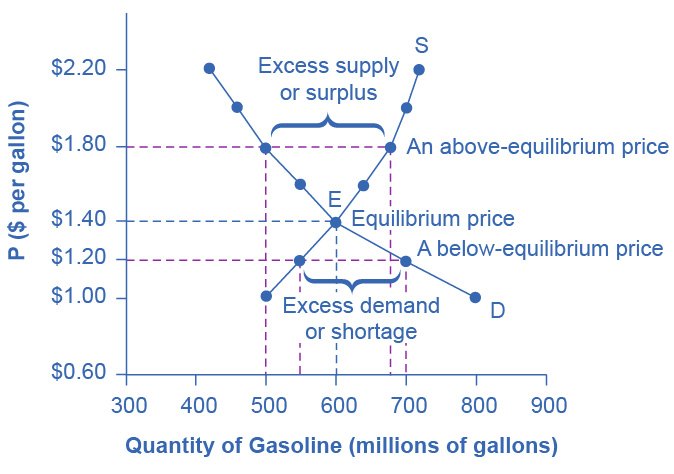
Equilibrium is where quantity demanded equals quantity supplied.
| State | Condition | Adjustment |
|---|---|---|
| Excess supply | Price above equilibrium | Unsold stock → firms cut price → equilibrium restored |
| Excess demand | Price below equilibrium | Shortages → sellers raise price → equilibrium restored |
The three functions of the price mechanism, Edexcel's exact terms:
- Rationing: a rising price allocates scarce goods to those willing and able to pay most.
- Incentive: a higher price makes supply more profitable, so producers supply more and firms enter.
- Signalling: prices carry information about relative scarcity to both sides of the market.
Together they reallocate resources in line with consumer sovereignty.
Consumer and producer surplus
- Consumer surplus: the area below the demand curve and above the price: what consumers were willing to pay minus what they actually paid.
- Producer surplus: the area above the supply curve and below the price: the price received minus the minimum acceptable.
- Community surplus = the two combined, and it is maximised at the competitive equilibrium when there are no externalities.
Indirect taxes and subsidies
An indirect tax raises costs, shifting supply left (upward by the tax).
- Price rises, quantity falls
- consumer and producer surplus both fall
- part is transferred to the government as revenue
- part is lost entirely as deadweight loss, representing mutually beneficial trades that no longer occur.
A subsidy shifts supply right: price falls, quantity rises, both surpluses rise, but the government's cost exceeds the combined gain, so there is again a deadweight loss unless the subsidy is correcting a positive externality.
Incidence, who actually bears the tax or captures the subsidy, depends on relative elasticity:
The more inelastic side of the market bears the larger share of a tax and captures the larger share of a subsidy.
Working a tax
A market sits at £10 with 1,000 units traded. A £2 per-unit tax raises the consumer price to £11.50; producers keep £9.50; quantity falls to 900.
Government revenue = £2 × 900 = £1,800
Consumer burden = £1.50 × 900 = £1,350
Producer burden = £0.50 × 900 = £450
Deadweight loss = ½ × £2 × 100 = £100
Check the burdens sum to the revenue: £1,350 + £450 = £1,800. They must, because every pound collected comes out of one side or the other, and if yours do not add up, one of the prices has been read off the wrong curve.
Consumers bear 75% of the burden, so demand is the more inelastic side here. Note also that the consumer price rose by £1.50, not the full £2: a price rise equal to the whole tax happens only when demand is perfectly inelastic, and many answers draw the £2 shift correctly and then describe a £2 price rise.
Worked example
A government imposes a specific indirect tax on cigarettes.
- The tax raises firms' costs
- supply shifts left
- price rises and quantity falls.
Why the outcome depends on PED:
- Demand is highly inelastic, few substitutes, addictive, a small share of income for most smokers.
- Quantity therefore falls proportionately less than price rises → consumption barely falls but tax revenue rises substantially.
- Because demand is inelastic relative to supply, most of the incidence falls on consumers.
- The deadweight loss is small, precisely because quantity changes little.
Evaluation.
- The policy succeeds as a revenue measure and largely fails as a short-run consumption measure, an inherent tension, since a tax that genuinely stopped people smoking would raise little revenue.
- It is regressive, taking a larger share of income from poorer smokers.
- It may create a black market, so measured consumption falls more than actual consumption.
- In the long run PED rises as substitutes emerge and habits change, so consumption falls further than short-run data suggests.
- If the good generates negative externalities, the free-market equilibrium was never efficient, and the "deadweight loss" is actually an efficiency gain, the analysis changes sign entirely (1.3).
Judgement: with inelastic demand, taxation is an efficient revenue instrument and a weak short-run behavioural one. Pairing it with information provision and substitutes, both of which raise PED, makes the consumption objective attainable.
Common exam mistakes
- Confusing a movement along with a shift.
- Dropping the sign in YED and XED, where the sign carries the meaning.
- Saying an elasticity is "high" without comparing it to 1.
- Treating "inferior good" as low quality; it means demand falls as income rises.
- Reversing the surplus areas, consumer surplus is below demand, above price.
- Treating government tax revenue as part of the deadweight loss; it is a transfer.
- Ignoring elasticity when discussing tax incidence.
Exam technique
Draw the diagram and label everything: both equilibria, the price consumers pay, the price producers receive, and the shaded areas for surplus, revenue and deadweight loss. Most of the analysis marks are attached to correctly identified areas.
Show the elasticity formula, substitute, and then interpret, the interpretation carries the marks, not the arithmetic.
For evaluation, the reliable angles are the time period (elasticities rise in the long run), the reliability of the elasticity estimate, and whether the original equilibrium was efficient at all.
Quick revision
- Own price → movement along. Anything else → shift.
- PED determinants: SPLAT. Inelastic → raise price to raise revenue.
- YED: positive = normal, above 1 = luxury, negative = inferior.
- XED: positive = substitutes, negative = complements.
- PES: time period, spare capacity, stocks, mobility, production lags.
- Price mechanism: rationing, incentive, signalling.
- Consumer surplus below demand above price; producer surplus above supply below price.
- Indirect tax → both surpluses fall, part transfers to government, part is deadweight loss.
- Incidence falls mainly on the more inelastic side.
Check you have it
Question 1
Estimates for the demand for black tea in the UK suggest that it is an inferior good. This implies it has a negative:
Answer: B.
The other options are incorrect because they measure different types of responsiveness. A) Cross elasticity of demand (XED) measures how the demand for one good changes when the price of a different good changes. C) Price elasticity of demand (PED) measures how quantity demanded responds to a change in the product’s own price. Finally, D) Price elasticity of supply (PES) measures how the quantity supplied by firms responds to a change in the market price. None of these relate to the relationship between consumer income and the quantity demanded of a specific good.
Question 2
Assume ‘Bettys’ merges with a major tea leaf supplier. Which one of the following is most likely to be an advantage as a result of this merger?
Answer: B.
Question 3
Which one of the following is an example of government failure associated with the maximum price?
Answer: B.
Options A, C, and D are incorrect because they describe market outcomes rather than government failure. A contraction in demand (A), excess supply (C), and an extension in supply (D) are simply the mechanical changes in quantity that result from price interventions; they are market responses to the price change, not the failure of the government's intervention itself.
What the syllabus asks for on this topicSpecification points
Specification points
- Rational decision-making; demand and the factors affecting it.
- Price, income and cross elasticities of demand (PED, YED, XED).
- Supply and the factors affecting it; price elasticity of supply (PES).
- Price determination and the price mechanism.
- Consumer and producer surplus; the impact of indirect taxes and subsidies.
Related Edexcel A-Level topics
Not the topic you were looking for? Describe what you are stuck on in your own words and we will take you to the notes that answer it.