The Labour Market
Contents: 13 sections
The demand for labour
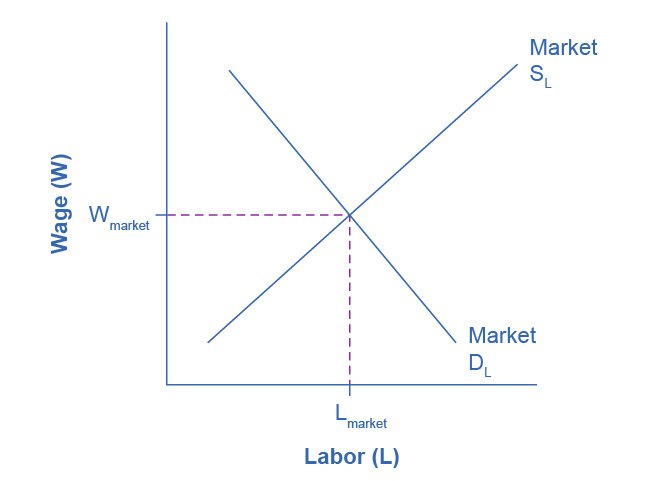
Labour demand is derived demand, firms want workers not for their own sake but for the output they produce. If demand for the product falls, demand for the labour that makes it falls with it.
A profit-maximising firm hires up to where the marginal revenue product of labour equals the wage.
MRP = marginal physical product × marginal revenue
MRP slopes downwards because of the law of diminishing returns (3.3): with capital fixed, each extra worker adds less physical output than the last.
The hiring rule: employ up to where MRP = wage. Below that point the worker adds more revenue than they cost; beyond it they cost more than they contribute.
Determinants: demand for the final product, labour productivity, the price of capital (a substitute or a complement), and the wage itself.
Elasticity of labour demand is higher when:
- The product's PED is high, so cost rises cannot be passed on.
- Labour is a large proportion of total costs.
- Capital substitutes easily for labour.
- The time period is long.
The supply of labour
Supply to an occupation slopes upwards: a higher wage attracts workers from other occupations and induces longer hours.
Determinants: the wage; wages in alternatives; non-monetary characteristics (danger, hours, status, satisfaction); qualifications and training required; barriers such as professional licensing; population size and migration; and social attitudes.
Elasticity of labour supply is low where training is long and qualifications demanding, which is why the supply of surgeons cannot expand quickly, and why their wages are high.
Mobility matters throughout: occupational immobility (lacking the skills to move between jobs) and geographical immobility (housing costs, family ties, information gaps) both prevent wages equalising, and cause structural unemployment.
Wage determination in a competitive labour market
With many small employers and many workers, no participant can influence the wage.
- The market wage is set where labour demand meets labour supply
- each firm is a wage taker facing a perfectly elastic supply of labour at that wage
- so wage = ACL = MCL
- and the firm employs where MRP = wage.
Workers are paid exactly the value of what they contribute at the margin, the allocatively efficient outcome.
Monopsony
A monopsony is a single or dominant buyer of labour, a large public employer, or the only significant employer in a town.
Because it is large relative to the market it faces the upward-sloping market supply curve. To attract one more worker it must raise the wage, and, if it cannot discriminate, raise it for everyone already employed.
Therefore MCL lies above ACL, exactly as MR lies below AR for a monopolist.
- The monopsonist hires where MRP = MCL, then reads the wage down to the supply (ACL) curve
- lower employment and a lower wage than in a competitive market
- workers are paid less than their MRP, which is exploitation in the technical sense, and there is a welfare loss.
Trade unions
In a competitive labour market, a union raising the wage above equilibrium creates excess supply of labour, higher wages for those employed, at the cost of fewer jobs. The employment loss is larger where labour demand is elastic.
In a monopsonistic labour market the result reverses, the highest-value analysis in this topic:
- A union facing a monopsonist creates a bilateral monopoly
- it can raise the wage towards the competitive level
- the employer can no longer depress the wage by restricting hiring, so the effective MCL becomes flat at the negotiated wage
- both the wage AND employment can rise.
Union power depends on membership density, the elasticity of labour demand (the more inelastic, the more it can extract), the firm's profitability, the legal framework, and the macroeconomic climate.
Unions may also raise productivity, through worker voice, lower turnover and negotiated training, shifting MRP right and raising wages without costing jobs.
The national minimum wage
A legal price floor set above the equilibrium wage.
The standard analysis: it creates excess supply, more workers want jobs at that wage than firms wish to hire, so unemployment results, concentrated among the low-skilled and the young, and larger where labour demand is elastic.
The counter-arguments:
- Under monopsony, a minimum wage set between the monopsony and competitive wage raises both wages and employment.
- Higher pay may raise motivation and productivity (efficiency wage theory), shifting MRP right.
- Lower turnover cuts recruitment and training costs.
- Higher incomes for low earners raise consumption, and with a high MPC this raises AD and hence derived demand for labour.
- It reduces in-work poverty and the cost of in-work benefits.
The judgement turns on the level at which it is set and how much monopsony power employers hold.
Wage differentials
- Different MRP: skills, education and the value of the output.
- Different elasticity of supply: long training and licensing restrict supply and raise pay.
- Compensating differentials: dangerous or unpleasant work pays more, other things equal.
- Immobility of labour, occupational and geographical.
- Trade union power in some occupations but not others.
- Discrimination, lowering demand for or pay of particular groups regardless of MRP.
- Imperfect information about jobs and pay.
Working the numbers
Marginal revenue product is what a firm is actually buying when it hires, and it decides the wage it will pay.
MRP = marginal physical product × marginal revenue (= price, for a firm selling in a competitive market)
A firm sells its output at £8 a unit:
| Workers | Total output | MPP | MRP (at £8) |
|---|---|---|---|
| 1 | 12 | 12 | £96 |
| 2 | 26 | 14 | £112 |
| 3 | 38 | 12 | £96 |
| 4 | 46 | 8 | £64 |
| 5 | 50 | 4 | £32 |
Hire while MRP ≥ the wage. At a market wage of £70:
Worker 3 adds £96 ≥ £70 → hire. Worker 4 adds £64 < £70 → do not.
The firm employs 3 workers.
Note that MPP rises then falls, the second worker is the most productive through specialisation, and diminishing returns set in from the third. MRP falls for the same reason, which is why the labour demand curve slopes downward.
If the firm had market power in its product market, MR would be below price and falling, so MRP would decline for two reasons at once, diminishing returns and falling marginal revenue. It would therefore hire fewer workers than a competitive firm with identical technology.
Raise the wage to £100 and the firm employs only 2: worker 3's £96 no longer covers it. That is the labour demand curve in numbers, and the standard argument against setting a minimum wage above the market rate, though it is qualified where the employer holds monopsony power.
Worked example
A government raises the national minimum wage significantly in a region where one large employer dominates local hiring.
The competitive prediction:
- The floor sits above the competitive equilibrium
- quantity demanded falls, quantity supplied rises
- excess supply, i.e. unemployment
- the low-skilled are hit hardest, since their MRP is closest to the new wage.
The monopsony prediction:
- The dominant employer was hiring where MRP = MCL and paying below MRP
- the minimum wage removes its ability to depress pay by restricting hiring
- effective MCL becomes horizontal at the legal wage
- the firm now hires where MRP = the minimum wage
- both wage and employment rise, and the exploitation gap closes.
Evaluation.
- Which prediction holds depends on the degree of monopsony power and where the wage is set. Between the monopsony and competitive wage, employment rises; above the competitive wage, it falls.
- The elasticity of labour demand governs the size of any job losses.
- Firms may substitute capital for labour, cut hours rather than headcount, or raise prices, so measured unemployment understates the adjustment.
- Empirical studies of real minimum wages consistently find smaller employment effects than the competitive model predicts, which is itself evidence that monopsony power is widespread.
Judgement: a moderate minimum wage in a monopsonistic labour market raises pay and employment together; an aggressive one in a competitive market with elastic demand costs jobs. The policy is not right or wrong in principle, it depends on the level and the market structure.
Common exam mistakes
- Forgetting that labour demand is derived.
- Confusing MRP with marginal physical product, MRP is measured in revenue.
- Drawing MCL below ACL for a monopsonist; it must be above.
- Reading the monopsonist's wage off the MRP curve instead of down to the supply curve.
- Claiming a minimum wage always causes unemployment, ignoring monopsony and efficiency wages.
- Saying unions always cost jobs, under monopsony they can raise wages and employment.
- Explaining wage differentials only by MRP, ignoring elasticity of supply and immobility.
Exam technique
State whether the market is competitive or monopsonistic before drawing anything, the entire analysis and conclusion follow from it.
For monopsony, label MRP, ACL and MCL, mark the intersection of MRP and MCL, then drop down to ACL for the wage, and shade the gap as exploitation.
For any minimum wage or union question, give both models and then judge between them using elasticity, the level of the wage and the empirical evidence. That two-model structure is what top answers do.
Quick revision
- Labour demand is derived; hire where MRP = wage.
- MRP = marginal physical product × marginal revenue; falls due to diminishing returns.
- Labour demand more elastic when product PED is high, labour is a big share of costs, and capital substitutes easily.
- Competitive market: wage = ACL = MCL; workers paid their MRP.
- Monopsony: MCL above ACL, hires where MRP = MCL, pays down on the supply curve → lower wage and employment, workers paid below MRP.
- Unions in a competitive market: higher wage, fewer jobs. Against a monopsonist: higher wage and more jobs.
- Minimum wage: unemployment in a competitive market; higher wages and employment under monopsony.
- Differentials: MRP, elasticity of supply, compensating differentials, immobility, union power, discrimination.
Check you have it
Question 1
The UK hair and beauty industry is an example of monopolistic competition because:
Answer: D.
Options A, B, and C are incorrect because they describe different market structures. Firms in this industry spend heavily on advertising and research to differentiate their services, contradicting A. The industry consists of many small-to-medium-sized providers rather than a few large firms, making B incorrect. Finally, C is wrong because hair and beauty services are highly differentiated, through unique branding, staff expertise, or location, rather than being homogenous, which is a feature of perfect competition.
What the syllabus asks for on this topicSpecification points
Specification points
- The demand for and supply of labour; wage determination.
- Elasticity of demand and supply of labour.
- Labour market imperfections: monopsony, trade unions and the minimum wage.
Related Edexcel A-Level topics
Not the topic you were looking for? Describe what you are stuck on in your own words and we will take you to the notes that answer it.