The Financial Sector
Contents: 9 sections
The role of financial markets
Financial markets exist to move funds from those who have a surplus (savers) to those who need them (borrowers and investors). Edexcel lists six functions, and naming them precisely is worth marks:
- To facilitate saving: providing secure places to store purchasing power.
- To lend to businesses and individuals: channelling savings into investment and consumption.
- To allow the exchange of goods and services: payment systems, current accounts, cards.
- To provide forward markets in currencies and commodities, allowing firms to fix a price today for a transaction in the future, and so to hedge against price and exchange rate risk.
- To provide a market for equities: allowing firms to raise capital by selling shares, and shareholders to sell them on.
- To insure against risk, pooling risk across many participants.
Without these, saving would not translate into investment, firms could not manage risk, and the savings gap would bind (4.3).
Money markets deal in short-term debt; capital markets in long-term debt and equity; foreign exchange markets in currencies.
Market failure in the financial sector
Asymmetric information (1.3). Borrowers know more about their own creditworthiness than lenders, and sellers of financial products know more than buyers. This produces:
- Adverse selection: the riskiest borrowers are the keenest to borrow at any given rate, so raising rates worsens the pool of applicants.
- Moral hazard: being protected from a risk changes behaviour. Banks that expect a bailout because they are too big to fail take more risk than they otherwise would, since gains are private while losses are socialised.
Externalities. Bank failure imposes enormous costs on third parties who were never party to the transaction, the systemic risk the 2008 crisis exposed. The private cost of a bank's risk-taking is far below its social cost, so MSC > MPC and too much risk is taken.
Speculation and market bubbles. Prices can move far from fundamentals when participants buy because they expect others to buy. Herding and extrapolative expectations amplify the movement, and the correction imposes costs across the whole economy.
Market rigging. Participants can collude to manipulate benchmark rates and prices, LIBOR being the standard example, which is a straightforward abuse of market power.
Monopoly power. A concentrated banking sector can charge excessive fees and offer poor rates.
The role of central banks
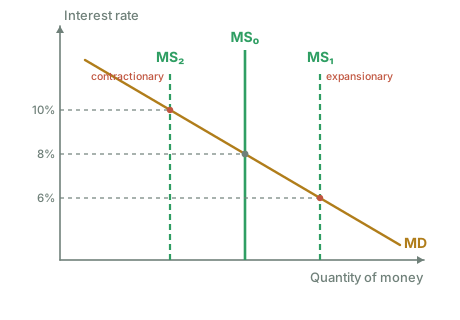
1. Implementation of monetary policy. Setting Bank Rate and conducting quantitative easing to meet the 2% CPI symmetric inflation target set by the government. Operational independence since 1997 makes the commitment to low inflation credible, so expectations stay anchored.
- The transmission runs: Bank Rate
- market rates
- consumption, investment, asset prices and wealth, and the exchange rate
- AD.
2. Banker to the government, managing the government's accounts and its debt issuance.
3. Banker to the banks and lender of last resort. In a liquidity crisis the central bank lends to solvent but illiquid banks, preventing a solvency problem at one institution becoming a system-wide collapse. This is essential, and it is also the source of the moral hazard above, which is why it is paired with regulation.
4. Regulation of the financial system. In the UK the Financial Policy Committee conducts macroprudential regulation, using tools that act on the system rather than on the interest rate:
- Capital requirements: banks must hold a minimum ratio of capital to risk-weighted assets, so losses are absorbed by shareholders rather than depositors or taxpayers.
- Liquidity requirements: holdings of assets that can be sold quickly.
- Loan-to-value and loan-to-income limits on mortgage lending, restraining credit growth without raising Bank Rate for the whole economy.
- Stress testing: modelling whether banks would survive a severe downturn.
- Ring-fencing retail banking from investment banking, so ordinary deposits are not exposed to trading losses.
The virtue of macroprudential tools is that they are targeted: they can cool a housing bubble without the blunt instrument of a rate rise that would hit every borrower and every firm.
Working the numbers
Credit creation. Banks hold a fraction of deposits as reserves and lend the rest, and the lending returns as new deposits.
With a reserve ratio of 10% and an initial deposit of £1,000:
| Round | Deposit | Held as reserves | Lent on |
|---|---|---|---|
| 1 | £1,000 | £100 | £900 |
| 2 | £900 | £90 | £810 |
| 3 | £810 | £81 | £729 |
Credit multiplier = 1 ÷ 0.10 = 10
Total deposits = £1,000 × 10 = £10,000, of which £9,000 is newly created
Two qualifications the exam wants. It is a maximum: banks holding excess reserves voluntarily, or customers holding cash rather than redepositing, both shrink it. And it is why a run on confidence contracts credit so violently, the same multiplier works in reverse.
Bond prices and interest rates move inversely. A bond paying £50 a year costs £1,000 when the market rate is 5%. If the market rate rises to 8%:
Price ≈ £50 ÷ 0.08 = £625
Nobody pays £1,000 for a £50 income they could buy for £625 elsewhere, so the old bond's price falls until its return matches the market. This is also why quantitative easing works: the central bank buying bonds bids their price up, which is the same event as yields coming down.
Real returns. A saver offered 3% with inflation at 4.5%:
Real interest rate = 3.0 − 4.5 = −1.5%
The saver loses purchasing power despite positive nominal interest, which is the clearest illustration of why the real rate, not the nominal one, drives saving and borrowing decisions.
Worked example
A period of very low interest rates encourages rapid growth in mortgage lending, and house prices rise sharply.
- Cheap credit raises demand for housing
- prices rise
- rising prices encourage buyers to expect further rises
- speculative demand enters
- prices move further above what incomes and rents justify
- a bubble forms.
Banks lending against inflated collateral appear well secured, so they lend more, the feedback loop that makes credit cycles self-reinforcing. Meanwhile moral hazard operates: banks that believe they are too big to fail underprice the risk, because the downside is socialised.
- When the correction comes, collateral values fall below loan values
- banks restrict lending
- firms and households cannot borrow
- AD falls
- the costs fall on third parties who never took part, a substantial negative externality.
Policy response and evaluation.
- Raising Bank Rate would cool the market, but it is a blunt instrument, hitting every borrower and every firm, and would be inappropriate if inflation elsewhere is at target.
- Macroprudential tools are better targeted: loan-to-income limits restrain mortgage lending specifically, leaving the rest of the economy untouched. This is precisely the case for having tools separate from the interest rate.
- Higher capital requirements make banks more resilient and internalise some of the risk, but they also reduce lending capacity, which may slow growth. The trade-off is stability versus credit availability.
- Regulatory failure is a live risk: the regulator has less information than the banks, and regulatory capture is possible in a sector with concentrated expertise and heavy lobbying (3.6).
- Identifying a bubble in advance is genuinely difficult, high prices may reflect real shifts in supply and demand. Acting on a misdiagnosis imposes costs of its own, which is a strong argument for caution rather than inaction.
Judgement: the market failure is real and the externalities large, so intervention is justified. Macroprudential tools are preferable to the interest rate because they are targeted, but their effectiveness is limited by the regulator's information disadvantage, which argues for resilience measures such as capital requirements, which work whether or not the bubble is correctly identified.
Common exam mistakes
- Listing fewer than the six functions of financial markets, or omitting forward markets and hedging, which are the ones most often forgotten.
- Confusing adverse selection (before the transaction) with moral hazard (after it).
- Saying the central bank sets the inflation target, the government sets it, the Bank meets it.
- Confusing monetary policy (Bank Rate, QE) with macroprudential regulation (capital ratios, LTV limits).
- Treating "too big to fail" as a description rather than a moral hazard problem.
- Ignoring the externality framing, bank failure imposes costs on third parties, which is why this is market failure rather than just bad luck.
- Presenting regulation as costless, ignoring reduced lending capacity and regulatory capture.
Exam technique
Name the specific function or specific regulatory tool rather than referring generally to "the financial system". Precision separates the bands here.
Frame every failure in the standard market-failure vocabulary from Theme 1, asymmetric information, externalities, moral hazard, market power. Doing so makes the analysis synoptic, which is exactly what Theme 4 rewards.
For evaluation, use the stability versus growth trade-off, the regulator's information disadvantage, regulatory capture, and the difficulty of identifying a bubble before it bursts.
Quick revision
- Six functions: facilitate saving; lend; enable exchange; forward markets for hedging; a market for equities; insure against risk.
- Money markets = short-term; capital markets = long-term debt and equity.
- Failures: asymmetric information (adverse selection, moral hazard), externalities and systemic risk, speculation and bubbles, market rigging, monopoly power.
- Too big to fail creates moral hazard: gains private, losses socialised.
- Central bank roles: monetary policy, banker to the government, lender of last resort, regulation.
- Macroprudential tools: capital and liquidity requirements, LTV and loan-to-income limits, stress tests, ring-fencing.
- Macroprudential tools are targeted; Bank Rate is blunt.
- Trade-off: financial stability versus credit availability and growth.
Check you have it
Question 1
Which one of the following is a role of financial markets?
Answer: C.
What the syllabus asks for on this topicSpecification points
Specification points
- The role of financial markets and the reasons they exist.
- Market failure in the financial sector.
- The role of central banks.
Related Edexcel A-Level topics
Not the topic you were looking for? Describe what you are stuck on in your own words and we will take you to the notes that answer it.