Market Failure
Contents: 11 sections
What market failure means
Market failure occurs when the free market misallocates resources, producing too much or too little of a good relative to the socially optimal quantity, so welfare is not maximised.
The efficient outcome requires MSB = MSC. Market failure exists wherever private decisions diverge from that condition.
Complete market failure, the market supplies none of the good (a missing market, e.g. public goods).
Partial market failure, the good is supplied, but in the wrong quantity.
Externalities
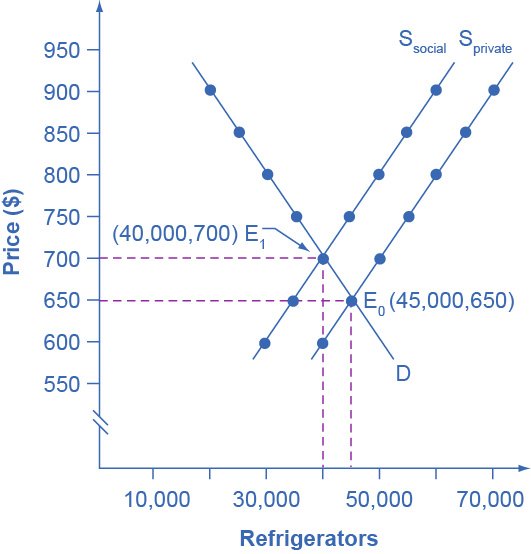
An externality is a cost or benefit affecting a third party not involved in the transaction.
- Private cost/benefit: falls on the producer or consumer directly.
- External cost/benefit: falls on third parties.
- Social cost/benefit = private + external.
MSC = MPC + external cost. MSB = MPB + external benefit.
The four cases:
| Type | Divergence | Outcome | Example |
|---|---|---|---|
| Negative externality of production | MSC > MPC | Over-production; welfare loss | Factory pollution |
| Negative externality of consumption | MSB < MPB | Over-consumption; welfare loss | Smoking, driving |
| Positive externality of production | MSC < MPC | Under-production | A firm training workers who later move on |
| Positive externality of consumption | MSB > MPB | Under-consumption | Vaccination, education |
In each case the welfare loss triangle lies between the private and social curves, over the gap between the free-market quantity and the social optimum. Identifying that triangle correctly is where the diagram marks are.
Why externalities arise: the price mechanism transmits only private costs and benefits (1.2), so third-party effects are invisible to the decision-maker. A closely related cause is missing property rights, nobody owns the atmosphere, so nobody charges for polluting it. Where a resource is commonly owned and freely accessible, it tends to be over-exploited: the tragedy of the commons, which explains overfishing and deforestation.
Public goods
Public goods have two defining characteristics:
- Non-excludable: those who have not paid cannot be prevented from consuming.
- Non-rival: one person's consumption does not reduce the amount available to others.
Non-excludability produces the free-rider problem: consumers can benefit without paying, so they have no incentive to pay, so no firm can profitably supply it, so the market supplies nothing at all. This is complete market failure, and it is the strongest justification for state provision funded by taxation.
Examples: national defence, street lighting, flood defences, lighthouses, policing.
Quasi-public goods are partly excludable or partly rival, roads (excludable with tolls, rival when congested), beaches, public parks. Technology can change the classification: broadcast television was once non-excludable, and encryption made it excludable.
Merit and demerit goods, and information gaps
These are defined by information failure, not by externalities, though they usually generate externalities too.
- Merit goods are under-consumed because individuals underestimate the private benefit, education, healthcare, pensions, insurance. The benefit is long-term and uncertain, so people discount it.
- Demerit goods are over-consumed because individuals underestimate the private cost, tobacco, alcohol, gambling, junk food. The harm is delayed and probabilistic.
Judging a good to be merit or demerit is a value judgement (1.1): it asserts that the state knows the individual's interest better than they do, which is why intervention here is contested.
Symmetric and asymmetric information:
- Symmetric information: both parties know the same, the assumption behind efficient markets.
- Asymmetric information: one party knows more than the other.
Asymmetric information produces two named problems Edexcel expects:
- Adverse selection: the better-informed party self-selects. Only high-risk people buy insurance, so premiums rise, so low-risk people leave, and the market can unravel. The used-car "market for lemons" is the classic case.
- Moral hazard: being protected from a risk changes behaviour, so the insured take more risk, and banks that expect a bailout lend more recklessly.
Market imperfections and inequality
- Monopoly power restricts output and sets P > MC, so allocative efficiency fails (3.4).
- Factor immobility: occupational and geographical, prevents resources moving to where they are most valued, and causes structural unemployment.
- Inequality: the market rations by ability to pay, so an efficient allocation can still leave people without necessities. Note carefully that this is a failure of equity, not of efficiency, a distinction Edexcel rewards.
Working the numbers
Putting a figure on the welfare loss turns a shaded triangle into an answer.
A chemical plant imposes a marginal external cost of £12 per tonne. The free market produces 5,000 tonnes; the socially optimal output is 4,200.
Welfare loss = ½ × £12 × (5,000 − 4,200) = £4,800
The corrective tax = £12 per tonne, the marginal external cost at the optimum, which raises MPC to MSC and cuts output to 4,200.
The triangle's height is the external cost per unit and its base is the over-production. Getting those the right way round is the whole calculation.
The positive case is the mirror. Vaccination generates an external benefit of £9 per dose; the market provides 30,000 doses against a social optimum of 38,000.
Welfare loss = ½ × £9 × (38,000 − 30,000) = £36,000
The correction is a subsidy of £9 per dose.
Two differences to state explicitly, because that is where the marks separate: the failure is under-provision rather than over-provision, and the triangle sits to the right of the market quantity rather than the left. The arithmetic is identical; only the direction reverses.
Worked example
A coal-fired power station emits pollution that damages health and crops nearby.
- The firm pays only its private costs, fuel, labour, capital
- the pollution imposes external costs on residents and farmers
- so MSC > MPC
- the firm produces where MPB = MPC, to the right of the social optimum where MSB = MSC
- over-production, and a welfare loss equal to the triangle between MSC and MSB over the excess output.
Why the market cannot correct this itself:
- The atmosphere has no property rights, so nobody can charge for using it as a dump.
- The damage is spread thinly over thousands of people, so no individual has enough at stake to negotiate or litigate, transaction costs defeat the Coase solution.
- The electricity price therefore understates its true social cost, and consumers over-consume accordingly.
Evaluation.
- Valuing the externality is genuinely difficult. What is the monetary value of a life shortened by air pollution, or of a degraded landscape? Without a reliable figure the size of the welfare loss, and the right corrective tax, cannot be known.
- The time horizon matters: carbon costs fall on future generations, and how heavily they are discounted is a normative choice.
- There are offsetting positive externalities, reliable electricity raises productivity across the whole economy, and the plant provides employment. The net externality is what matters.
- The externality is global for carbon and local for particulates, pointing to different levels of policy response.
Judgement: the market clearly over-produces here, but the scale of the misallocation rests on valuations that are genuinely uncertain, which is why the policy response (1.4) remains contested even when the diagnosis is agreed.
Common exam mistakes
- Confusing negative externalities of production (shift the cost curve) with consumption (shift the benefit curve). Ask who is causing the third-party effect.
- Shading the welfare loss triangle in the wrong place, or omitting it.
- Defining public goods as "goods the government provides", the test is non-excludable and non-rival.
- Confusing merit goods with positive externalities. Merit goods are about information failure and the individual's own benefit.
- Confusing adverse selection (before the transaction) with moral hazard (after it).
- Treating inequality as an efficiency failure rather than an equity issue.
- Forgetting that the free-rider problem causes complete market failure.
Exam technique
Draw the diagram with both private and social curves, mark both equilibria, and shade the welfare loss triangle, that accounts for most of the analysis marks.
State which of the four externality cases applies in your first line; it determines which curve shifts.
For evaluation, use the difficulty of valuing externalities, the time horizon and discounting, the possibility of offsetting externalities of the opposite sign, and the reminder that identifying market failure does not by itself justify intervention (1.4).
Quick revision
- Market failure = misallocation; efficiency requires MSB = MSC.
- MSC = MPC + external cost. MSB = MPB + external benefit.
- Negative externalities → over-production/consumption; positive → under-.
- Public goods: non-excludable + non-rival → free-rider problem → complete market failure.
- Quasi-public goods are partly excludable or rival.
- Merit goods under-consumed, demerit over-consumed, due to information gaps.
- Asymmetric information → adverse selection and moral hazard.
- Tragedy of the commons where property rights are absent.
- Inequality is an equity failure, not an efficiency failure.
Check you have it
Question 1
Which one of the following is an example of government failure associated with the maximum price?
Answer: B.
Options A, C, and D are incorrect because they describe market outcomes rather than government failure. A contraction in demand (A), excess supply (C), and an extension in supply (D) are simply the mechanical changes in quantity that result from price interventions; they are market responses to the price change, not the failure of the government's intervention itself.
What the syllabus asks for on this topicSpecification points
Specification points
- Types of market failure: externalities, public goods and information gaps.
- Positive and negative externalities in production and consumption.
- Merit and demerit goods; the free-rider problem.
- Symmetric and asymmetric information.
Related Edexcel A-Level topics
Not the topic you were looking for? Describe what you are stuck on in your own words and we will take you to the notes that answer it.