Business Growth
Contents: 12 sections
Why firms grow
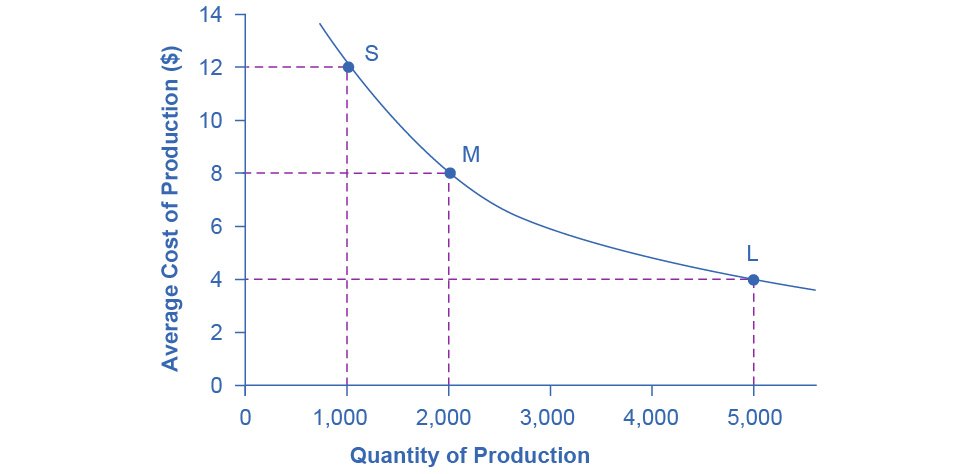
The figure is the central motive for growth made concrete: average cost falling from £12 to £4 as the scale of the plant rises. A firm at the small scale simply cannot match the large one's prices and survive, which is why growth is often a competitive necessity rather than an ambition.
Note that the curve shown is the falling section only. A complete LRAC curve turns flat and then rises as diseconomies of scale set in, the reason the next section exists.
- Economies of scale: larger output lowers long-run average cost (3.3), improving competitiveness and margins.
- Market power: a larger share allows price-setting and reduces the threat from rivals.
- Higher profit in absolute terms, funding investment and rewarding shareholders.
- Risk diversification: spreading across products and markets so a downturn in one does not sink the firm.
- Managerial motives: larger firms pay their managers more and carry more prestige, which is a reason for growth that has nothing to do with shareholder value.
Why firms stay small
Edexcel expects both directions, and "why stay small" is the half candidates neglect:
- Niche markets. Demand is too small to support a large firm, and the profit lies in specialisation.
- Diseconomies of scale set in beyond the minimum efficient scale, so growth would raise unit costs.
- Personalised service is the product, a local restaurant or a bespoke tailor cannot scale without becoming something else.
- Owner objectives: many owners prefer control, independence and a manageable workload to maximum profit.
- Barriers to growth: limited access to finance, especially for firms without collateral or a track record.
- Government support for small firms, such as reliefs and grants.
- Monopsony power of large customers, which can squeeze a small supplier's margins and prevent accumulation.
The principal–agent problem
In small firms the owner is the manager. As firms grow, ownership and control separate: shareholders own the firm but managers run it.
This is the divorce of ownership from control, and it creates a principal–agent problem. The principals (shareholders) want profit; the agents (managers) may pursue their own objectives, salary, prestige, job security, empire-building, which are tied more closely to firm size than to profitability.
It rests on asymmetric information (1.3): shareholders cannot observe what managers actually do, so they cannot fully hold them to account. This is the direct cause of the alternative business objectives in 3.2, and the standard remedies are performance-related pay and share options, which realign the agent's incentives with the principal's.
Organic and inorganic growth
Organic (internal) growth, expanding output using the firm's own resources: opening new outlets, developing new products, entering new markets.
Slower and cheaper, funded largely from retained profit, with less risk of overstretch and no culture clash. But it may be too slow to secure a market position before rivals do.
Inorganic (external) growth, growth by merger (two firms combining) or takeover/acquisition (one buying another).
Fast, buys market share and assets immediately, and can deliver synergies. But it is expensive, frequently overpays, and a large share of mergers destroy value through culture clashes, integration problems and diseconomies of scale.
Types of integration
| Type | What it is | Main motive |
|---|---|---|
| Horizontal | Two firms at the same stage of the same industry | Market share, economies of scale, reduced competition |
| Forward vertical | Merging with a firm closer to the consumer | Securing distribution, capturing retail margin |
| Backward vertical | Merging with a firm closer to the raw material | Securing supply, controlling input costs and quality |
| Conglomerate | Firms in unrelated industries | Diversification and risk-spreading |
Vertical integration raises a barrier to entry: a rival must now enter at two stages rather than one. It can also foreclose competitors from supply or distribution, which is why competition authorities scrutinise it (3.6).
Conglomerate mergers offer the least synergy, and are the ones most often reversed.
Demergers
A demerger splits a firm into separate entities.
Reasons:
- Diseconomies of scale: the combined firm has become too large to coordinate, so splitting lowers average cost.
- Lack of synergy: the expected gains from the merger never materialised.
- Focus on core competencies, so management attention is not spread thin.
- Value in a clearer proposition: markets often value two focused firms above one sprawling one.
- Regulatory requirement, where authorities order a break-up.
- Raising cash by selling off a division.
Impacts: on firms, lower costs and sharper focus but loss of scale economies; on workers, redundancies where functions were duplicated, but clearer career paths; on consumers, possibly more competition and choice, though also the loss of any cross-subsidy the larger firm supported.
Working the numbers
The concentration ratio measures how much of a market the largest firms hold.
| Firm | A | B | C | D | E | Others |
|---|---|---|---|---|---|---|
| Share | 28% | 22% | 15% | 9% | 6% | 20% |
3-firm CR = 28 + 22 + 15 = 65%
5-firm CR = 28 + 22 + 15 + 9 + 6 = 80%
An 80% five-firm ratio says oligopoly. But note how much the figure hides: the same 80% could be five firms at 16% each, which behaves very differently from one firm at 28% able to act as price leader. Concentration describes structure, not conduct, treating a high ratio as proof of collusion skips the argument the question is asking for.
Economies of scale, quantified. A firm producing 1,000 units at an average cost of £12 expands to 5,000 units at £4:
Total cost at small scale = 1,000 × £12 = £12,000
Total cost at large scale = 5,000 × £4 = £20,000
Five times the output for 1.67 times the cost. That is the whole competitive motive for growth: the small firm cannot match the large one's prices and survive, so growth is often a necessity rather than an ambition.
But scale is not free. If diseconomies push average cost back to £6 at 8,000 units, the firm has passed its minimum efficient scale, and coordination and communication costs, not technology, are usually what put it there.
Worked example
A large supermarket chain backward vertically integrates by acquiring a food processing company.
- The supermarket now controls its own supply
- it captures the processor's profit margin rather than paying it away
- input costs fall
- average cost falls
- it can cut prices or widen margins.
It also gains certainty of supply and direct control over quality and specification, and it can coordinate production with its own demand forecasts, cutting waste.
Competitively, rivals who used that processor now buy from a competitor, or must find an alternative, a barrier to entry has been raised, and the supermarket's market power increases.
Evaluation.
- The gains assume synergy that often fails to appear. Running a processing plant is a different business from running shops, and the supermarket's management may have no comparative advantage in it.
- Beyond the minimum efficient scale, diseconomies of scale, coordination, communication, motivation, can raise average cost rather than lower it.
- Acquisitions are frequently overpaid for, so even a successful integration may not repay its purchase price.
- Consumers may gain from lower prices in the short run, but if the integration forecloses rivals from supply, reduced competition raises prices later. The net welfare effect depends on whether the cost savings are passed on, which depends on the competitiveness of the retail market.
- The CMA may intervene if the merger substantially lessens competition (3.6).
Judgement: backward integration is most defensible where supply is genuinely insecure or quality is critical. Where the motive is chiefly to raise rivals' costs, the efficiency case is weak and the competition case against it is strong.
Common exam mistakes
- Confusing horizontal with vertical integration, or forward with backward. Ask: same stage, or a different stage of the same chain?
- Explaining only why firms grow, when the specification asks equally why they stay small.
- Treating a merger as automatically beneficial, most fail to deliver the projected synergies.
- Confusing the principal–agent problem with simple disagreement; it rests specifically on asymmetric information.
- Saying a demerger is an admission of failure. It is often a rational response to diseconomies of scale.
- Ignoring the effect on consumers and competition, which is where the evaluation marks are.
Exam technique
Name the type of integration precisely in your first line, then give the motive that follows from it, the analysis flows from the classification.
For any growth question, use the cost curve: growth lowers average cost only up to the minimum efficient scale, and raises it beyond. That single idea supports both the case for growth and the case against.
For evaluation, use stakeholders (shareholders, managers, workers, consumers, suppliers), the frequency with which mergers fail, and whether cost savings are actually passed on to consumers.
Quick revision
- Firms grow for economies of scale, market power, profit, diversification and managerial motives.
- Firms stay small for niche markets, diseconomies of scale, personal service, owner objectives and finance constraints.
- Divorce of ownership from control → principal–agent problem, resting on asymmetric information.
- Organic growth is slow, cheap and low-risk; inorganic is fast, costly and often fails.
- Horizontal = same stage. Vertical = different stage (forward = toward consumer, backward = toward supplier). Conglomerate = unrelated.
- Demergers follow diseconomies of scale, absent synergy, or a need to refocus.
What the syllabus asks for on this topicSpecification points
Specification points
- Reasons why firms grow or stay small; the principal-agent problem.
- Organic and inorganic growth; types of integration.
- Demergers.
Related Edexcel A-Level topics
Not the topic you were looking for? Describe what you are stuck on in your own words and we will take you to the notes that answer it.