Market Structures
Contents: 13 sections
The four types of efficiency
| Type | Condition | Meaning |
|---|---|---|
| Allocative | P = MC | Resources go where consumers value them most |
| Productive | Output at minimum ATC | Produced at the lowest possible average cost |
| Dynamic | Innovation and falling costs over time | Needs retained profit to fund R&D |
| X-inefficiency | Costs above the minimum attainable | Organisational slack from weak competitive pressure |
Static efficiency (allocative and productive) is measured at a point in time; dynamic efficiency is about improvement over time. The central tension of this topic: competitive markets deliver static efficiency, concentrated markets may deliver dynamic efficiency, because supernormal profit funds R&D.
Perfect competition
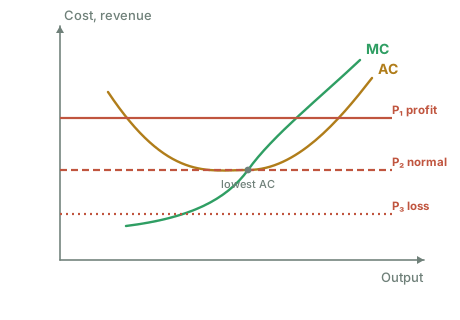
Assumptions: many buyers and sellers; a homogeneous product; perfect information; freedom of entry and exit; perfectly mobile factors. The firm is a price taker with AR = MR = price.
Short run: produces where MC = MR; may earn supernormal profit or make a loss.
Long run:
- Supernormal profit attracts entry
- market supply shifts right
- price falls
- each firm's horizontal AR falls
- entry stops only when supernormal profit is competed away
- normal profit, where P = MC = MR = ATC at minimum ATC.
That single condition delivers both allocative efficiency (P = MC) and productive efficiency (minimum ATC), which is why perfect competition is the benchmark.
But not dynamically efficient: with only normal profit there are no retained earnings for R&D, and with perfect information any innovation is instantly copied, so there is no incentive to innovate at all.
Monopolistic competition
Assumptions: many firms; low barriers to entry; and, the defining feature, differentiated products, so each firm has a small amount of price-setting power and faces a downward-sloping but highly elastic demand curve.
Short run: supernormal profit is possible.
Long run: low barriers mean entry competes it away, so the firm earns normal profit where AR is tangential to ATC.
- Because AR is downward-sloping, the tangency occurs to the left of minimum ATC
- so the firm is neither allocatively efficient (P > MC) nor productively efficient
- there is excess capacity.
The evaluation point: that inefficiency is the price of variety. Consumers get differentiated products, a choice of restaurants, hairdressers, coffee shops, and the excess capacity is what makes that choice possible. Whether the variety is worth the efficiency loss is a genuine judgement.
Oligopoly
Dominated by a few large firms, and defined not by number but by interdependence: each firm's best action depends on what rivals do.
Features: high concentration ratio, barriers to entry, differentiated products, price rigidity, and dominant non-price competition.
The kinked demand curve explains the rigidity: a firm believes rivals will not follow a price rise (so demand is elastic above) but will follow a price cut (so demand is inelastic below).
- Elastic above and inelastic below the kink
- the MR curve has a discontinuity at that output
- MC can shift anywhere within that gap without changing the profit-maximising price
- prices stay rigid even when costs change.
Collusion. A cartel, a formal agreement to fix price or output, is illegal in the UK and EU. Tacit collusion operates through price leadership. A successful cartel behaves like a monopoly, but each member has an incentive to cheat by secretly undercutting the cartel price, and leniency programmes reward the first firm to confess, which is why cartels are unstable.
Game theory. The prisoner's dilemma: both firms have a dominant strategy to price low, producing a Nash equilibrium, neither can improve by changing strategy alone; that is jointly worse than colluding. That explains both the incentive to collude and the incentive to defect.
Non-price competition dominates because price cuts are matched: advertising, branding, quality, loyalty schemes, customer service.
Monopoly
A pure monopoly is a single seller; the UK threshold for investigating monopoly power is a 25% market share.
Barriers to entry: economies of scale and a large MES, legal barriers (patents, licences), control of an essential resource, brand loyalty, limit pricing, and high sunk costs.
- The monopolist is a price maker with MR below AR
- produces where MC = MR, reading price up to AR
- higher price and lower output than under competition
- P > MC, so allocatively inefficient
- not at minimum ATC, so productively inefficient
- weak competitive pressure permits X-inefficiency
- deadweight welfare loss, with consumer surplus transferred to producer surplus.
In defence of monopoly: economies of scale may put ATC so far below a competitive firm's that price is actually lower, and where scale economies are vast relative to the market, a natural monopoly exists and fragmenting it would raise costs. Dynamic efficiency: supernormal profit funds R&D and patents make innovation worth undertaking. Cross-subsidisation sustains socially valuable but unprofitable services.
Price discrimination
Charging different prices to different consumers for the same good, where the difference is not justified by cost.
Three conditions, all required: the firm has price-setting power; it can separate consumers by PED; and it can prevent resale.
It charges more where demand is inelastic and less where elastic, peak rail fares, student cinema tickets, advance airline seats.
Effects: producer surplus rises and consumer surplus falls. But output usually rises, because consumers with elastic demand who would not have bought at the single price now do, so some consumers gain access, and the extra revenue may cross-subsidise services or fund investment.
Contestable markets
A market is contestable where entry and exit are cheap and easy. What disciplines a firm is not the number of rivals but the threat of entry.
The key condition is low sunk costs, costs that cannot be recovered on leaving.
Where a market is perfectly contestable, the threat of hit-and-run entry forces even a single incumbent to price near normal profit → so a concentrated market can produce a competitive outcome.
The policy implication is significant: rather than breaking up large firms, a government can improve outcomes by lowering barriers to entry (3.6).
Working the numbers
Monopoly against perfect competition, from the same cost and demand. Demand is P = 180 − 3Q; MC = 30.
TR = 180Q − 3Q², so MR = 180 − 6Q
Monopoly: 180 − 6Q = 30 → Q = 25, price read up to demand → P = £105
Perfect competition (P = MC): 180 − 3Q = 30 → Q = 50 at £30
The monopolist sells half the quantity at three and a half times the price.
Deadweight loss = ½ × (£105 − £30) × (50 − 25) = £937.50
With ATC of £70 at 25 units, supernormal profit = (£105 − £70) × 25 = £875, the rectangle between price and ATC, sustained because barriers block entry.
The oligopoly game. Two firms choose a high or low price; cells show (A, B) in £m:
| B: high | B: low | |
|---|---|---|
| A: high | (12, 12) | (4, 16) |
| A: low | (16, 4) | (7, 7) |
If B prices high, A earns 12 high against 16 low → low is better.
If B prices low, A earns 4 high against 7 low → low is better.
Low is a dominant strategy for both, so the Nash equilibrium is (low, low) paying £7m each, worse for both than the £12m they would earn by colluding. That is the prisoner's dilemma, and it explains simultaneously why cartels form and why they collapse: from (12, 12), either firm gains by defecting to 16.
Worked example
A pharmaceutical firm holds a 20-year patent on a new drug.
- The patent is a legal barrier to entry
- the firm is a monopolist
- produces where MC = MR
- price is set well above marginal cost
- output is below the allocatively efficient level
- deadweight welfare loss, and patients who value the drug above its marginal cost go without.
The counter-argument:
- Development cost hundreds of millions with a high failure rate
- without the prospect of supernormal profit no firm would fund the research at all
- the patent creates dynamic efficiency: the drug exists because monopoly profit was available.
Evaluation.
- The trade-off is static loss now against dynamic gain over time, and the judgement depends on the horizon.
- The patent is temporary, on expiry, generic entry drives price towards marginal cost, so the deadweight loss is time-limited by design.
- Price discrimination between rich and poor countries lets the firm charge near marginal cost in low-income markets while recovering R&D in high-income ones, raising output and access without destroying the incentive.
- Monopoly may breed X-inefficiency, so part of the supernormal profit is dissipated rather than reinvested.
- Governments could fund research directly through grants or prizes, capturing the dynamic gain without the monopoly price, though this shifts risk to the taxpayer.
Judgement: the monopoly is defensible where the innovation would not otherwise occur and protection is genuinely temporary; not where the barrier is permanent and the profit funds nothing.
Common exam mistakes
- Confusing allocative (P = MC) with productive (minimum ATC) efficiency.
- Treating X-inefficiency as productive inefficiency, X-inefficiency means costs sit above the cost curve entirely.
- Forgetting that monopolistic competition earns normal profit in the long run with excess capacity.
- Defining oligopoly by the number of firms rather than interdependence.
- Drawing the kinked demand curve without the discontinuity in MR, which is the entire point.
- Omitting one of the three conditions for price discrimination, usually preventing resale.
- Saying a concentrated market must be uncompetitive, ignoring contestability.
Exam technique
Draw the diagram for the structure named, and label it fully, MC = MR, price read up to AR, and the relevant efficiency comparison. For perfect competition, show industry and firm side by side.
Use the four efficiencies as an evaluative framework: most structures fail some and deliver others, and setting that out systematically answers most 25-markers here.
Contestability is the highest-value evaluation concept in this topic: it lets you argue a snapshot market share overstates real market power, and points to a different policy conclusion from breaking a firm up.
Quick revision
- Allocative: P = MC. Productive: minimum ATC. Dynamic: innovation over time. X-inefficiency: costs above the minimum.
- Perfect competition long run: normal profit, P = MC = ATC at minimum, allocatively and productively efficient, but not dynamically.
- Monopolistic competition long run: normal profit at tangency, left of minimum ATC → excess capacity, the price of variety.
- Oligopoly: interdependence, kinked demand → discontinuous MR → price rigidity; cartels unstable; Nash equilibrium worse than collusion.
- Monopoly: higher price, lower output, P > MC, deadweight loss, possible X-inefficiency, defended by economies of scale and dynamic efficiency.
- Price discrimination: price-setting power, separable PED groups, no resale. Output usually rises.
- Contestability depends on low sunk costs; the threat of entry disciplines incumbents.
Check you have it
Question 1
The UK hair and beauty industry is an example of monopolistic competition because:
Answer: D.
Options A, B, and C are incorrect because they describe different market structures. Firms in this industry spend heavily on advertising and research to differentiate their services, contradicting A. The industry consists of many small-to-medium-sized providers rather than a few large firms, making B incorrect. Finally, C is wrong because hair and beauty services are highly differentiated, through unique branding, staff expertise, or location, rather than being homogenous, which is a feature of perfect competition.
What the syllabus asks for on this topicSpecification points
Specification points
- Efficiency: allocative, productive, dynamic and X-inefficiency.
- Perfect competition, monopolistic competition, oligopoly and monopoly.
- Monopoly power, price discrimination and contestable markets.
Related Edexcel A-Level topics
Not the topic you were looking for? Describe what you are stuck on in your own words and we will take you to the notes that answer it.