Government Intervention (Business & Labour)
Contents: 12 sections
Why intervene
Firms with market power set P > MC, restrict output, permit X-inefficiency and generate a deadweight welfare loss (3.4). Monopsony power over suppliers and workers produces a parallel problem: prices and wages pushed below the competitive level.
In the UK the Competition and Markets Authority (CMA) investigates. The statutory trigger for examining monopoly power is a 25% market share, and mergers are assessed on whether they produce a substantial lessening of competition.
Controlling monopolies
| Method | How it works | Drawback |
|---|---|---|
| Price regulation | A price cap, classically RPI − X, forcing real prices down by X% a year | Setting X requires cost information the regulator does not have: regulatory capture and information asymmetry |
| Profit regulation | Capping the rate of return on capital | Removes the incentive to cut costs, and encourages gold-plating: over-investing in capital to inflate the allowed return |
| Quality standards | Minimum service levels, compensation for failure | Costly to monitor; firms meet the letter rather than the spirit |
| Performance targets | Punctuality, waiting times, leakage rates | Distorts behaviour towards what is measured |
| Windfall taxes | Taxing unexpected supernormal profit | May deter investment if firms expect repetition |
| Nationalisation | Public ownership | Loses the profit incentive; risk of X-inefficiency and political interference |
RPI − X is the one to know in detail. It is a form of incentive regulation: because the cap is fixed in advance, any cost saving the firm achieves beyond X is kept as profit, so the firm has a genuine reason to become efficient. Its weakness is that the regulator must set X, and the firm knows its own costs far better, the asymmetric information problem again.
Controlling mergers
The CMA can block a merger, allow it with remedies (requiring the sale of parts of the business), or clear it.
The test is whether the merger substantially lessens competition. Against that sits the possibility that the merger delivers genuine economies of scale, so a merger may raise concentration and lower prices. Where a natural monopoly exists, competition would actually raise costs, and regulation is the right answer rather than fragmentation.
Promoting competition
- Deregulation: removing statutory barriers to entry, making markets more contestable (3.4).
- Privatisation: transferring state firms to the private sector on the argument that the profit motive drives efficiency. The counter-argument is that a public monopoly may simply become a private one.
- Preventing collusion: cartels are illegal; leniency programmes grant immunity to the first firm to confess, which destabilises cartels from the inside by making betrayal individually rational.
- Restricting anti-competitive practices: predatory pricing, exclusive dealing, refusal to supply.
- Promoting small business: grants, reliefs and simplified regulation.
- Improving information: price comparison requirements and switching rules, which lower search costs and raise the elasticity of demand facing incumbents.
Protecting suppliers and employees
Suppliers face monopsony power from large buyers, who can force prices down, extend payment terms and change orders at short notice. Remedies include a Groceries Code Adjudicator-style regulator, enforceable codes of practice and payment terms legislation.
Employees are protected by the national minimum wage, maximum working hours, health and safety regulation, anti-discrimination law and employment protection. The counter-argument in every case is that protection raises firms' costs, which may reduce employment or push activity into the informal economy, so the standard evaluation is that the level matters more than the principle.
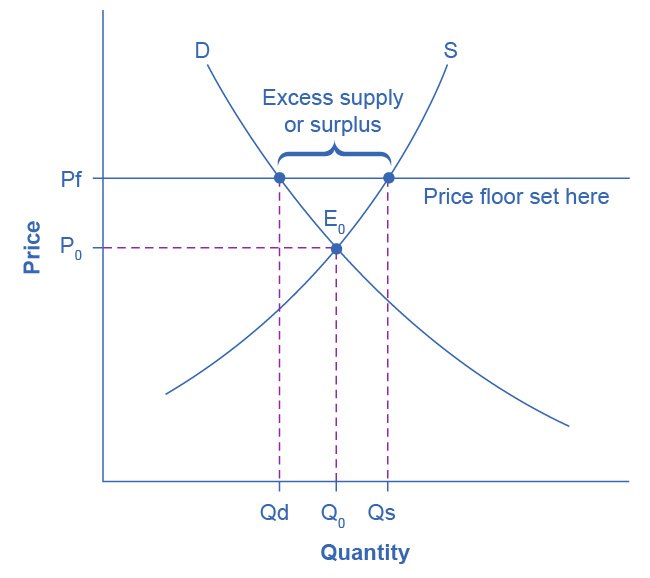
The minimum wage is a price floor, and the diagram is the ordinary one with relabelled axes: the wage on the vertical, quantity of labour on the horizontal. Set above the equilibrium wage, quantity of labour supplied rises while quantity demanded falls, and the bracketed gap between them is excess supply of labour, unemployment.
That is the theoretical case against it, and it should be stated with the qualification that carries the marks: where employers hold monopsony power, the very problem named two paragraphs above, a carefully set minimum wage can raise both the wage and employment, because it removes the employer's incentive to restrict hiring in order to hold wages down. The empirical effect of moderate minimum wages is therefore genuinely contested, and depends on the level set and on how competitive the labour market already is.
Limits to government intervention
This is where the evaluation marks concentrate:
- Regulatory capture: the regulator comes to serve the industry's interests, because the industry holds the expertise and lobbies hardest.
- Asymmetric information: the regulator cannot know the firm's true costs, so price caps are set wrongly in one direction or the other.
- Administrative and enforcement costs, which may exceed the welfare gain.
- Unintended consequences: profit caps encouraging gold-plating; price caps cutting investment in the network.
- Loss of economies of scale if a firm is broken up below its minimum efficient scale.
- Reduced dynamic efficiency: capping profit reduces the retained earnings that fund R&D.
- Globalised markets: a national regulator has limited reach over multinational firms.
Together these are government failure (1.4): intervention producing a worse allocation of resources than the market outcome it was meant to correct.
Working the numbers
A minimum wage as a price floor. A labour market clears at £9.00 an hour with 40,000 workers employed. A minimum wage of £11.00 is imposed:
Quantity of labour supplied rises to 46,000, more people want work at the higher wage
Quantity demanded falls to 36,000, firms hire fewer
Excess supply of labour = 46,000 − 36,000 = 10,000, the unemployment the floor creates
Note that only 36,000 are now employed against 40,000 before: 4,000 lose their jobs, while the 36,000 who keep theirs gain £2.00 an hour. That distributional split, concentrated losses, spread gains, is the heart of the argument.
The monopsony qualification, which reverses it. Where a single large employer holds wage-setting power, it restricts hiring to keep wages down, so the market wage sits below the competitive level. A minimum wage set carefully then removes that incentive: the employer's marginal cost of labour becomes flat at the legal wage, and it hires up to where MRP meets it.
Employment and pay can therefore both rise, the opposite of the competitive prediction.
Which case applies is an empirical question about the specific labour market, and saying so is the evaluation. The size matters too: a floor slightly above equilibrium behaves very differently from one far above it.
Price capping a monopoly. A regulator caps price at average cost. If a monopolist charging £90 with ATC of £60 at 10,000 units is capped at £60:
Supernormal profit falls from (£90 − £60) × 10,000 = £300,000 to zero
The firm still covers its costs including a normal return, so it survives, but a cap at marginal cost would push price below ATC for a natural monopoly and guarantee losses, requiring a permanent subsidy. That trade-off is the standard answer on utility regulation.
Worked example
A regulator imposes an RPI − 3% price cap on a privatised water company that is a natural monopoly.
- The firm must cut real prices by 3% a year
- to protect its margin it must cut costs by at least as much
- it has a direct incentive to become more efficient, because any saving beyond 3% is retained as profit
- consumers gain from lower real bills
- the deadweight loss from monopoly pricing is reduced, and price moves closer to marginal cost.
Evaluation.
- Setting X requires knowing the firm's achievable cost reductions, and the firm knows them far better than the regulator. Set too low, consumers gain little; set too high, the firm cannot finance itself.
- The firm may meet the cap by cutting investment in the network rather than by becoming efficient, deferring maintenance shows up as leakage and supply failures years later, long after the regulator's term. This is the classic unintended consequence of price capping a capital-intensive network.
- Quality standards and performance targets are therefore needed alongside the cap, which raises monitoring costs.
- Regulatory capture is a live risk in a sector with one firm, deep technical expertise and a revolving door of staff.
- Because water is a natural monopoly, introducing competition is not the alternative, duplicating the pipe network would raise costs. Regulation is the only realistic instrument, which strengthens the case for getting it right rather than abandoning it.
- Nationalisation is the alternative, trading the profit incentive for direct control, but risking X-inefficiency and political rather than economic decision-making.
Judgement: RPI − X is the right instrument for a natural monopoly because it preserves an efficiency incentive that profit regulation destroys. But it only works paired with quality standards, since otherwise the cheapest way to meet the cap is to let the asset deteriorate.
Common exam mistakes
- Describing a policy without linking it to the market failure it addresses.
- Treating monopoly as automatically bad, ignoring economies of scale, natural monopoly and dynamic efficiency.
- Forgetting that price caps can be met by cutting investment or quality, not only by raising efficiency.
- Confusing profit regulation (encourages gold-plating) with price regulation (preserves the efficiency incentive).
- Recommending breaking up a natural monopoly, which raises costs.
- Omitting government failure, regulatory capture and asymmetric information are the two to name.
- Discussing only firms, when the specification also covers protecting suppliers and employees.
Exam technique
Name the specific instrument, RPI − X, a merger remedy, a leniency programme, rather than "the government could regulate". Precision is what separates the bands here.
Structure evaluation by stakeholder: consumers, the firm, its suppliers, its employees, and the taxpayer. Then close with limits to intervention.
The strongest single evaluation move is to ask whether the market is a natural monopoly or genuinely contestable, because the right policy differs completely, regulate the first, lower barriers to entry in the second.
Quick revision
- The CMA investigates at a 25% share; mergers are tested for a substantial lessening of competition.
- RPI − X caps real prices and preserves the efficiency incentive; profit caps encourage gold-plating.
- Other tools: quality standards, performance targets, windfall taxes, nationalisation.
- Promoting competition: deregulation, privatisation, leniency programmes, banning anti-competitive practices, improving information.
- Suppliers need protection from monopsony; employees from low pay and poor conditions.
- Limits: regulatory capture, asymmetric information, enforcement costs, unintended consequences, lost economies of scale, reduced dynamic efficiency.
- Regulate a natural monopoly; make a contestable market easier to enter.
What the syllabus asks for on this topicSpecification points
Specification points
- Government intervention to control monopolies and mergers.
- Promoting competition and protecting suppliers and employees.
- The impact of government intervention; limits to intervention.
Related Edexcel A-Level topics
Not the topic you were looking for? Describe what you are stuck on in your own words and we will take you to the notes that answer it.