International Economics
Contents: 12 sections
Globalisation
The increasing integration of national economies through trade, capital flows, migration and the transfer of technology.
Causes: falling transport costs, above all containerisation; communications technology making services tradable; trade liberalisation through the WTO and regional agreements; deregulation of capital markets; the growth of multinational corporations and global supply chains; and the opening of China, India and the former Soviet bloc.
Benefits: lower prices and greater choice; economies of scale from larger markets; technology transfer; hundreds of millions lifted out of absolute poverty; greater competition raising efficiency.
Costs: structural unemployment in import-competing industries; widening inequality within countries as returns accrue to capital and skilled labour; environmental damage; loss of policy autonomy; rapid transmission of shocks across borders; and exploitation of weak labour and environmental standards.
Absolute and comparative advantage
- Absolute advantage: producing more with the same resources.
- Comparative advantage: producing at a lower opportunity cost.
The gains from trade come from comparative, not absolute, advantage. Even if one country is absolutely better at producing everything, both gain by specialising where they are relatively best and trading.
Worked illustration. Two countries with equal resources:
| Wheat | Cloth | |
|---|---|---|
| Country A | 100 | 50 |
| Country B | 40 | 40 |
A has an absolute advantage in both. But in opportunity cost terms:
- In A, 1 cloth costs 2 wheat; 1 wheat costs 0.5 cloth.
- In B, 1 cloth costs 1 wheat; 1 wheat costs 1 cloth.
- Cloth is cheaper in B (1 wheat versus 2); wheat is cheaper in A (0.5 cloth versus 1)
- A specialises in wheat, B in cloth
- world output rises
- and provided the terms of trade lie between the two opportunity cost ratios (between 1 and 2 wheat per cloth), both consume beyond their own PPFs.
Assumptions, and why they matter: no transport costs; constant returns to scale; perfectly mobile factors; no trade barriers; perfect information. Relaxing them weakens the case, transport costs can eliminate the gain entirely, and factor immobility means displaced workers do not smoothly move into the expanding sector, which is the source of the political backlash against trade.
Terms of trade = (index of export prices ÷ index of import prices) × 100. A rise is an improvement: each unit of exports buys more imports.
Protectionism
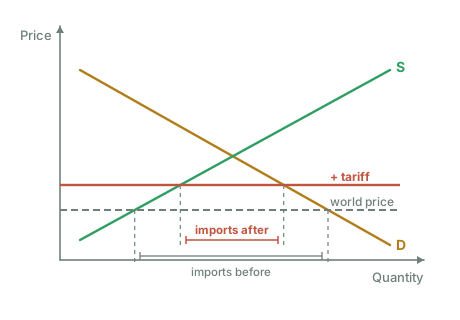
| Method | Effects |
|---|---|
| Tariff | Tax on imports; raises price, cuts imports, raises government revenue; deadweight welfare loss |
| Quota | Quantity limit; raises price but no revenue: the gain goes to the licence holder |
| Subsidy to domestic producers | Lowers their costs so they undercut imports; cost falls on the taxpayer |
| Embargo | Total ban, usually political |
| Administrative barriers | Standards, licensing, paperwork; hard to challenge legally |
Arguments for: infant industry; protecting employment; preventing dumping; strategic industries; correcting a current account deficit; managing decline in sunset industries.
Arguments against: higher prices and less choice; higher input costs for downstream firms; inefficiency in sheltered firms; retaliation; lower world output; infant industries that never mature.
The balance of payments
Records all transactions with the rest of the world, and always balances overall, a current account deficit is financed by a financial account surplus.
- Current account: trade in goods, trade in services, primary income (profits, interest, dividends, wages), secondary income (transfers, aid, remittances).
- Capital account: small; transfers of capital assets.
- Financial account: FDI, portfolio investment, reserves.
Causes of a deficit: loss of competitiveness, a strong exchange rate, strong domestic growth pulling in imports, a narrow export base.
But its significance depends on the cause. A deficit financed by inward FDI, or caused by importing capital goods that raise future capacity, differs fundamentally from one funding consumption on borrowed money.
Exchange rates
- Floating: set by demand and supply; appreciation / depreciation.
- Fixed: maintained by the central bank using reserves; revaluation / devaluation.
- Managed float: mainly market-determined with occasional intervention.
Using "devaluation" for a market movement is the standard terminology error.
Demand for the currency comes from exports, inward FDI and speculation; supply from imports and outward investment.
A depreciation: exports cheaper abroad, imports dearer at home.
- Export volumes rise, import volumes fall
- net exports rise
- AD shifts right
- output and employment rise.
Two essential qualifications:
- The Marshall–Lerner condition: the current account improves only if PEDx + PEDm > 1. In the short run both are typically inelastic, so the balance can worsen before it improves, the J-curve.
- Imported inflation: dearer imported inputs shift SRAS left, eroding the competitiveness gain over time.
SPICED, Strong Pound, Imports Cheaper, Exports Dearer.
International competitiveness
- Price competitiveness: relative unit labour costs, relative inflation, the exchange rate, taxation, energy costs.
- Non-price competitiveness: quality, design, reliability, branding, after-sales service, delivery times, innovation.
Improving it: raising productivity is the fundamental answer, since it lowers unit costs without lowering wages. Investment in skills, infrastructure and R&D, all supply-side. A depreciation improves competitiveness immediately but does not raise productivity, so its effect erodes.
Working the numbers
Comparative advantage. With equal resources:
| Wheat | Cloth | |
|---|---|---|
| Country X | 90 | 180 |
| Country Y | 40 | 120 |
X has an absolute advantage in both. Opportunity costs still decide specialisation:
X: 180 ÷ 90 = 2 cloth per wheat · Y: 120 ÷ 40 = 3 cloth per wheat
X gives up less cloth per wheat → X specialises in wheat
X: 90 ÷ 180 = 0.5 wheat per cloth · Y: 40 ÷ 120 = 0.33 wheat per cloth
Y gives up less wheat per cloth → Y specialises in cloth
The two calculations must agree, and here they do. Terms of trade lie between 2 and 3 cloth per wheat, at 2.5, both gain.
Terms of trade as an index.
Terms of trade = (export price index ÷ import price index) × 100
Export prices rise from 100 to 112 while import prices rise to 105:
(112 ÷ 105) × 100 = 106.7, an improvement of 6.7%
Each unit exported now buys 6.7% more imports. But an improvement does not mean a better current account: if export demand is price elastic, the higher price cuts volume more than proportionately and export revenue falls. The index measures purchasing power per unit, not earnings, and confusing the two is the standard error.
Exchange rate conversion. Sterling appreciates from $1.25 to $1.40:
A £500 export costs an American 500 × 1.25 = $625 before, and 500 × 1.40 = $700 after, 12% dearer, so less competitive.
A $700 import costs 700 ÷ 1.25 = £560 before, and 700 ÷ 1.40 = £500 after, cheaper, easing cost-push pressure.
An appreciation therefore hurts exporters and helps importers and inflation at once, which is why "a strong pound is good" is a claim to be examined rather than accepted.
Worked example
A country's currency depreciates by 15%.
- Exports are 15% cheaper in foreign currency
- export demand rises
- imports are 15% dearer
- import demand falls
- net exports rise
- AD shifts right
- output and employment rise, and the current account improves.
The complications the question is really testing:
- In the short run PEDx + PEDm is likely below 1: contracts are signed, supply chains cannot be reconfigured quickly, consumers take time to switch. Marshall–Lerner fails, so the current account worsens first: the same volume of imports simply costs more. As elasticities rise it improves, the J-curve.
- Imported inflation: energy, food and components all cost more → SRAS shifts left → cost-push inflation. If workers secure compensating wage rises, unit labour costs rise and the competitiveness gain is fully eroded within a few years.
- The distributional effect is uneven: exporters and import-competing producers gain; importers and consumers of imported necessities lose.
- Near full capacity, the AD increase raises the price level rather than output.
Evaluation. The gain is temporary unless productivity improves, a depreciation buys competitiveness rather than creating it. It may also reduce the pressure on firms to become efficient. And if the depreciation was caused by lost confidence; it may overshoot, raising the cost of servicing foreign-currency debt.
Judgement: a depreciation improves the current account only if Marshall–Lerner holds, and durably only if the inflationary consequences are contained. It is a short-run adjustment mechanism, not a substitute for supply-side reform.
Common exam mistakes
- Explaining the gains from trade using absolute rather than comparative advantage.
- Failing to compute opportunity cost ratios when data is given.
- Forgetting that the terms of trade must lie between the two ratios for both to gain.
- Confusing tariffs (revenue) with quotas (no revenue).
- Asserting a depreciation improves the current account without Marshall–Lerner.
- Saying the balance of payments does not balance; it always does; the current account can be in deficit.
- Discussing competitiveness only in price terms, ignoring non-price factors.
Exam technique
Where numerical data appears, always calculate opportunity costs explicitly, that computation is usually worth several marks on its own.
Name Marshall–Lerner and the J-curve whenever a depreciation and the current account are involved; these are the two pieces of apparatus the examiner is looking for.
For protectionism, structure by stakeholder: domestic producers, consumers, downstream firms, exporters facing retaliation, and the government.
Quick revision
- Absolute advantage = more output. Comparative advantage = lower opportunity cost, and it is the source of the gains from trade.
- Terms of trade must lie between the two opportunity cost ratios.
- Terms of trade = (export price index ÷ import price index) × 100.
- Tariff raises revenue; quota does not.
- Current account: goods, services, primary income, secondary income. It is financed on the financial account.
- Depreciation → AD right, SRAS left through imported input costs.
- Marshall–Lerner: improves the current account only if PEDx + PEDm > 1. J-curve: worse before better.
- Competitiveness: price, unit labour costs, inflation, exchange rate, and non-price (quality, design). Productivity is the durable route.
What the syllabus asks for on this topicSpecification points
Specification points
- Globalisation and its causes and impacts.
- Absolute and comparative advantage; the benefits and costs of trade.
- Protectionism; the balance of payments; exchange rates.
- International competitiveness.
Related Edexcel A-Level topics
Not the topic you were looking for? Describe what you are stuck on in your own words and we will take you to the notes that answer it.