Types of Markets
Contents: 14 sections
What is market structure?
Market structure describes how a market is organised, above all, how many firms there are and how easily new firms can enter.
The two structures IGCSE focuses on sit at opposite ends:
| Competitive market | Monopoly | |
|---|---|---|
| Number of firms | Many | One (or one dominant firm) |
| Barriers to entry | Low | High |
| Control over price | Very little: firms are price takers | Considerable: the firm is a price maker |
| Products | Similar or identical | No close substitutes |
| Consumer choice | Wide | Limited |
| Prices | Lower | Higher |
| Profits in the long run | Normal, because entry competes them away | Abnormal profit can persist |
Barriers to entry
Barriers to entry are what stops new firms joining a market, and they are the reason a monopoly can persist:
- High start-up costs: building a rail network or a car factory needs enormous investment.
- Economies of scale: an established large firm has lower average costs, so a small newcomer cannot match its prices.
- Legal barriers: patents, licences, or a legal monopoly granted by government.
- Control of resources or distribution: owning the only supply of a raw material, or the shelf space.
- Brand loyalty: customers stay with a familiar name.
Where barriers are low, high profits attract new firms, competition increases and prices fall. Where they are high, that correction never happens.
Effects of competition
Advantages
- Lower prices, because firms compete for customers.
- Better quality and more choice, as firms differentiate themselves.
- Efficiency: firms must keep costs down to survive, so resources are not wasted.
- Innovation, to stay ahead of rivals.
Possible drawbacks
- Small firms may not achieve economies of scale, so costs per unit can be higher.
- Lower profits may leave less money for research and development.
- Wasteful duplication, many firms advertising similar products.
Effects of monopoly
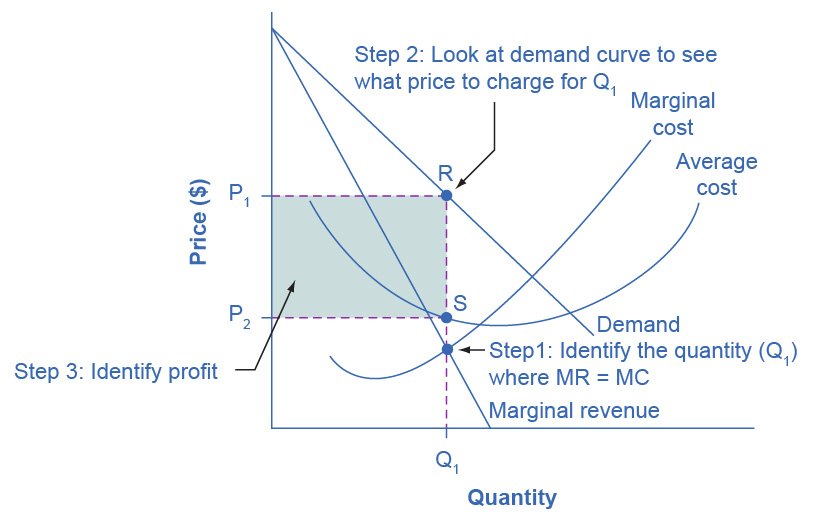
Disadvantages
- Higher prices and lower output than in a competitive market.
- Less choice for consumers.
- Less incentive to innovate or improve quality, since customers have nowhere else to go.
- Inefficiency: without competitive pressure, costs may drift upwards.
Possible advantages
- Economies of scale. A single large producer may have such low average costs that prices are actually lower than many small firms could manage. This is the strongest argument in a monopoly's favour.
- Natural monopoly. For water pipes, rail track or electricity grids, duplicating the network would waste resources, one supplier makes sense.
- Funds for investment. High profits can pay for research and long-term improvements.
Government responses to monopoly
- Competition law to prevent abuse of a dominant position, and to block mergers that reduce competition.
- Price controls: a maximum price to protect consumers.
- Regulation of quality and service standards.
- Removing barriers to entry to encourage competitors.
- Public ownership, so the service is run for the public rather than for profit.
Each has drawbacks: a price cap set too low may deter investment, regulation costs money to enforce, and governments may lack the information to set rules correctly (government failure).
Worked example
A country has one company supplying tap water.
- High start-up costs, laying a second network of pipes would be enormously expensive
- this is a natural monopoly, with very high barriers to entry
- the firm faces no competition, so it could charge high prices and provide poor service, knowing customers cannot switch.
But a single supplier is genuinely cheaper here. Two competing pipe networks would double the fixed costs and raise average cost for everyone. So breaking it up would make things worse.
The sensible response is regulation: a government regulator caps the price and sets minimum standards for water quality and leakage.
Evaluation. The regulator has to know the firm's true costs to set the cap fairly, and only the firm holds that information. Set the cap too high and consumers are exploited; too low and the firm cannot afford to maintain the pipes. That difficulty is a genuine limitation worth stating.
Common exam mistakes
- Saying monopoly is always bad, mention economies of scale and natural monopoly.
- Forgetting barriers to entry, which are what allow a monopoly to persist.
- Saying competitive firms make no profit. They make normal profit; abnormal profit is competed away.
- Confusing a monopoly with a large firm. What matters is the lack of competition, not size alone.
- Listing government policies without giving a drawback of any.
Exam technique
Structure comparisons around the four things the syllabus names: price, choice, quality/efficiency, and profit. Covering all four gives a complete answer.
Always explain why a monopoly can behave as it does, because barriers to entry stop competitors arriving. That causal step is where the marks are.
For evaluation, the natural-monopoly case is the strongest counter-argument, and the regulator's information problem is the strongest limitation of the remedy.
Building an answer
4 marks, "Explain two features of a competitive market."
There are many buyers and sellers, so no single firm is large enough to influence the market price, each is a price taker.
There is freedom of entry and exit, so if firms in the market are earning high profits, new firms can enter and compete those profits away.
6 marks, "Analyse the effects of a monopoly on consumers."
A monopolist faces no competition, so it can restrict output and charge a price above the competitive level, which reduces consumer surplus and makes consumers worse off.
Choice is limited, since there is only one supplier and no alternative to switch to.
Without competitive pressure the incentive to improve quality or control costs is weaker, so service may deteriorate.
Against this, a monopoly may achieve economies of scale unavailable to smaller firms, and its supernormal profit can fund research and development, so consumers may gain lower costs and better products over time, particularly where the industry is a natural monopoly.
Competition against monopoly
| Competitive market | Monopoly | |
|---|---|---|
| Number of firms | Many | One dominant |
| Price | Determined by the market; firms are price takers | Set by the firm; it is a price maker |
| Barriers to entry | Low | High |
| Profit in the long run | Normal | Supernormal can persist |
| Choice for consumers | Wide | Limited |
| Efficiency | Pressure to keep costs low | Weaker pressure |
Barriers to entry: the reason monopoly persists
Legal barriers such as patents and licences; economies of scale that leave an entrant at a cost disadvantage; high sunk costs that cannot be recovered on exit; brand loyalty built by heavy advertising; and control of an essential input or distribution channel.
Without barriers, high profits attract entry and the monopoly erodes. Barriers are what make market power durable, which is why competition authorities focus on them.
A real case to quote
Google search. Its share of search rests less on legal protection than on data, more searches produce better results, which attract more searches. Regulators in the EU and US have focused on default-placement agreements precisely because those are the barrier, not the technology itself. A modern illustration that barriers to entry need not be legal or physical to be effective.
Quick revision
- Market structure = number of firms and ease of entry.
- Competitive: many firms, low barriers, price takers, lower prices, normal profit.
- Monopoly: one firm, high barriers, price maker, higher prices, abnormal profit persists.
- Barriers: start-up costs, economies of scale, legal protection, resource control, brand loyalty.
- Competition brings lower prices, choice, efficiency and innovation.
- Monopoly may still be justified by economies of scale or where it is a natural monopoly.
- Government: competition law, price controls, regulation, removing barriers, public ownership.
Check you have it
Question 1
Which international market is closest to the model of perfect competition?
Answer: B.
The foreign exchange market comes closest to perfect competition because it satisfies the assumptions almost exactly. There are very many buyers and sellers worldwide, no one of whom can influence the price. The product is perfectly homogeneous: one US dollar is identical to any other. Information is close to perfect, since prices are quoted continuously and visible to everyone. And entry is essentially free: anyone can buy or sell currency. The result is that traders are genuine price takers.
Why the other options are wrong:
- A, diamonds, has historically been dominated by a small number of producers controlling supply, and stones are highly differentiated by size, cut and clarity, the opposite of homogeneous.
- C, petrol, is supplied by a handful of large oil companies, and OPEC coordinates a substantial share of crude output. That is an oligopoly with an element of cartel behaviour.
- D, washing machines, are heavily differentiated by brand, features and reliability, and are made by relatively few large manufacturers.
Question 2
What is a characteristic of a perfectly competitive firm?
Answer: D.
A perfectly competitive firm is one of very many selling an identical product, so it supplies a negligible fraction of total market output. Raise the price even slightly and buyers, who have perfect information, switch instantly to an identical product elsewhere; there is no reason to sell below the market price either. The firm must therefore accept the price the market sets, which makes it a price taker facing a perfectly elastic (horizontal) demand curve.
Why the other options are wrong:
- A, absence of competitors, describes monopoly. Perfect competition has the maximum possible number of competitors.
- B, non-price competition, describes monopolistic competition and oligopoly, where firms compete through branding, advertising and product differentiation. In perfect competition the product is homogeneous, so there is nothing to differentiate and no reason to advertise.
- C, one dominant firm, again describes monopoly, or the price-leadership pattern found in oligopoly.
Question 3
Which type of business is always in the public sector?
Answer: C.
A public corporation is a business owned and controlled by the state, set up by government to run a nationalised industry or public service. Public ownership is what defines it, so it is always in the public sector.
Why the other options are wrong:
- D, a public limited company, is the sharpest trap. "Public" here means its shares are traded publicly on a stock exchange and can be bought by anyone; it is privately owned by its shareholders and firmly in the private sector. The word carries an entirely different meaning in the two terms.
- A, a monopoly, is a market structure defined by being the sole supplier. A monopoly can be state-owned (a national rail operator) or privately owned (a firm protected by a patent), so ownership is not determined by it.
- B, a multinational corporation, produces in more than one country and is almost always privately owned, though some state-owned firms operate internationally too.
What the syllabus asks for on this topicSyllabus points
Syllabus points
- Explain the meaning of competitive markets and monopoly.
- Explain how market structure affects price, choice and efficiency.
Related Cambridge IGCSE topics
Not the topic you were looking for? Describe what you are stuck on in your own words and we will take you to the notes that answer it.