Characteristics and classification of living organisms
Contents: 10 sections
The seven characteristics
Every living organism does all seven of these. That word all is what questions test: a car moves and uses fuel, but it does not reproduce or grow, so it is not alive.
- Movement — an action that changes position or place.
- Respiration — the chemical reactions that break down nutrient molecules in living cells to release energy.
- Sensitivity — detecting stimuli and responding to them.
- Growth — a permanent increase in size and dry mass.
- Reproduction — making more of the same kind of organism.
- Excretion — removing the waste products of metabolism and substances in excess.
- Nutrition — taking in materials for energy, growth and development.
Two of these are regularly confused in exams.
Excretion is not egestion. Excretion removes waste your own cells MADE, such as carbon dioxide from respiration or urea from breaking down excess amino acids. Egestion removes food that was never absorbed, so it never took part in metabolism at all. Faeces is egested, not excreted.
Growth means dry mass, not just size. A plant that takes up water swells but has not grown. Dry mass excludes water, so it measures material actually built into the organism.
Why we classify
Classification puts organisms into groups based on shared features. The purpose is not tidiness: a good classification reflects how closely related organisms are, so it also tells you something about their evolutionary history.
Organisms in the same group share more features with each other than with organisms outside it, and the groups sit inside one another: kingdom, phylum, class, order, family, genus, species.
A species is a group of organisms that can reproduce to produce fertile offspring. The word fertile is the whole test. A horse and a donkey produce a mule, but a mule cannot breed, so horses and donkeys stay separate species.
The binomial system
Every species has a two-word Latin name: the genus first with a capital letter, then the species in lower case. Both are italicised, or underlined in handwriting.
Homo sapiens, Panthera leo, Escherichia coli.
The system is international. A biologist anywhere reads the same name for the same organism, which common names do not allow: "robin" means one bird in Britain and a different one in North America.
Classifying by sequence data
Visible features can mislead. Two unrelated organisms living in the same conditions can end up looking similar, because the same environment favours the same solutions.
Comparing DNA base sequences, or the amino acid sequences of proteins, avoids that. Organisms that are closely related share more of their sequence, because less time has passed for mutations to accumulate since they diverged. Where sequence evidence and appearance disagree, sequence evidence is taken as the better guide, and several groups have been reorganised because of it.
The five kingdoms
- Animals — many cells, no cell wall, no chlorophyll, feed on other organisms.
- Plants — many cells, cellulose cell wall, chlorophyll, make their own food by photosynthesis.
- Fungi — usually many cells arranged as hyphae forming a mycelium, cell wall not made of cellulose, no chlorophyll, feed by secreting enzymes onto food and absorbing the products.
- Prokaryotes — one cell, no nucleus, DNA loose in the cytoplasm, often a plasmid.
- Protoctists — mostly one cell, with a nucleus; the group that holds everything not fitting the other four.
Viruses sit in none of them. They have no cytoplasm, no organelles and carry out no metabolism of their own, so most biologists do not treat them as living.
Arthropods
All arthropods have an exoskeleton and jointed legs. The four groups are told apart by counting.
| Group | Legs | Body | Antennae |
|---|---|---|---|
| Insects | 6 | 3 parts, usually wings | 1 pair |
| Arachnids | 8 | 2 parts | none |
| Crustaceans | 10 or more | 2 parts, hard case | 2 pairs |
| Myriapods | many, one or two pairs per segment | many segments | 1 pair |
Counting legs settles almost every arthropod question, so count before reading the options.
Vertebrates
All have a backbone. The distinguishing feature is usually the body covering or how the young develop.
- Fish — wet scales, gills, external fertilisation, eggs without shells.
- Amphibians — moist smooth skin, larvae with gills, eggs laid in water.
- Reptiles — dry scaly skin, eggs with leathery shells laid on land.
- Birds — feathers, beak, hard-shelled eggs, constant body temperature.
- Mammals — fur or hair, mammary glands, young born live, constant body temperature.
Feathers alone identify a bird, and fur alone identifies a mammal. Wings do not: bats are mammals and many insects fly.
Plants
- Ferns — leaves called fronds, reproduce by spores, no flowers.
- Flowering plants — reproduce by seeds formed inside flowers. Split into monocotyledons, with one seed leaf, narrow leaves and parallel veins, and dicotyledons, with two seed leaves, broader leaves and branching veins.
Dichotomous keys
A dichotomous key is a series of paired statements. Each pair splits the remaining organisms in two, and following the branches leads to a name.
Two rules make keys work in an exam:
- Use only visible features. "Lives in water" is not usable from a picture; "has four legs" is.
- Each pair must be a genuine either/or, so every organism follows exactly one branch.
Work through a key one numbered step at a time and do not skip ahead, because a key gives a wrong answer confidently if a step is missed.
Check you have it
Question 1
Which row is correct for arthropod classification? Each answer gives, in order: arthropod group; antennae present; number of body parts; number of legs.
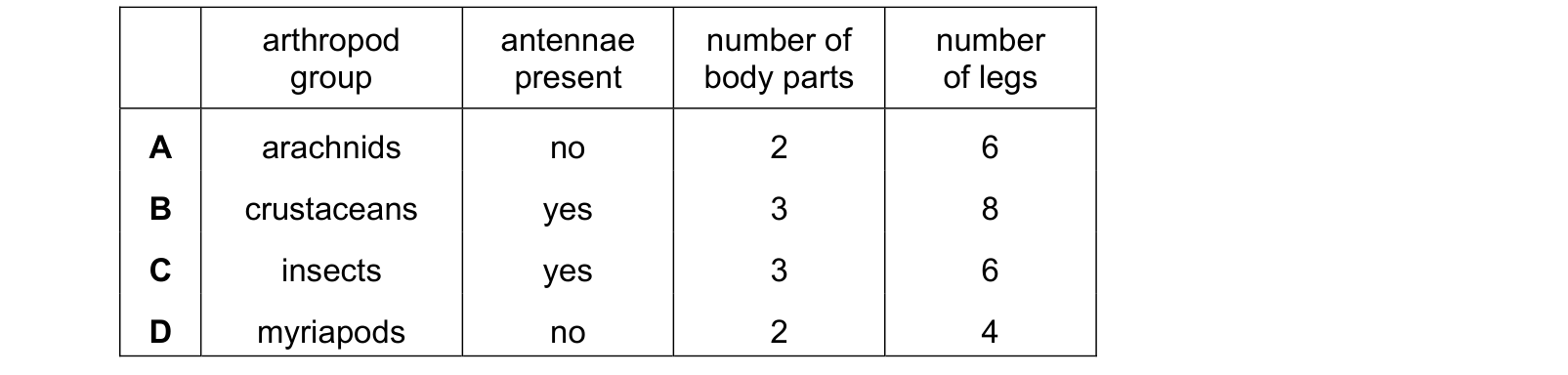
Answer: C.
The wrong rows each contain a real group with at least one wrong figure. Arachnids do have no antennae and 2 body parts, but 8 legs rather than 6. Crustaceans do have antennae, two pairs of them, but not 3 body parts and 8 legs. Myriapods have antennae, which that row denies, and far more than 4 legs.
The reference set worth memorising: insects 6 legs, 3 parts, 1 pair of antennae; arachnids 8 legs, 2 parts, no antennae; crustaceans 10 or more legs, 2 pairs of antennae; myriapods many legs, many segments, 1 pair of antennae.
Question 2
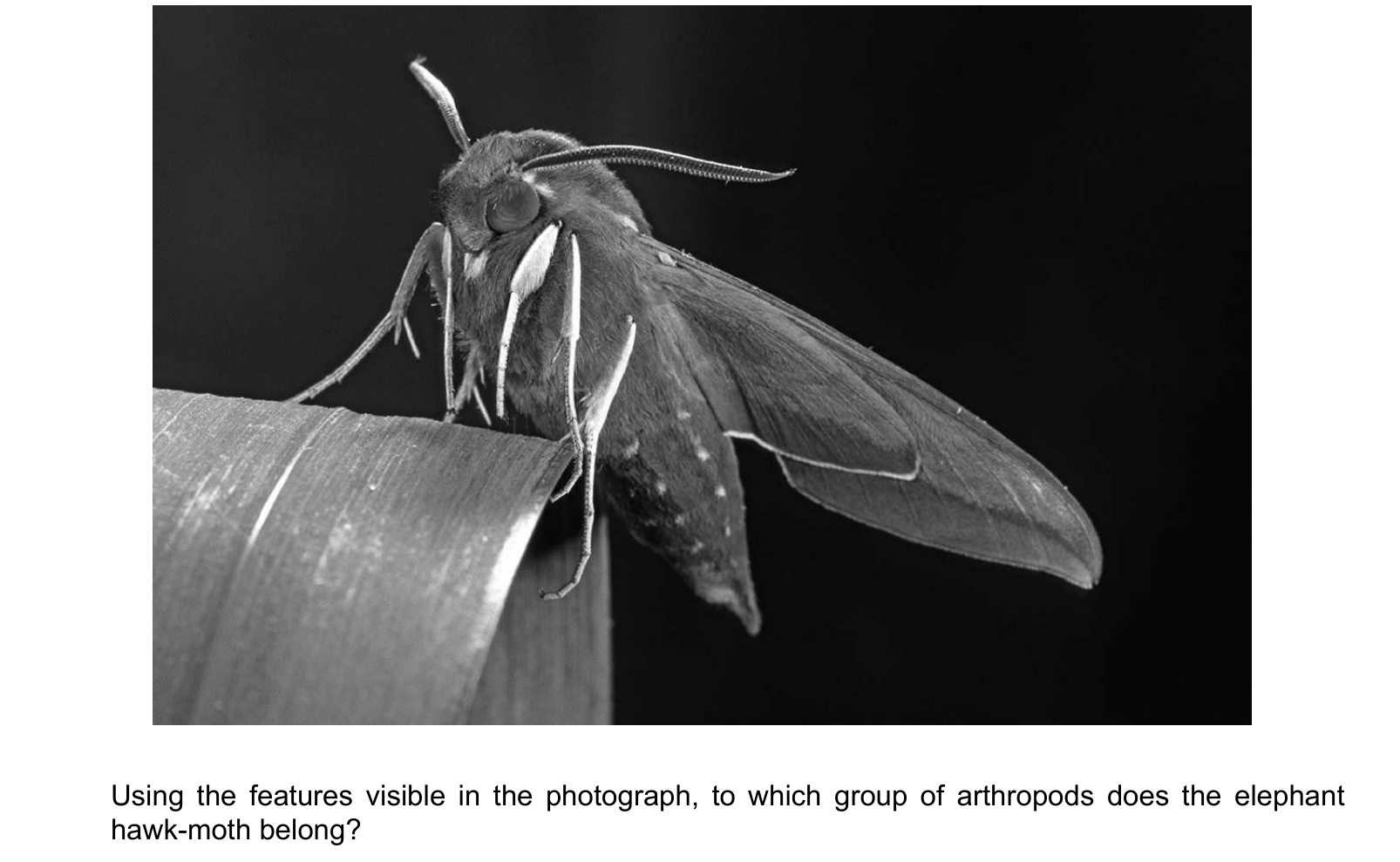
The photograph shows an elephant hawk-moth.
Using the features visible in the photograph, to which group of arthropods does the elephant hawk-moth belong?
Answer: C.
Leg count is the quickest discriminator. Arachnids have four pairs, crustaceans ten or more legs with two pairs of antennae, and myriapods a pair or two on every segment of a long body.
Wings help too, since among the arthropods only insects have them, though not every insect does. The question says to use the features visible in the photograph, so count what is actually shown rather than recalling what a moth is.
Question 3
The diagram shows two experiments investigating gas exchange in small aerobic crustaceans. Soda lime absorbs carbon dioxide. P Q Which way does the liquid marker move? Each answer gives, in order: P; Q.
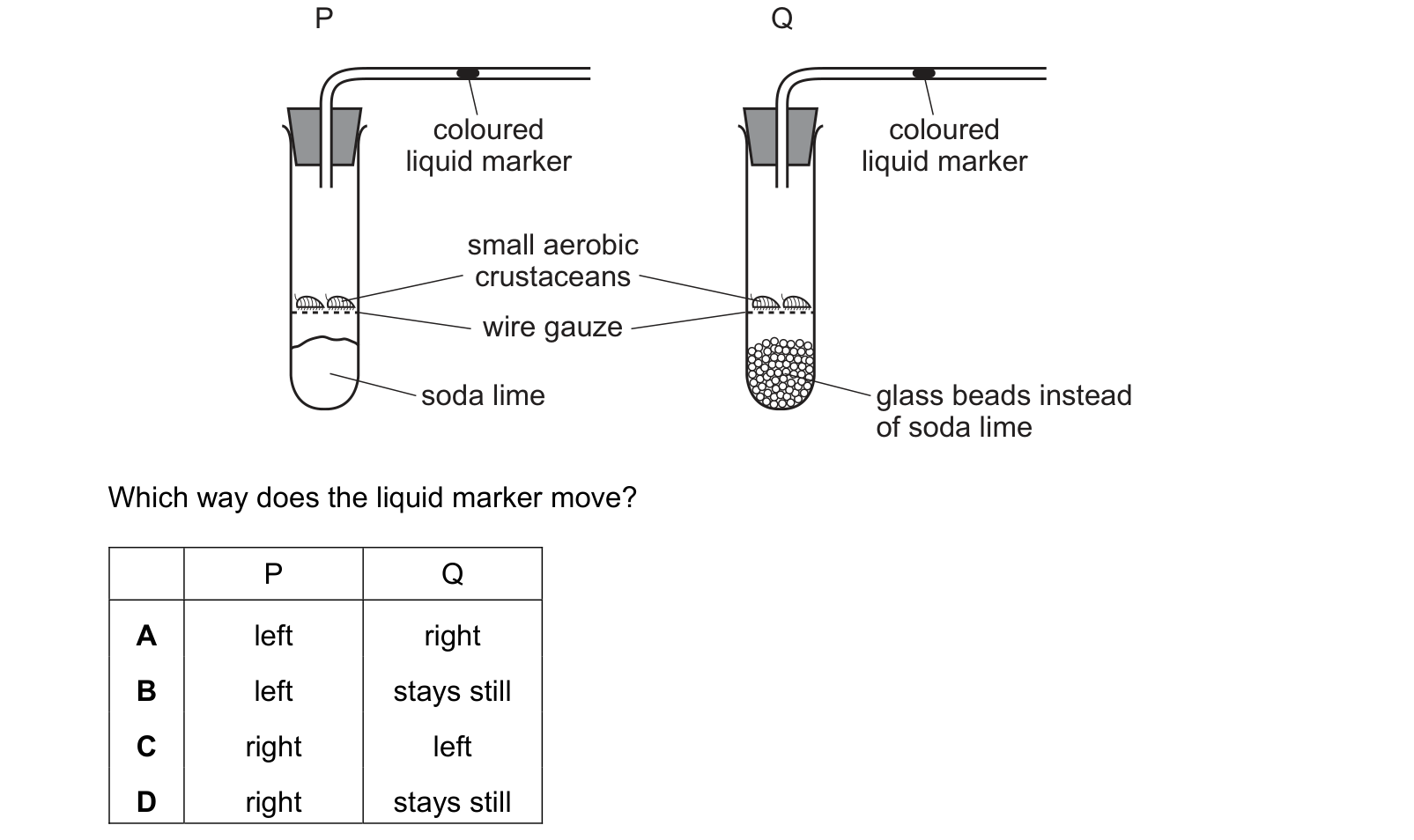
Answer: B.
The crustaceans respire aerobically, so they use oxygen and produce carbon dioxide. In tube P the soda lime absorbs the carbon dioxide as fast as it is made, so nothing replaces the oxygen taken up. The volume of gas falls, pressure drops, and the marker moves towards the organisms, which is left.
In tube Q there is no soda lime. The carbon dioxide produced replaces the oxygen used at roughly the same rate, so the total volume of gas barely changes and the marker stays still.
That pairing, left and stationary, is B. Tube Q is the control: it shows that the movement in P is caused by oxygen uptake rather than by a change in temperature or pressure in the room.
What the syllabus asks for on this topicSyllabus points
Syllabus points
- List and describe the seven characteristics of living organisms.
- Explain that organisms are classified into groups by shared features.
- Describe the binomial system of naming species.
- Explain that classification can be based on sequence data as well as on visible features.
- Describe the main features of the five kingdoms, the main groups of arthropods and vertebrates, and the main groups of plants.
- Use and construct simple dichotomous keys.
Related CIE 0610 Biology topics
Not the topic you were looking for? Describe what you are stuck on in your own words and we will take you to the notes that answer it.