Biological molecules
Contents: 6 sections
The elements
This is a common one-mark question and the answer is exact.
- Carbohydrates contain carbon, hydrogen and oxygen.
- Fats and oils contain carbon, hydrogen and oxygen.
- Proteins contain carbon, hydrogen, oxygen and nitrogen, and many also contain sulfur.
Nitrogen is what separates proteins from the other two, so any question naming nitrogen is pointing at protein.
Large molecules from small units
Every large biological molecule is built by joining smaller units together, and every one is broken down by splitting them apart again.
| Large molecule | Built from |
|---|---|
| Starch, glycogen, cellulose | glucose |
| Protein | amino acids |
| Fats and oils | glycerol and fatty acids |
Three of those are built from glucose alone, and the differences between them come from how the glucose units are linked and arranged.
- Starch is the plant storage carbohydrate. It is insoluble, so it does not affect the water potential of the cell, and it coils compactly.
- Glycogen is the animal storage carbohydrate, stored in liver and muscle.
- Cellulose forms plant cell walls, where its long straight chains give great strength.
Fats and oils are the same class of molecule; the only difference is that a fat is solid at room temperature and an oil is liquid.
The food tests
Learn the reagent, the conditions and the colour change in both directions. Marks are lost by giving the final colour without the starting one.
Starch — add iodine solution. Orange-brown to blue-black. No heating.
Reducing sugars — add Benedict's solution and heat in a water bath. Blue to green, then yellow, orange and finally brick red. The sequence matters because the colour indicates how much sugar is present: green is a little, brick red is a lot.
Protein — add biuret solution. Blue to purple or lilac. No heating.
Fats — the ethanol emulsion test. Dissolve the sample in ethanol, then add water. A cloudy white emulsion forms.
Two traps appear regularly. Benedict's test is the only one of the four that needs heat, and sucrose is not a reducing sugar, so it gives a negative Benedict's result even though it is a sugar.
DNA
DNA carries the instructions for making proteins, and its structure is the reason it can both store information and copy itself.
A DNA molecule is two strands twisted into a double helix. Each strand is a chain of units, and each unit carries one of four bases: adenine (A), thymine (T), cytosine (C) and guanine (G).
Complementary base pairing
The two strands are held together by bonds between bases, and the pairing is fixed:
A pairs with T. C pairs with G.
That is the whole rule, and a great many questions are just an application of it.
Reading off the opposite strand. Given one strand, write the partner of each base in order. If one strand reads A-C-T-T-C-A-G, the other reads T-G-A-A-G-T-C.
Working out percentages. Because A always pairs with T, the amount of A in a molecule equals the amount of T; the same holds for C and G. So if 35% of the bases are G, then 35% are C, which accounts for 70%. The remaining 30% is split equally between A and T, giving 15% each.
That reasoning is worth practising until it is automatic, since it appears in some form in most sessions.
The order of bases along a strand is the genetic code. A gene is a length of DNA that codes for one protein, and the base sequence determines the order of amino acids in that protein, which determines the protein's shape and therefore its job.
Check you have it
Question 1
Sucrose and amino acids move around a plant from sources to sinks. Which row shows the sources and sinks? Each answer gives, in order: root cortex cells; xylem vessels; palisade mesophyll cells.
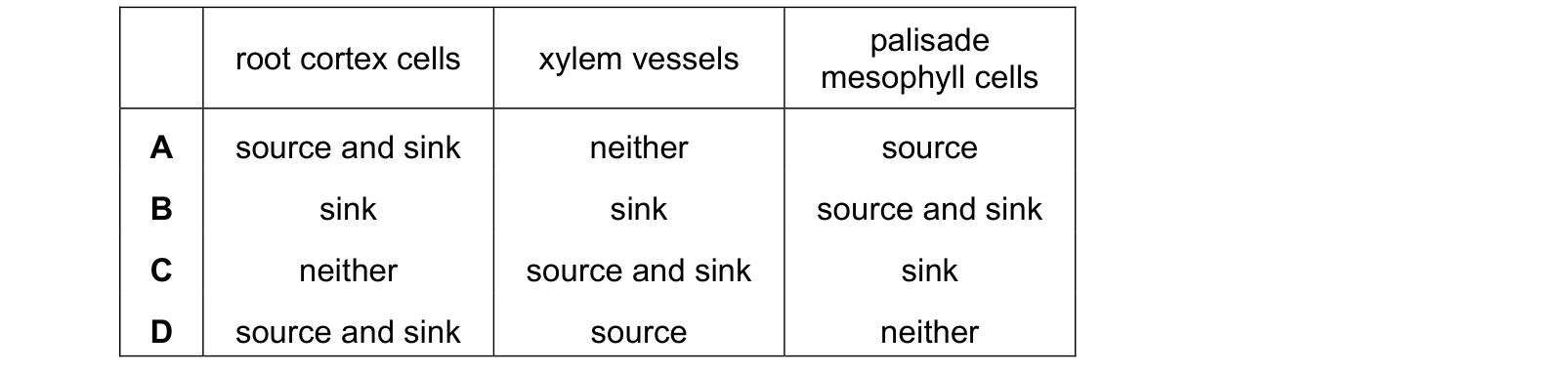
Answer: A.
Palisade mesophyll cells are in the leaf, where photosynthesis makes sucrose, so they are a source.
Root cortex cells are both. They are a sink in summer, receiving and storing sucrose, and a source in spring, releasing it again to supply new growth before the leaves are working. That pairing is what makes translocation two-directional, unlike the one-way flow in the xylem.
Xylem vessels are neither. Xylem carries water and mineral ions upwards only. Sucrose and amino acids travel in the phloem, so the xylem plays no part in this at all.
The fastest route to the answer is the xylem column, since it eliminates every row that assigns it a role.
Question 2
The diagram shows a villus. Which parts transport glucose and fatty acids away from the villus? Each answer gives, in order: glucose; fatty acids.
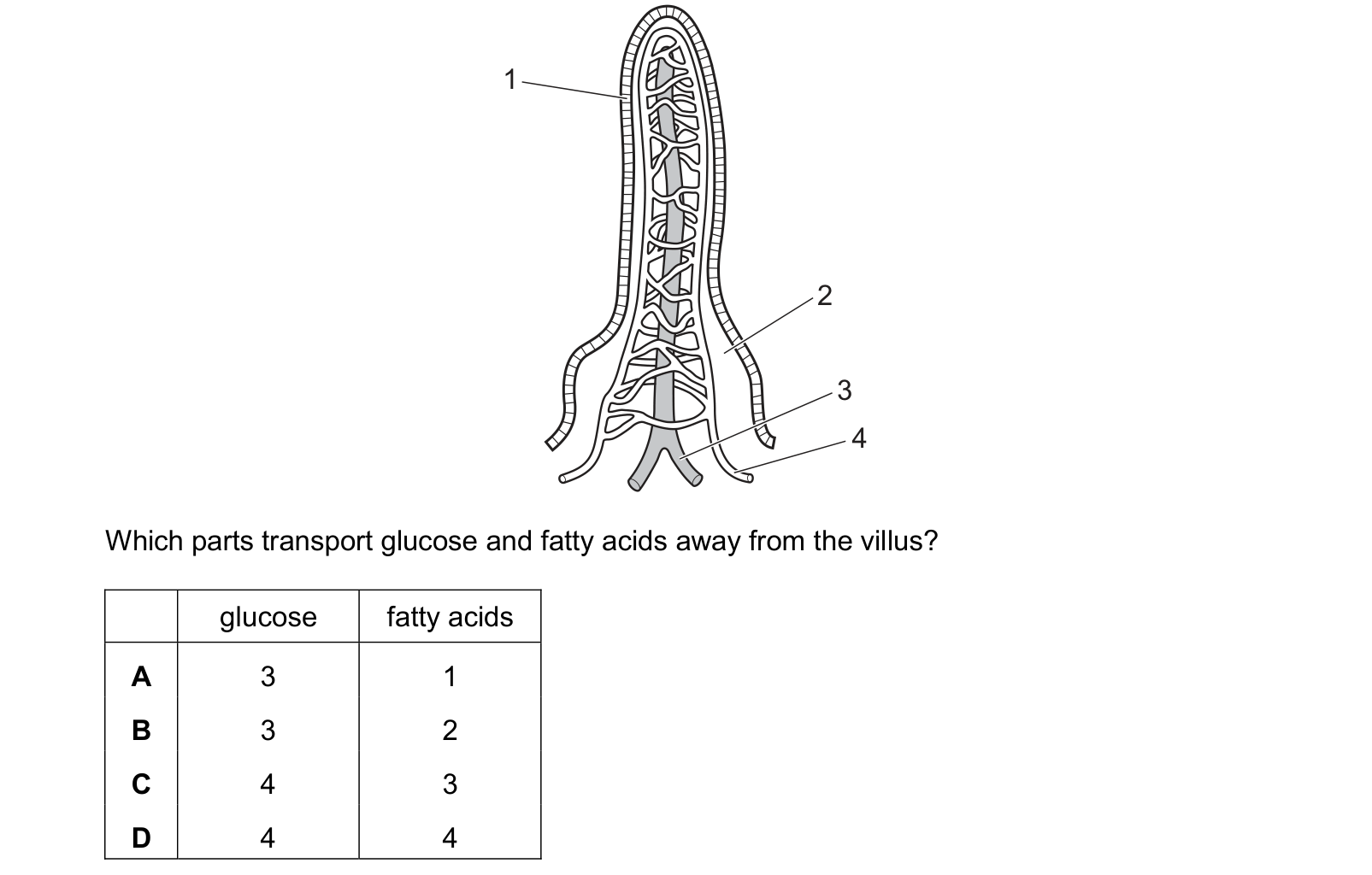
Answer: C.
Glucose is water-soluble, so it is absorbed into the blood and leaves in the blood vessel, 4.
Fatty acids are not water-soluble, so they are absorbed into the lacteal and leave in the lymph vessel, 3, the one continuous with the shaded column up the centre.
So glucose 4, fatty acids 3.
1 is the epithelium, the villus surface where absorption happens. It is where the substances enter, not what carries them away. 2 is a capillary within the villus, part of the network rather than the vessel leaving it.
Reading the two words away from carefully is what separates the right answer from options built on the parts that do the absorbing.
Question 3
Large biological molecules are made of smaller molecules. Which row correctly matches the large molecule with the smaller molecules? Each answer gives, in order: large molecule; smaller molecules.
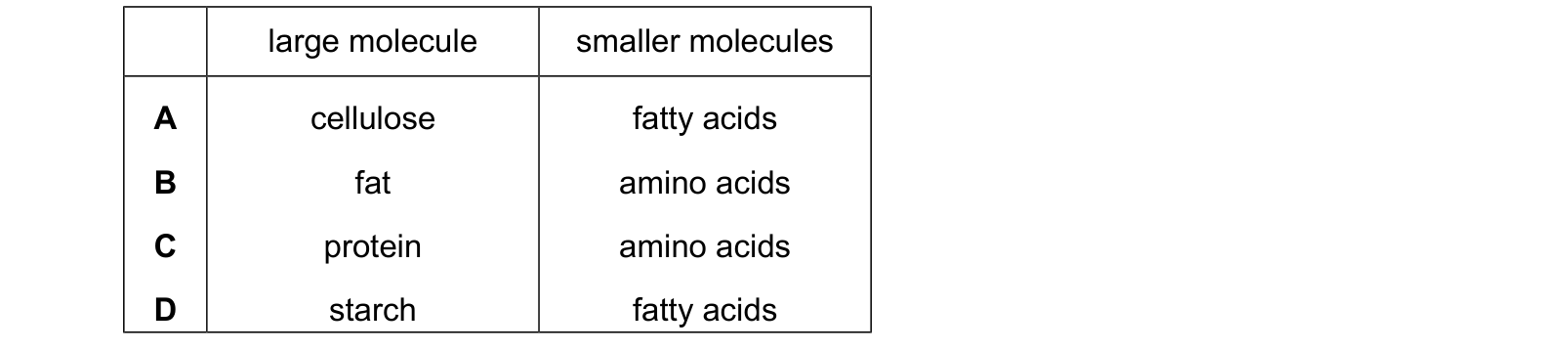
Answer: C.
The check that settles all four is one line: carbohydrates come from simple sugars, proteins from amino acids, fats and oils from fatty acids and glycerol.
Applying it, cellulose (A) and starch (D) are both carbohydrates, so both are built from glucose, not fatty acids. And fat (B) is built from fatty acids and glycerol, not from amino acids.
Notice that two wrong rows offer fatty acids for a carbohydrate and one offers amino acids for a fat, so the mistakes run in both directions. Deciding what group the large molecule belongs to first, before looking at the second column, is what makes this quick.
What the syllabus asks for on this topicSyllabus points
Syllabus points
- List the chemical elements that make up carbohydrates, fats and proteins.
- State that large molecules are made from smaller basic units.
- Describe the food tests for starch, reducing sugars, protein and fats.
- Describe the structure of a DNA molecule and explain complementary base pairing.
Related CIE 0610 Biology topics
Not the topic you were looking for? Describe what you are stuck on in your own words and we will take you to the notes that answer it.