Reproduction
Contents: 9 sections
Asexual and sexual reproduction
Asexual reproduction is the process resulting in genetically identical offspring from one parent.
Sexual reproduction is the process involving the fusion of the nuclei of two gametes to form a zygote and the production of offspring that are genetically different from each other.
The whole comparison follows from those definitions:
| Asexual | Sexual | |
|---|---|---|
| Parents | one | two |
| Offspring | genetically identical, a clone | genetically different |
| Variation | none, except by mutation | plenty |
| Speed | fast | slower |
| Gametes | none | two, fusing |
Advantages of asexual: fast, no mate needed, all offspring keep the parent's successful characteristics, and good conditions can be exploited quickly.
Disadvantage of asexual: no variation. If the environment changes or a disease arrives, every individual is equally vulnerable, so the whole population can be wiped out.
Advantage of sexual: variation means some individuals may survive a change in conditions, and it is the raw material for natural selection and for selective breeding.
Disadvantages of sexual: slower, requires a mate, and useful combinations of characteristics can be broken up.
A gardener wanting plants identical to an existing one uses an asexual method: cuttings, or growing from a tuber or runner. That is a very common question.
Flowers and pollination
Pollination is the transfer of pollen grains from the male part of the plant (anther of stamen) to the female part of the plant (stigma).
The male part is the stamen: anther plus filament. The female part is the carpel: stigma, style and ovary containing ovules.
The two pollination strategies produce very different flowers:
| Insect-pollinated | Wind-pollinated | |
|---|---|---|
| Petals | large, brightly coloured, scented | small, green, no scent |
| Nectar | present | absent |
| Anthers | inside the flower, firm | hanging outside, loose |
| Stigma | inside, sticky | outside, large and feathery |
| Pollen | sticky or spiky, less of it | smooth and light, huge amounts |
Every difference follows from the method. Wind pollination is random, so it needs enormous quantities of light pollen and a large feathery stigma to catch it. Insect pollination is targeted, so the plant invests in attracting the insect instead.
Self-pollination is transfer to a stigma on the same plant; cross-pollination is to a different plant of the same species. Cross-pollination gives more variation, which is its advantage.
Fertilisation and germination in plants
After pollination, the pollen grain grows a pollen tube down the style to the ovule. The male nucleus travels down it, and fertilisation is the fusion of the pollen nucleus with the ovule nucleus.
Then: the ovule becomes the seed, and the ovary becomes the fruit.
Germination needs three conditions: water, oxygen and a suitable temperature. Water activates enzymes and lets the seed swell, oxygen is needed for aerobic respiration to release energy for growth, and temperature must suit the enzymes. Light is not required, which is a frequent trap.
The human reproductive systems
Male: testes make sperm and testosterone; scrotum holds them outside the body where it is cooler; sperm ducts carry sperm; prostate gland adds fluid to make semen; urethra carries semen out; penis.
Female: ovaries make eggs and oestrogen; oviducts carry the egg towards the uterus and are where fertilisation happens; uterus where the fetus develops; cervix the ring of muscle at its base; vagina.
Fertilisation and the fetus
Fertilisation is the fusion of the nuclei of a sperm and an egg cell, and it happens in the oviduct.
The resulting zygote divides repeatedly to form a ball of cells, the embryo, which travels to the uterus and implants in its lining.
The placenta develops as the exchange surface between mother and fetus, connected by the umbilical cord.
Across the placenta, from mother to fetus: oxygen, glucose, amino acids, water, minerals, antibodies. From fetus to mother: carbon dioxide and urea.
The two bloodstreams never mix. They come very close, separated by a thin barrier with a large surface area, and exchange happens by diffusion. Keeping them separate matters because the blood pressures differ and the blood groups may differ.
Some harmful substances still cross, which is why nicotine, alcohol, some drugs and some pathogens such as HIV and rubella can reach the fetus.
The amniotic sac contains amniotic fluid, which cushions the fetus against physical damage.
The menstrual cycle
About 28 days, counted from the first day of bleeding.
- Days 1 to 5 — menstruation, the uterus lining breaks down and is lost.
- Days 6 to 13 — the lining rebuilds and thickens, driven by oestrogen from the ovary.
- Day 14 — ovulation, an egg is released.
- Days 15 to 28 — progesterone maintains the thick lining ready for implantation.
If the egg is not fertilised, progesterone falls and the lining breaks down, starting the next cycle. If it is fertilised, progesterone stays high and the lining is maintained.
The fertile period is around ovulation, which matters for both conceiving and avoiding conception.
Birth control
- Natural — avoiding intercourse near ovulation.
- Chemical — the contraceptive pill, containing hormones that prevent ovulation; spermicides.
- Barrier — condom, diaphragm. Only the condom also reduces the transmission of sexually transmitted infections.
- Surgical — vasectomy, cutting the sperm ducts; female sterilisation, cutting the oviducts.
HIV and AIDS
HIV is a virus transmitted through body fluids: unprotected sexual contact, sharing needles, infected blood transfusions, and from mother to child across the placenta or in breast milk.
HIV infects and destroys lymphocytes. Since lymphocytes produce antibodies, the immune system is progressively weakened, and the person becomes vulnerable to infections they would normally fight off. That condition is AIDS.
Prevention: use condoms, do not share needles, screen donated blood, and treat infected mothers to reduce transmission.
Check you have it
Question 1
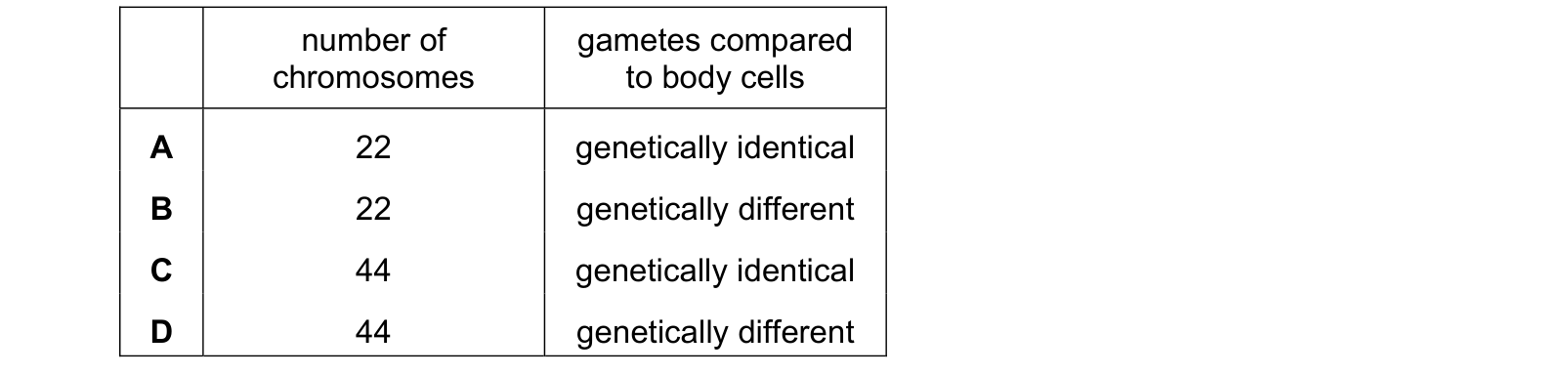
A rabbit has 44 chromosomes in each of its body cells. Which row correctly describes the gamete cells? Each answer gives, in order: number of chromosomes; gametes compared to body cells.
Answer: B.
A rabbit body cell has 44, which is diploid, two sets of 22. Gametes are made by meiosis, which halves the number, so each gamete is haploid with 22. That halving is what allows fertilisation to restore 44 rather than doubling it every generation.
They are also genetically different, and for two reasons. Each gamete receives only one of each pair of chromosomes, and which one it gets is decided independently for every pair, so no two gametes carry the same combination.
44 and identical (C) describes a cell produced by mitosis, which is how the rabbit's body cells are made.
22 and identical (A) gets the halving right but misses the shuffling, and 44 and different (D) does the reverse.
Genetic variation among the gametes is what makes sexually produced offspring differ from each other.
Question 2
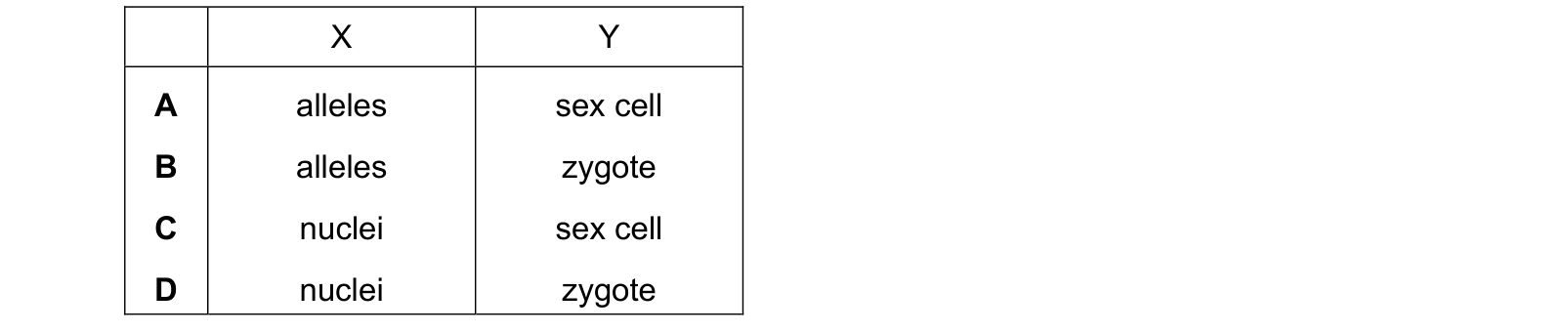
Fertilisation is defined as the fusion of the ……X…… of two gametes to form a ……Y…… . Which row completes the sentence? Each answer gives, in order: X; Y.
Answer: D.
Nuclei, because the nucleus is where the chromosomes are. Each gamete's nucleus carries a haploid set, 23 in a human, and joining them gives a diploid cell with 46.
Zygote, because that is the name of the single cell produced. It then divides by mitosis to form an embryo.
Alleles (A and B) are different versions of the same gene, such as the allele for brown eyes against the one for blue. Individual alleles do not fuse; whole nuclei do, bringing all the alleles with them.
Sex cell (A and C) is another name for a gamete, so it names the ingredient rather than the product. Two gametes fusing to form a gamete would make no sense.
So the sentence describes both what joins, the nuclei, and what results, a zygote with a full set of chromosomes.
Question 3
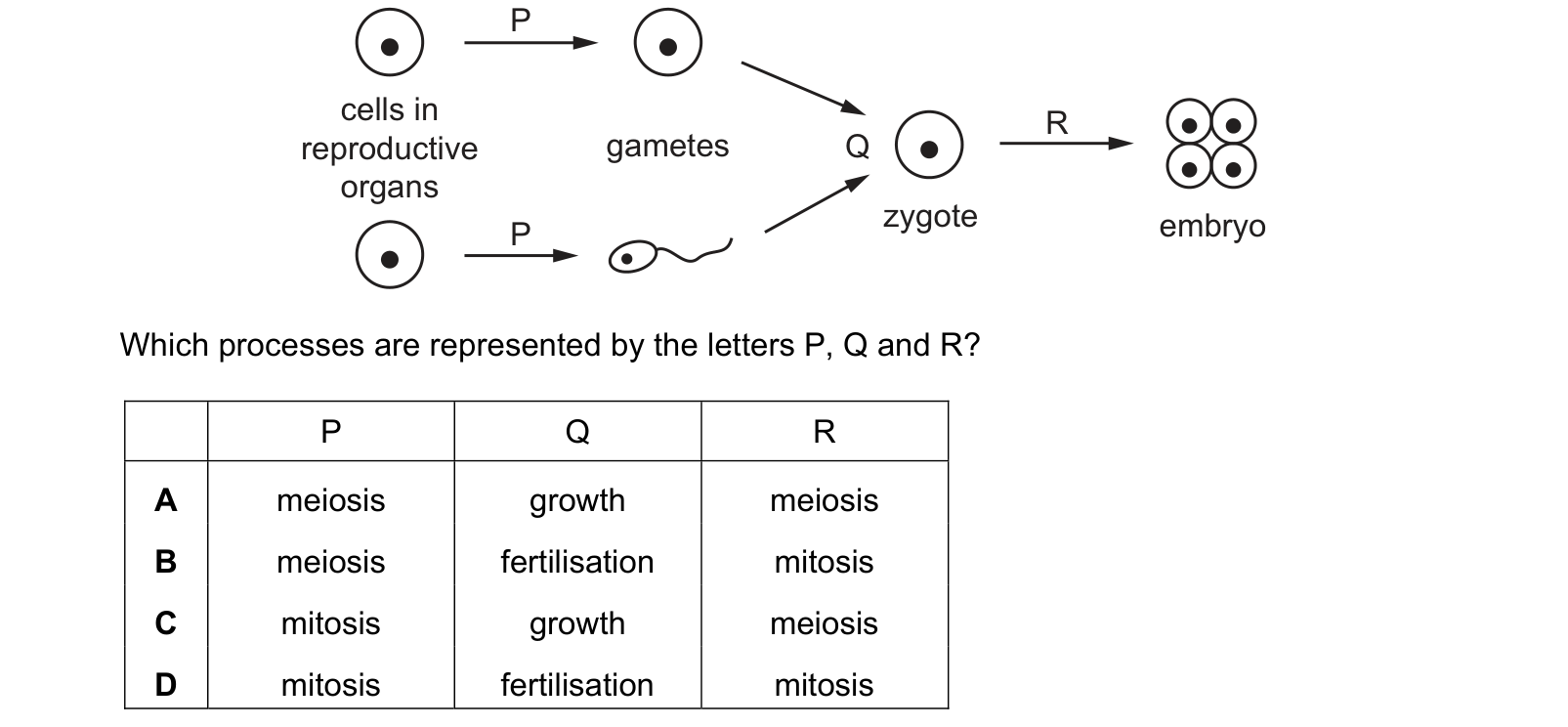
The diagram represents processes in sexual reproduction. Which processes are represented by the letters P, Q and R? Each answer gives, in order: P; Q; R.
Answer: B.
Follow the diagram. P turns cells in the reproductive organs into gametes, and gametes are made by meiosis, which halves the chromosome number and produces genetically varied cells.
Q brings the egg and the sperm together to form a zygote. Two arrows converging on one cell is fusion, which is fertilisation.
R turns that single zygote into a four-celled embryo. Dividing to produce identical cells for growth is mitosis.
Growth for Q (A and C) misreads the arrows: two cells become one, which is the opposite of growth.
Mitosis for P (C and D) would leave the gametes diploid, and the zygote would then have 92 chromosomes.
Meiosis for R (A and C) would halve the chromosome number in the embryo, which cannot happen in ordinary growth.
The pattern is halve, fuse, copy.
What the syllabus asks for on this topicSyllabus points
Syllabus points
- Describe asexual and sexual reproduction and discuss their advantages and disadvantages.
- Identify the parts of an insect-pollinated and a wind-pollinated flower.
- Describe pollination, fertilisation, seed formation and germination.
- Identify the parts of the male and female reproductive systems and state their functions.
- Describe fertilisation, the development of the fetus, and the role of the placenta.
- Describe the menstrual cycle and the roles of the sex hormones.
- Describe methods of birth control and the transmission and prevention of HIV.
Related CIE 0610 Biology topics
Not the topic you were looking for? Describe what you are stuck on in your own words and we will take you to the notes that answer it.