Plant nutrition
Contents: 6 sections
Photosynthesis
Photosynthesis is the process by which plants make carbohydrates from raw materials, using energy from light.
Word equation:
carbon dioxide + water → glucose + oxygen (in the presence of light and chlorophyll)
Balanced equation:
6CO₂ + 6H₂O → C₆H₁₂O₆ + 6O₂
Light and chlorophyll are written above and below the arrow, not as reactants, because neither is used up. Chlorophyll absorbs light energy and transfers it to chemical energy in the glucose. It is a catalyst-like participant, not an ingredient.
The glucose made is used immediately for respiration, converted to starch for storage, or used to build cellulose for cell walls, proteins once nitrate is added, and fats and oils.
The four classic experiments
Each tests one requirement, and each uses the same trick: destarch the plant first by leaving it in the dark for 24 to 48 hours, so any starch found afterwards must have been made during the experiment. Skipping that step invalidates the whole test.
Testing a leaf for starch: boil it in water to kill it and stop reactions, boil it in ethanol to remove the chlorophyll so the colour can be seen, dip it in hot water to soften it, then add iodine solution. Blue-black means starch is present.
- Light needed. Cover part of a leaf with foil. Only the exposed part turns blue-black.
- Chlorophyll needed. Use a variegated leaf. Only the green parts turn blue-black; the white parts have no chlorophyll and make no starch.
- Carbon dioxide needed. Enclose one plant with soda lime, which absorbs carbon dioxide. That leaf makes no starch.
- Oxygen produced. Collect the gas from pondweed and test it with a glowing splint. It relights.
Ethanol must be heated in a water bath, not over a flame, because it is flammable. That is a marked point in a practical question.
Limiting factors
At any moment the rate of photosynthesis is set by whichever factor is in shortest supply. That factor is the limiting factor, and increasing anything else has no effect until it is dealt with.
Reading a limiting-factor graph is a standard question:
- Where the line is rising, the factor on the x-axis is limiting, because increasing it increases the rate.
- Where the line has levelled off, that factor is no longer limiting, so something else is: usually carbon dioxide concentration or temperature.
Light intensity. Rate rises with light, then plateaus.
Carbon dioxide concentration. Rate rises, then plateaus. Carbon dioxide is only 0.04% of air, so it is limiting more often than students expect.
Temperature. Different shape, and the difference is the point. The rate rises to an optimum and then falls, because photosynthesis is controlled by enzymes and enzymes denature. A plateau means a limiting factor; a fall means denaturation.
Growers exploit all three in a greenhouse: extra lighting, a carbon dioxide burner and heating, each removed as a limit in turn.
Leaf structure
Every feature of a leaf answers a problem.
- Large flat surface area — absorbs the most light.
- Thin — carbon dioxide diffuses only a short distance to reach the cells.
- Waxy cuticle — transparent so light passes through, waterproof so water is not lost.
- Upper epidermis — transparent and with no chloroplasts, so light reaches the layer below.
- Palisade mesophyll — long cells packed with chloroplasts, at the top where light is strongest. This is where most photosynthesis happens.
- Spongy mesophyll — loosely packed with air spaces, so carbon dioxide diffuses freely to every cell.
- Stomata — pores, mostly on the lower surface, letting carbon dioxide in and oxygen out.
- Guard cells — open and close the stomata, controlling gas exchange and water loss.
- Xylem — brings water to the leaf. Phloem — carries sucrose away.
Mineral ions
Photosynthesis makes carbohydrate, which contains only carbon, hydrogen and oxygen. Anything else the plant needs must come from the soil as ions.
- Nitrate ions are needed to make amino acids, and so proteins. A shortage causes poor growth and yellow older leaves.
- Magnesium ions are needed to make chlorophyll. A shortage causes yellowing between the veins, because without chlorophyll the leaf cannot stay green.
These two are asked about constantly and are easy to separate: nitrate is for protein, magnesium is for chlorophyll.
Check you have it
Question 1
Which features of a leaf allow more diffusion of carbon dioxide into the palisade cells for photosynthesis? Each answer gives, in order: number of stomata; thickness of the leaf.
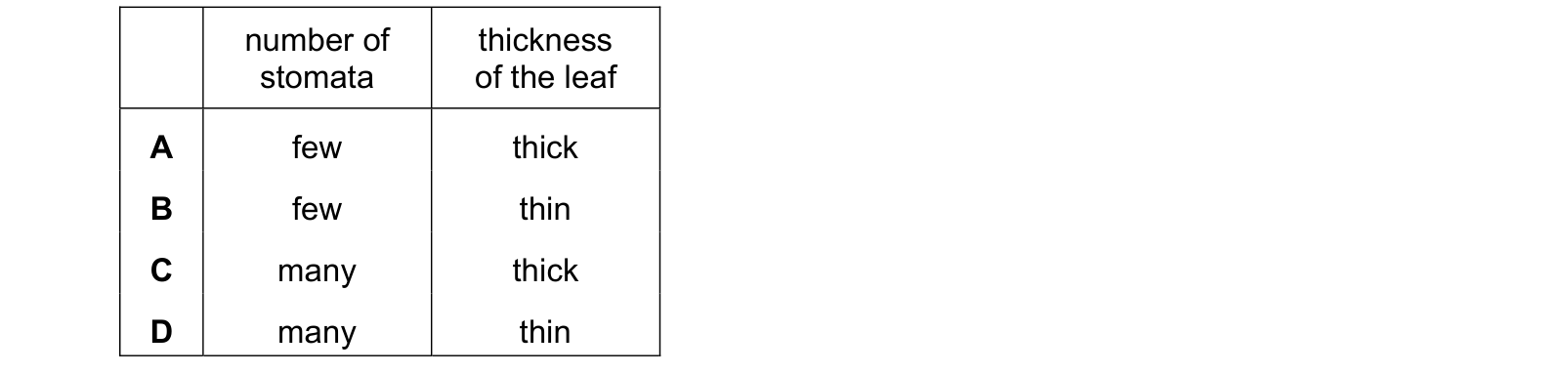
Answer: D.
Many stomata give more openings for carbon dioxide to diffuse through, so more enters per second.
A thin leaf means a short diffusion distance from the stoma to the palisade cells at the top. Diffusion is slow over long distances, so the thinner the leaf, the faster the gas arrives.
A thick leaf would leave cells in the middle poorly supplied, and light would not reach them either, which is why most leaves are broad and thin rather than chunky.
The two features are part of the same set of adaptations: large surface area to catch light and exchange gases, thin for short diffusion distances, air spaces in the spongy layer to let gases move, and stomata to let them in and out.
Thick leaves with few stomata do exist, on xerophytes, but that is a compromise for saving water rather than an adaptation for photosynthesis.
Question 2
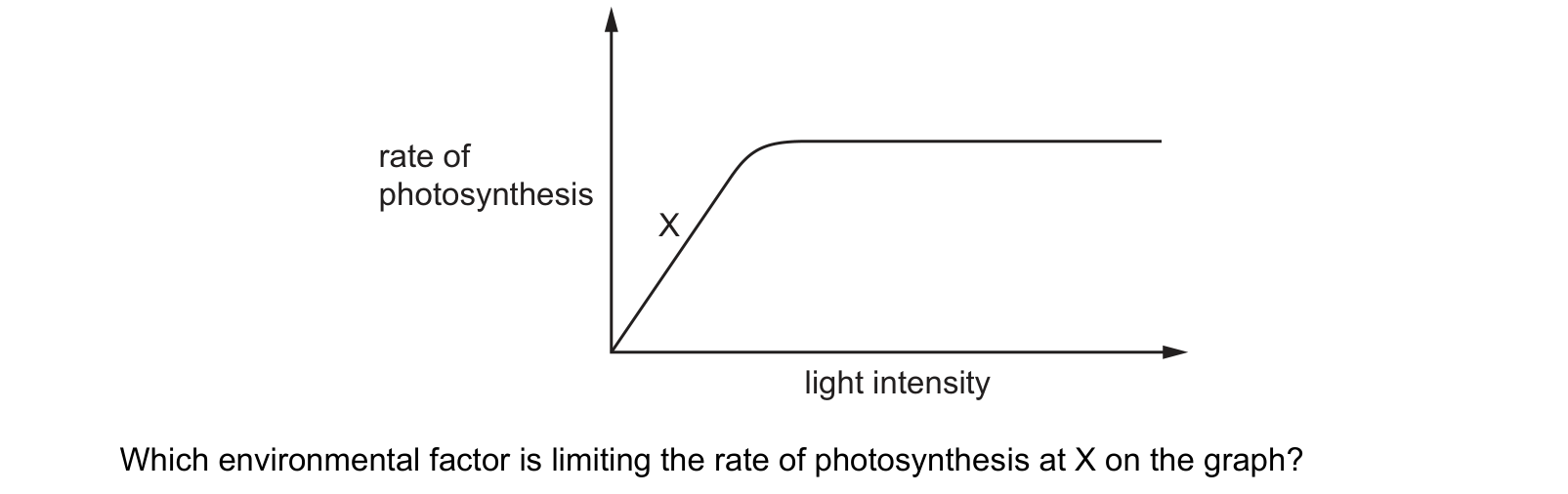
The graph shows the effect of light intensity on the rate of photosynthesis. Which environmental factor is limiting the rate of photosynthesis at X on the graph?
Answer: B.
The reasoning is worth stating in general terms. If increasing a factor increases the rate, that factor is limiting. If increasing it changes nothing, the rate is being held back by something else.
At X, more light gives more photosynthesis, so light is in short supply relative to everything else.
The other options describe factors that only become limiting later, on the flat part of the curve. Once the line levels off, extra light makes no difference and the limit has passed to carbon dioxide concentration (A) or temperature (D).
Oxygen concentration (C) is never a limiting factor for photosynthesis. Oxygen is a product, not a raw material.
Question 3
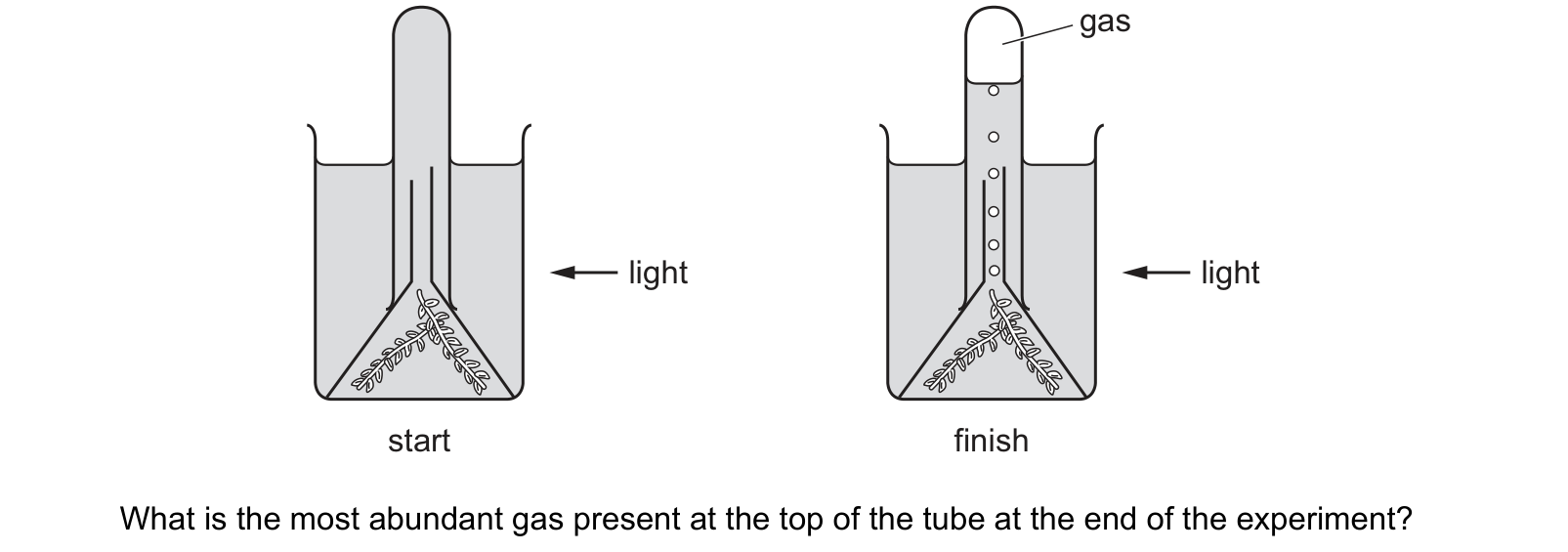
The diagram shows an experiment to investigate photosynthesis. What is the most abundant gas present at the top of the tube at the end of the experiment?
Answer: D.
The equation makes it explicit: carbon dioxide and water go in, glucose and oxygen come out. The oxygen is released from the water, and being a gas it bubbles up and collects at the top.
Carbon dioxide (A) is the gas being used up, not produced. The plant is respiring at the same time and does release some, but in the light photosynthesis far outpaces respiration, so the net movement is the other way.
Methane (B) and sulfur dioxide (C) have nothing to do with photosynthesis at all. Methane comes from decay in the absence of oxygen, and sulfur dioxide from burning fossil fuels.
The standard test confirms it: a glowing splint relights in oxygen, which is how this experiment is usually finished.
What the syllabus asks for on this topicSyllabus points
Syllabus points
- Describe photosynthesis and state the word and balanced chemical equations.
- Explain the importance of chlorophyll in transferring light energy.
- Investigate the need for chlorophyll, light and carbon dioxide, and the production of starch and oxygen.
- Explain the effects of light intensity, carbon dioxide concentration and temperature as limiting factors.
- Explain how the internal structure of a leaf is adapted for photosynthesis.
- Describe the role of nitrate and magnesium ions.
Related CIE 0610 Biology topics
Not the topic you were looking for? Describe what you are stuck on in your own words and we will take you to the notes that answer it.