Inheritance
Contents: 9 sections
Chromosomes, genes and alleles
- A chromosome is a thread of DNA, made up of genes.
- A gene is a length of DNA that codes for a protein.
- An allele is a version of a gene.
Human body cells contain 46 chromosomes, in 23 pairs. Gametes contain 23, one from each pair.
A cell with two of each chromosome is diploid; one with a single set is haploid. Fertilisation joins two haploid gametes to make a diploid zygote, which restores the number and is the reason meiosis has to halve it first.
From gene to protein
The base sequence of a gene determines the sequence of amino acids in a protein, and the sequence of amino acids determines how the protein folds, which determines what it does.
The outline of protein synthesis:
- The DNA of a gene stays in the nucleus, because it is too large to leave.
- A messenger RNA copy of the gene is made and carries the code out of the nucleus.
- The mRNA travels to a ribosome.
- The ribosome reads the code and assembles amino acids in the order specified.
Since every cell has the same genes, what makes cells different is which genes are switched on. A red blood cell precursor makes haemoglobin and a pancreatic cell makes insulin, using the same DNA.
Mitosis and meiosis
| Mitosis | Meiosis | |
|---|---|---|
| Divisions | one | two |
| Daughter cells | 2 | 4 |
| Chromosome number | unchanged, diploid | halved, haploid |
| Genetically | identical to parent | all different |
| Where | growth, repair, replacement, asexual reproduction | gamete production only |
Mitosis produces genetically identical cells, so it is used wherever an exact copy is wanted: growth, repairing damage, replacing worn-out cells, and asexual reproduction. Chromosomes are copied exactly before division, so each daughter cell gets a complete set.
Meiosis is a reduction division. It halves the chromosome number, which is necessary because fertilisation doubles it again. It also produces variation, because the chromosomes of each pair are shuffled independently, so every gamete carries a different combination.
The genetic vocabulary
Precision here is worth marks, since several of these are easy to blur.
- Genotype — the alleles present, written as letters, such as Bb.
- Phenotype — the observable features, such as brown eyes.
- Homozygous — two identical alleles, BB or bb.
- Heterozygous — two different alleles, Bb.
- Dominant — an allele expressed when only one copy is present.
- Recessive — expressed only when two copies are present.
Use a capital letter for the dominant allele and the same letter in lower case for the recessive one. Choosing letters whose capitals and lower case look different, such as B and b rather than S and s, avoids losing marks to handwriting.
Genetic diagrams
Set them out the same way every time:
- State the parents' phenotypes and genotypes.
- Show the gametes, circled, each carrying one allele.
- Combine them in a Punnett square.
- State the offspring genotypes and phenotypes, with the ratio.
Worked example. Two heterozygous brown-eyed parents, Bb × Bb.
Gametes: B and b from each.
| B | b | |
|---|---|---|
| B | BB | Bb |
| b | Bb | bb |
Offspring: 1 BB, 2 Bb, 1 bb, so 3 brown : 1 blue.
Say probability, not certainty. A 3:1 ratio means each offspring has a 3 in 4 chance of brown eyes; it does not mean that in four children exactly three will have them. Each fertilisation is independent, which is also why a man with three sons still has a 1 in 2 chance that his next child is a daughter.
Codominance
Sometimes neither allele is recessive and both are expressed in a heterozygote.
Human blood groups are the standard example. The alleles I^A and I^B are codominant, and I^O is recessive to both.
- Group A: I^A I^A or I^A I^O
- Group B: I^B I^B or I^B I^O
- Group AB: I^A I^B, with both expressed
- Group O: I^O I^O
So a parent of group AB and one of group O can only have children of group A or group B, never AB or O, which is exactly the sort of question set on this.
Sex determination and sex linkage
Sex is determined by one pair of chromosomes: XX is female, XY is male. Since the mother can only pass on an X, it is the father's gamete that determines sex, and the ratio is always 1:1.
A sex-linked characteristic is one whose gene is on the X chromosome. The Y chromosome is much smaller and lacks the corresponding gene, so a male has only one copy.
That asymmetry is the whole of sex linkage. A male with a single recessive allele on his X has the condition, because there is no second allele to mask it. A female needs two copies. This is why red-green colour blindness and haemophilia are far more common in males, and why a female with one copy is a carrier.
Write these genotypes with the allele on the X: X^B X^b for a carrier female, X^b Y for an affected male.
Stem cells
A stem cell is an unspecialised cell that divides by mitosis to produce cells that can become specialised.
- In animals, stem cells are found in the early embryo and in adult tissues such as bone marrow, which produces blood cells.
- In plants, stem cells are found in the meristems at root and shoot tips, which is why a plant can grow new organs throughout its life.
Medical uses include replacing damaged tissue and treating conditions such as leukaemia with bone marrow transplants. Embryonic stem cells can become any cell type, which makes them more useful and also the reason their use is debated.
Check you have it
Question 1
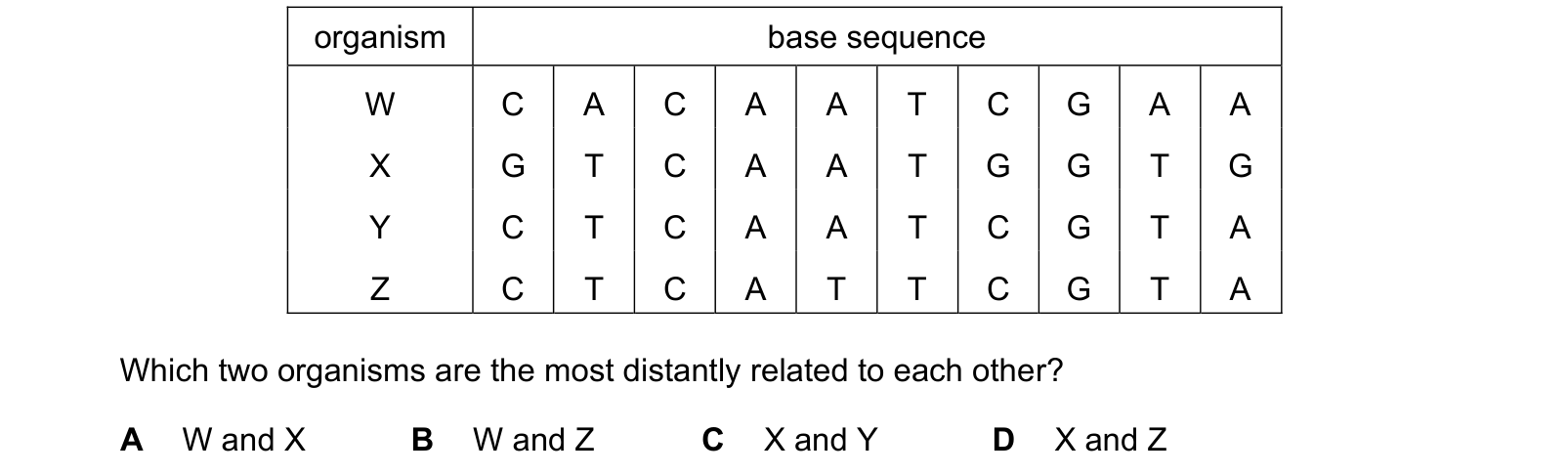
The table shows a section of DNA taken from four different organisms.
organism base sequence Which two organisms are the most distantly related to each other?
Answer: A.
The method is to count the positions where two sequences differ, since the more differences there are, the longer ago the two species shared an ancestor.
Compare W with X base by base and they differ at five positions. No other pair in the table differs by as many.
W and Z differ at three positions. X and Y differ at three. X and Z differ at four.
So W and X are the most different, and therefore the most distantly related.
The trap is to compare only the first base or two and stop. Every position must be checked, and it is worth writing the two sequences one above the other before counting.
Comparing DNA base sequences is the most accurate way of classifying organisms, because it looks directly at the inherited material rather than at features that can look similar for unrelated reasons.
Question 2
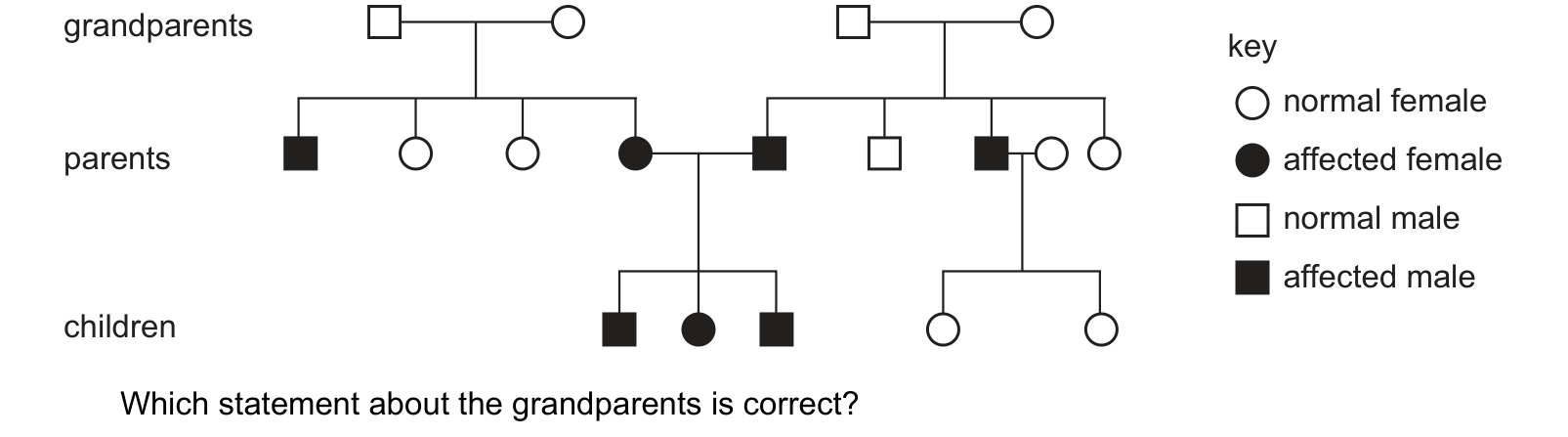
The diagram shows a family tree. Some individuals have inherited a genetic condition.
grandparents parents affected female children
Which statement about the grandparents is correct?
Answer: B.
All four grandparents are unaffected, yet each couple has affected children. Two unaffected parents can only produce an affected child if the condition is recessive and both of them carry the allele hidden. Each grandparent is therefore heterozygous, carrying one recessive allele alongside a dominant one.
Each carries two recessive alleles (A) would mean each grandparent had the condition themselves, and the diagram shows none of them does.
Only the grandmothers are heterozygous (C) and only the grandfathers are heterozygous (D) both leave one parent in each couple with no recessive allele to contribute. An affected child needs one from each side.
Affected children born to unaffected parents is the standard signature of a recessive condition, and it also shows the condition is not sex-linked, since affected males and females appear in equal numbers.
Question 3
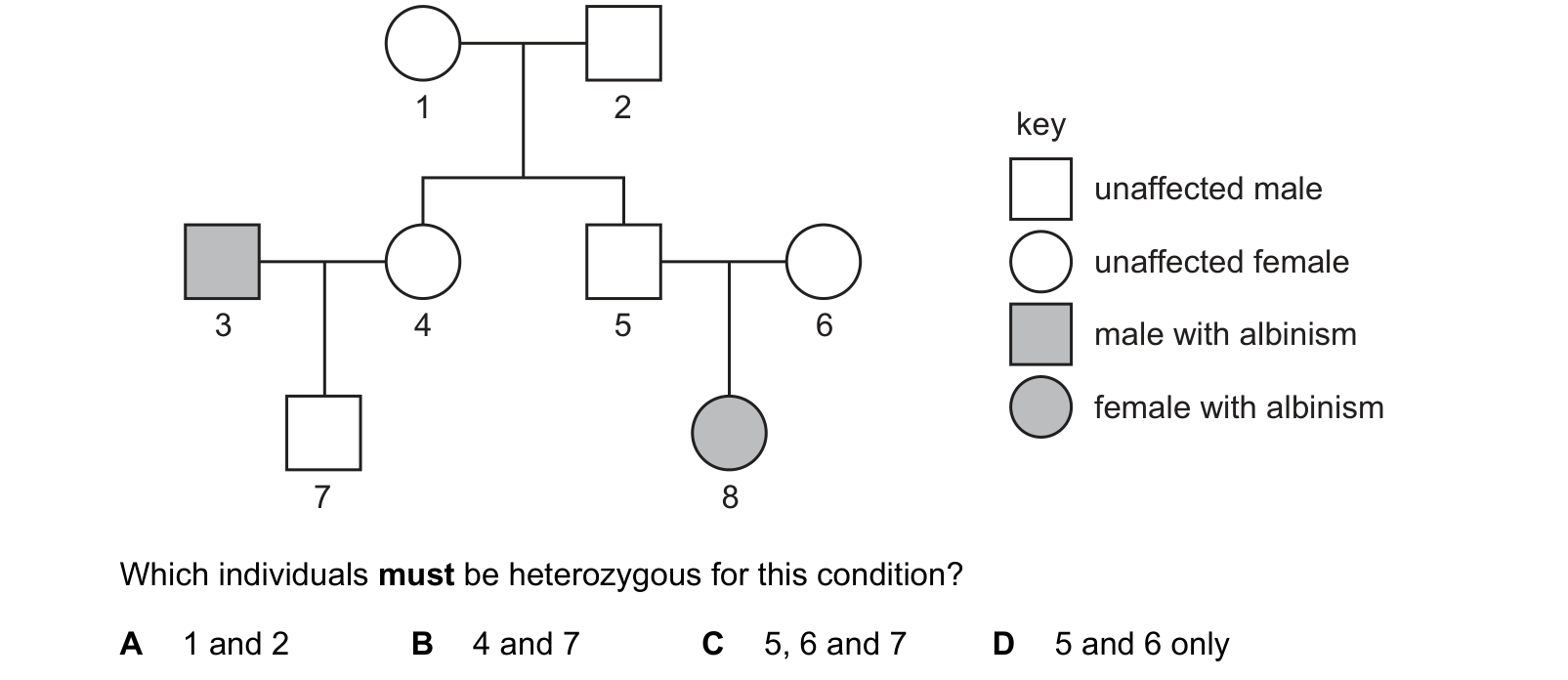
The diagram shows the inheritance of albinism in one family. Albinism is an inherited condition caused by a recessive allele. Which individuals must be heterozygous for this condition?
Answer: C.
Albinism is recessive, so an affected person is homozygous recessive and an unaffected carrier is heterozygous.
5 and 6 are unaffected, and their daughter 8 has albinism. She has two recessive alleles, one from each parent, so both 5 and 6 must carry one hidden. Both are heterozygous.
7 is unaffected, and his father 3 has albinism. Individual 3 is homozygous recessive, so every child of his receives a recessive allele. Since 7 does not have the condition, he must have received a dominant allele from his mother, which makes him heterozygous too.
1 and 2 (A) cannot be pinned down. Their son 5 is a carrier, so at least one of them carries the allele, but not necessarily both.
4 (B) is unaffected and might be homozygous dominant, so she is not forced.
The word must is what the question turns on.
What the syllabus asks for on this topicSyllabus points
Syllabus points
- Describe inheritance, chromosomes, genes and alleles.
- Explain how the base sequence of a gene determines a protein, and outline protein synthesis.
- Describe mitosis and meiosis and state where each occurs.
- Define and use the genetic terms and construct genetic diagrams.
- Explain codominance and sex-linked inheritance.
- Describe stem cells and their uses.
Related CIE 0610 Biology topics
Not the topic you were looking for? Describe what you are stuck on in your own words and we will take you to the notes that answer it.