Respiration
Contents: 7 sections
What respiration is
Respiration is the chemical reactions in cells that break down nutrient molecules and release energy for metabolism.
Two things to be clear about from the start.
Respiration is not breathing. Breathing is the movement of air in and out of the lungs. Respiration happens inside every living cell, in every organism, all the time. Plants respire as well as photosynthesise, and they respire day and night.
Energy is released, not made. The energy was already in the glucose; respiration transfers it into a usable form. An answer saying respiration "produces energy" loses the mark.
The energy released is used for muscle contraction, active transport, building large molecules from small ones, cell division, growth, and in mammals and birds keeping the body temperature constant.
Aerobic respiration
Aerobic respiration is the release of a relatively large amount of energy in cells by the breakdown of food substances in the presence of oxygen.
Word equation:
glucose + oxygen → carbon dioxide + water
Balanced equation:
C₆H₁₂O₆ + 6O₂ → 6CO₂ + 6H₂O
It takes place mainly in the mitochondria, which is why cells with high energy demands, such as muscle cells, sperm cells and root hair cells, contain so many of them.
Notice this equation is the reverse of photosynthesis. That is worth seeing, but do not let it confuse the two: photosynthesis stores energy from light in glucose, and respiration releases it again.
Anaerobic respiration
Anaerobic respiration is the release of a relatively small amount of energy by the breakdown of food substances in the absence of oxygen.
The word relatively matters. Anaerobic respiration releases much less energy per glucose molecule, because the glucose is only partly broken down and the products still contain a great deal of chemical energy.
In muscle:
glucose → lactic acid
In yeast and plants:
glucose → alcohol + carbon dioxide
The yeast reaction is fermentation, and it is the basis of both brewing, where the alcohol is wanted, and bread making, where the carbon dioxide is wanted because it makes the dough rise. The alcohol evaporates during baking.
Oxygen debt
During hard exercise the heart and lungs cannot deliver oxygen fast enough, so muscles respire anaerobically as well as aerobically. This produces lactic acid, which builds up and causes muscle fatigue and pain.
The oxygen debt is the extra oxygen the body needs after exercise to break down that lactic acid.
This is why breathing rate and heart rate stay high after exercise has stopped. Blood carries the lactic acid to the liver, where it is broken down using oxygen, and deep breathing continues until the debt is repaid.
Comparing the two
| Aerobic | Anaerobic | |
|---|---|---|
| Oxygen | required | not required |
| Energy released | relatively large | relatively small |
| Products in muscle | carbon dioxide and water | lactic acid |
| Products in yeast | carbon dioxide and water | alcohol and carbon dioxide |
| Glucose breakdown | complete | incomplete |
Investigating respiration
Yeast and temperature. Yeast is mixed with a sugar solution and kept at different temperatures, and the carbon dioxide given off is measured, either by counting bubbles or by collecting the gas. The rate rises with temperature to an optimum and then falls, because respiration is controlled by enzymes, which denature above the optimum. A curve that rises and then falls is the signature of an enzyme-controlled process.
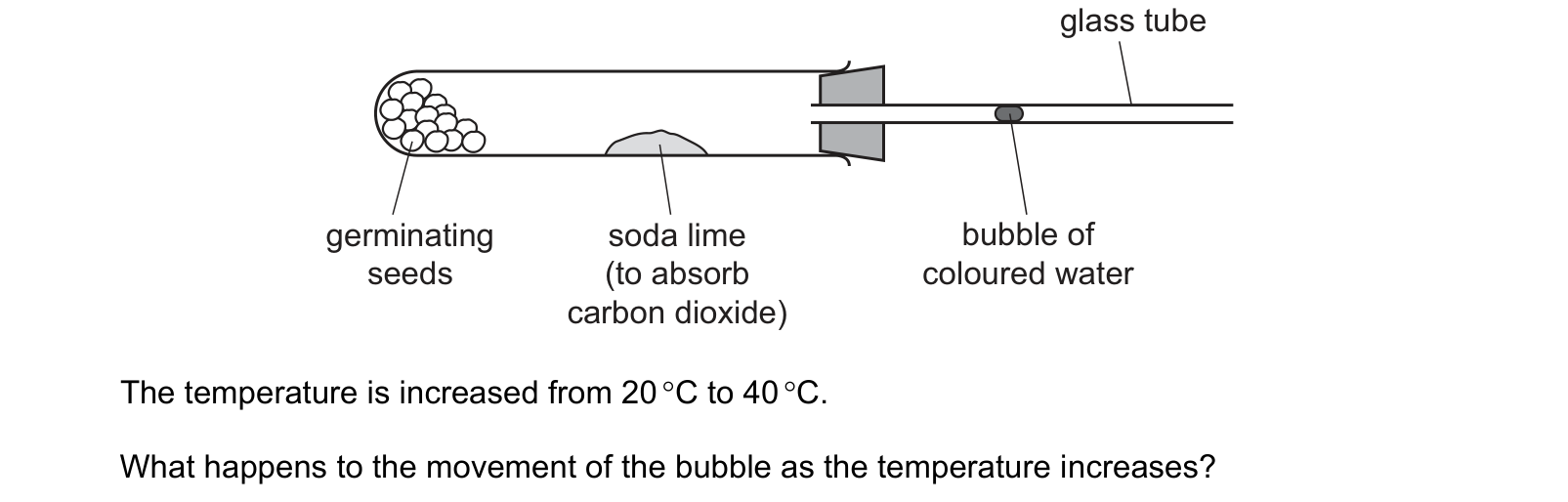
Germinating seeds. Germinating seeds respire rapidly. In a sealed flask with soda lime to absorb the carbon dioxide produced, the volume of gas falls as oxygen is used up, drawing liquid along a capillary tube. Boiled seeds are the control: they are dead, so they do not respire, and the liquid does not move. Including a control like that is often worth a mark on its own.
Germinating seeds also release heat, which is why a vacuum flask of them warms up while a flask of dead seeds does not.
Check you have it
Question 1
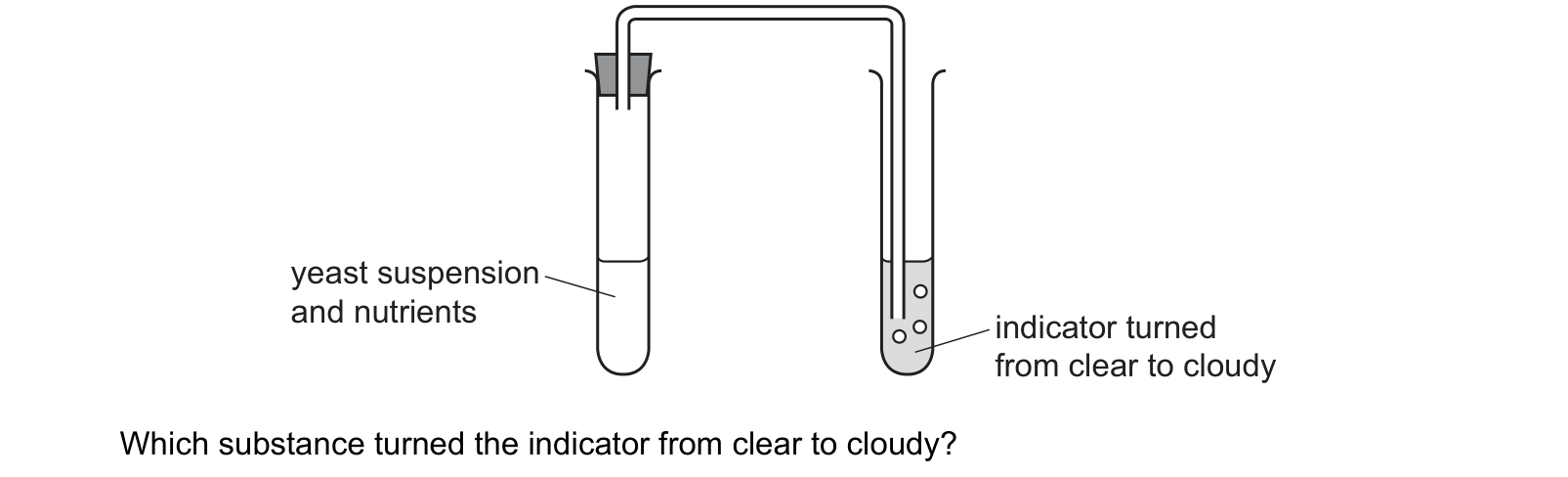
A student investigated the effect of temperature on respiration in yeast.
The diagram shows the apparatus they used. Which substance turned the indicator from clear to cloudy?
Answer: A.
The indicator is limewater, and carbon dioxide is the only substance here that turns it milky. Yeast respiring produces carbon dioxide whether it does so aerobically or anaerobically, so the gas is produced either way.
Oxygen (C) does not affect limewater, and yeast uses oxygen rather than producing it. Producing oxygen is photosynthesis, and yeast is a fungus with no chlorophyll.
Glucose (B) is the food supply the yeast is respiring, and it stays in the flask. It is not a gas, so it cannot bubble through to the indicator at all.
Water (D) is also produced in aerobic respiration, and it has no effect on limewater.
The test is worth stating precisely: limewater going milky identifies carbon dioxide, and it detects presence rather than amount.
Question 2
What is the effect on germinating seeds of increasing the temperature from 10 °C to 20 °C?
Answer: C.
A germinating seed is respiring hard, releasing energy from its food store to build new tissue. Respiration is a chain of enzyme-controlled reactions, so warming towards the optimum gives the molecules more kinetic energy, more collisions, and a faster rate.
A decrease in the respiration rate (B) is the opposite, and would happen on cooling.
A decrease in the production of oxygen (A) is wrong twice over. Respiration uses oxygen rather than producing it, and a germinating seed is not photosynthesising: it has no leaves and often no chlorophyll yet.
An increase in the transpiration rate (D) is wrong because a seed has no leaves and no stomata, so it does not transpire at all.
That heavy respiration is why germinating seeds are used to demonstrate it: they consume enough oxygen to move a marker in an hour, and release enough heat to warm a vacuum flask.
Question 3
The diagram shows the apparatus used to measure the rate of respiration in germinating seeds. As the seeds respire, the bubble of coloured water moves along the glass tube. seeds (to absorb coloured water carbon dioxide)
The temperature is increased from 20 °C to 40 °C.
What happens to the movement of the bubble as the temperature increases?
Answer: A.
Two things have to be right: the direction and the effect of temperature.
The direction follows from the apparatus. The seeds use oxygen and produce carbon dioxide, which on its own would leave the volume unchanged. But the tube contains an absorber that removes the carbon dioxide as fast as it is made. So there is a net loss of gas, the pressure falls, and the bubble moves towards the seeds.
The temperature effect follows from respiration being enzyme-controlled. Warming from 20 °C to 40 °C moves closer to the optimum, so the reactions run faster, oxygen is used faster, and the bubble moves faster.
Every wrong option reverses one of the two. Moving away from the seeds would require gas to be produced overall, which the absorber prevents, and moving faster at 20 °C would mean cooling speeds enzymes up.
The rate of bubble movement is a direct measure of the rate of oxygen uptake, and therefore of respiration.
What the syllabus asks for on this topicSyllabus points
Syllabus points
- Describe respiration and state the uses of the energy released.
- Describe aerobic respiration and state the word and balanced chemical equations.
- Describe anaerobic respiration in muscle and in yeast, with word equations.
- Explain oxygen debt and the fate of lactic acid.
- Investigate the effect of temperature on the rate of respiration in yeast.
Related CIE 0610 Biology topics
Not the topic you were looking for? Describe what you are stuck on in your own words and we will take you to the notes that answer it.