Excretion in humans
Contents: 8 sections
What excretion is
Excretion is the removal from organisms of the waste products of metabolism, toxic materials and substances in excess of requirements.
Three excretory organs, each with its own products:
- Kidneys — urea, excess water, excess salts.
- Lungs — carbon dioxide, and water vapour.
- Skin — sweat contains water, salts and a little urea, though sweating is for cooling rather than excretion.
Faeces is not excretion. It is undigested food that never entered a cell, so it was never part of metabolism; passing it out is egestion.
Where urea comes from
The body cannot store excess amino acids. The liver breaks them down in a process called deamination:
- The amino group is removed from the amino acid.
- It is converted to urea, which is less toxic and can be transported safely.
- The remainder of the molecule is used in respiration or converted to fat or glycogen.
Urea travels dissolved in the blood plasma from the liver to the kidneys, where it is removed.
The liver also breaks down alcohol, other toxins, and old red blood cells, and the breakdown of haemoglobin produces the pigment in bile.
The urinary system
kidneys → ureters → bladder → urethra
- Renal artery brings blood to the kidney, containing urea.
- Renal vein takes blood away, with much less urea.
- Ureter carries urine from each kidney to the bladder.
- Bladder stores urine.
- Urethra carries urine out of the body.
Do not confuse ureter with urethra: the ureter is the tube from kidney to bladder, and there are two of them.
Inside the kidney
The kidney has an outer cortex, an inner medulla, and a renal pelvis leading to the ureter. It contains about a million tiny tubules called nephrons, and each does the same two-step job.
Step one: filtration
Blood arrives at a knot of capillaries called the glomerulus, held inside a cup called the Bowman's capsule.
The blood is under high pressure, because the vessel bringing blood in is wider than the one taking it out. That pressure forces small molecules out through the capillary wall. This is ultrafiltration.
What is filtered out: water, glucose, amino acids, salts, urea.
What stays in the blood: blood cells and large proteins, because they are too big to pass through.
This is a filter by size alone. It removes useful substances along with waste, which is why the second step is necessary.
Step two: selective reabsorption
As the filtrate passes along the tubule, the useful substances are taken back into the blood.
- All the glucose is reabsorbed, by active transport.
- Much of the water is reabsorbed, by osmosis.
- Some salts are reabsorbed, as the body needs.
- Urea is not reabsorbed. It stays in the tubule and leaves as urine.
The word selective is the whole idea: the body chooses what to take back. Glucose being reabsorbed by active transport is the detail examiners look for, and it is why the tubule cells are packed with mitochondria.
If glucose appears in urine, either the blood glucose was so high that the tubule could not reabsorb it all, or the reabsorption mechanism has failed. Both point to diabetes, and this is the standard reasoning a question wants.
So urine is water, urea and excess salts, and in a healthy person contains no glucose and no protein.
Dialysis
If the kidneys fail, urea builds up in the blood and becomes toxic. A dialysis machine does the kidney's job from outside the body.
Blood is passed through tubing made of a partially permeable membrane, surrounded by dialysis fluid. Small molecules diffuse across the membrane; blood cells and proteins are too large and stay in the blood.
The composition of the dialysis fluid is what makes it work, and it is the point of the question:
- No urea in the fluid, so there is a steep concentration gradient and urea diffuses out of the blood.
- Normal blood glucose concentration, so there is no gradient and glucose is not lost.
- Normal salt concentration, so only excess salt leaves.
The fluid is kept flowing so that the gradient for urea stays steep, and it is kept at body temperature.
Check you have it
Question 1
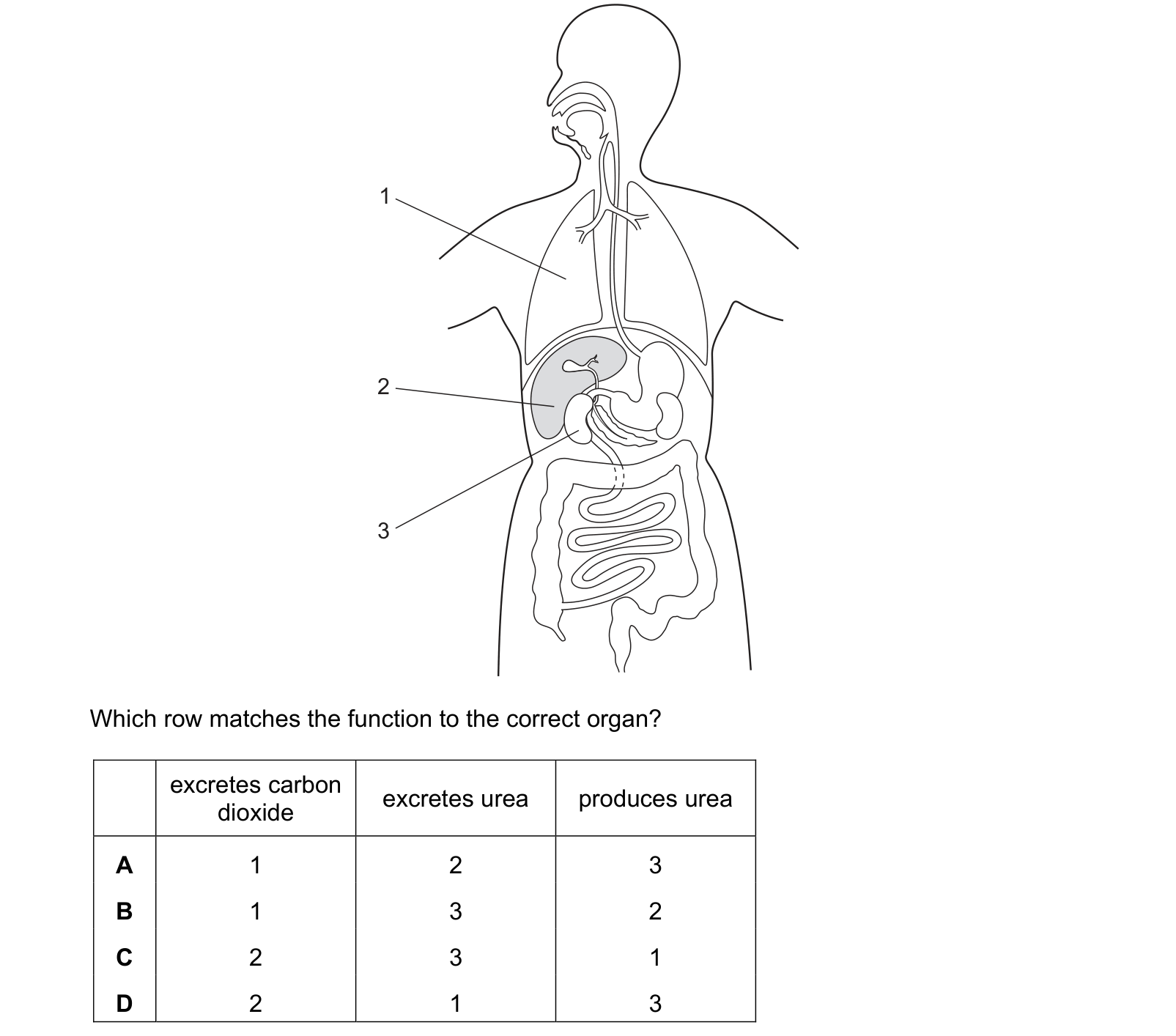
The diagram shows some of the organs in the human body. Which row matches the function to the correct organ? Each answer gives, in order: excretes carbon dioxide; excretes urea; produces urea.
Answer: B.
That gives 1 as the lungs, 2 as the liver and 3 as the kidney.
The question separates two things that are easy to run together. Producing urea and excreting it happen in different organs: the liver makes it by deamination of excess amino acids, and the kidney filters it out of the blood.
The lungs are the other excretory organ, removing carbon dioxide produced by respiration. Carbon dioxide is a gas, so it leaves in the breath rather than in urine.
So the three organs cover the two excretory products by two different routes, with one extra step for urea because it has to be made before it can be removed.
The bladder is not an excretory organ in this sense: it stores urine rather than removing anything from the blood.
Question 2
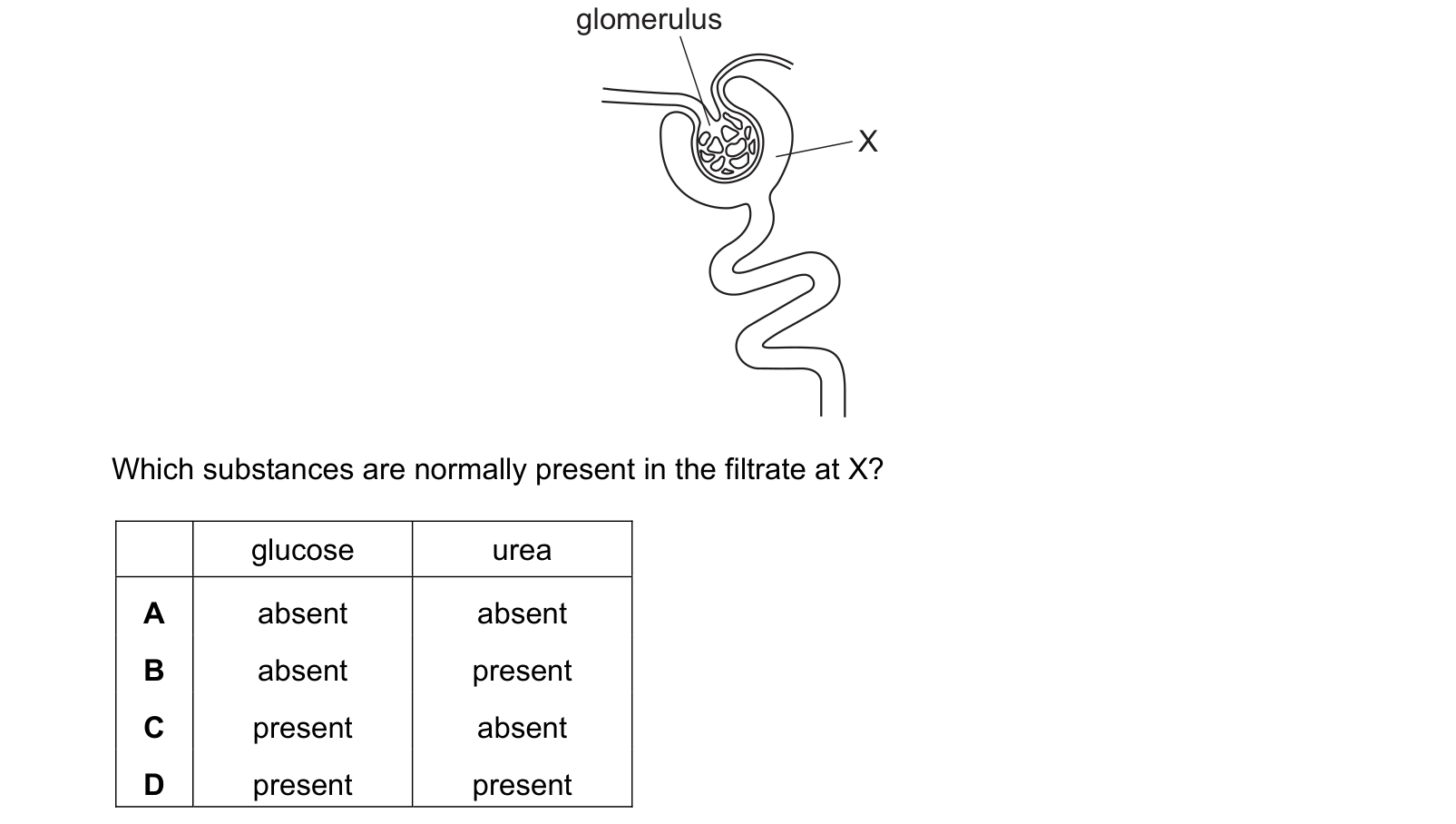
The diagram shows the structure of part of a kidney tubule and associated blood vessels. Which substances are normally present in the filtrate at X? Each answer gives, in order: glucose; urea.
Answer: D.
X is in the tubule just after the glomerulus, and filtration there is not selective about which small molecules pass. Anything small enough goes through: water, glucose, ions, amino acids and urea. Only large molecules such as proteins and blood cells are held back.
So at this point the filtrate still contains glucose, and it will be reabsorbed further along.
That is the distinction the question is testing. Glucose is absent from urine in a healthy person, but it is very much present in the filtrate, because reabsorption has not happened yet. Answering from what urine contains, rather than from where X is, gives the wrong row.
The urea stays, since removing it is the point of the whole process.
Question 3
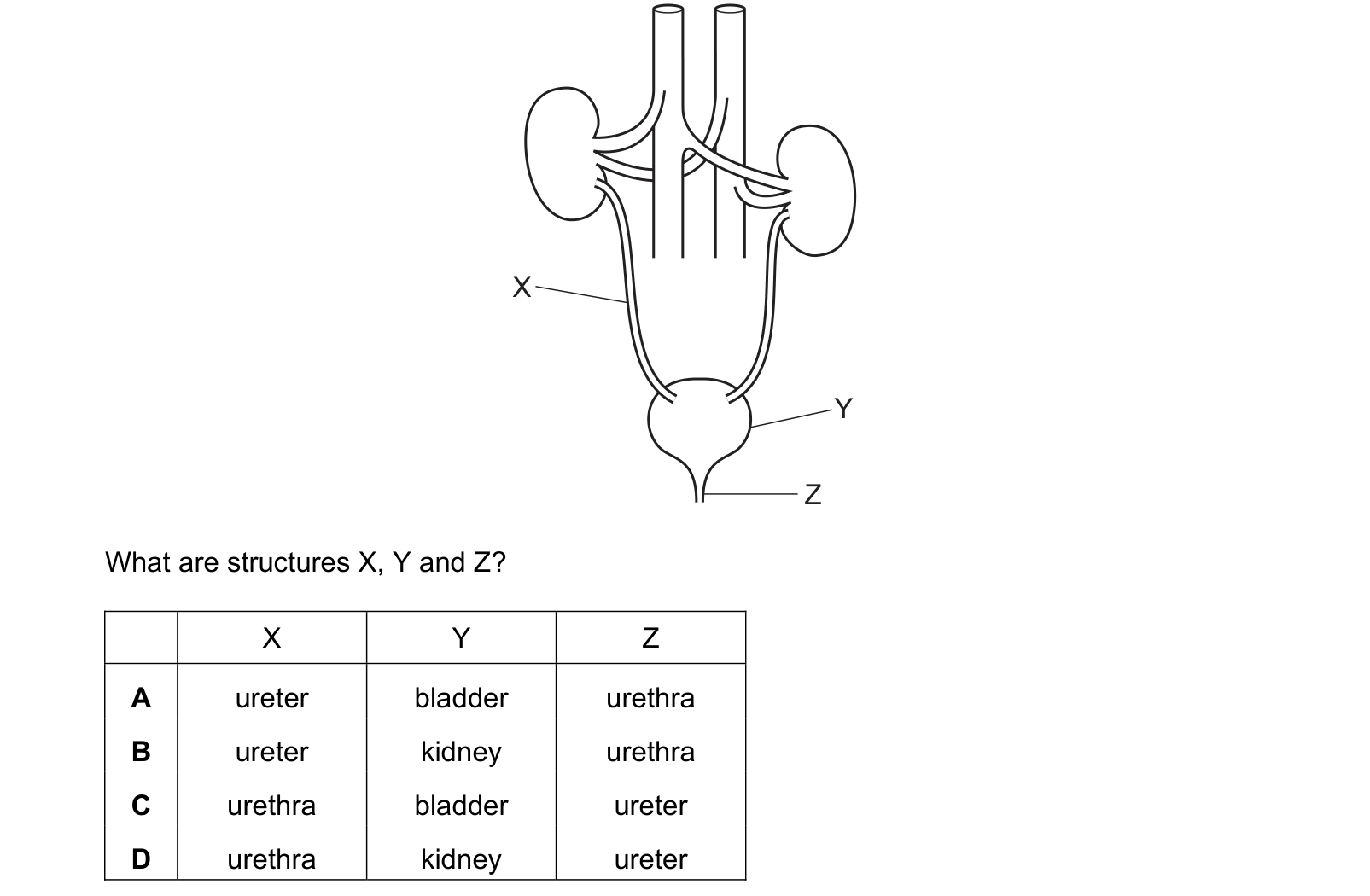
The diagram shows the human excretory system and associated blood vessels. What are structures X, Y and Z? Each answer gives, in order: X; Y; Z.
Answer: A.
Each part has one job. The kidneys filter the blood and make urine. The ureters are the two tubes carrying urine down to the bladder. The bladder stores it. The urethra is the single tube carrying it out of the body.
The pair most often confused is ureter and urethra, and the difference is position and number: two ureters above the bladder, one urethra below it. So any row placing the urethra above the bladder has them the wrong way round.
The kidney itself is not among the options here, since the labels start below it.
What the syllabus asks for on this topicSyllabus points
Syllabus points
- Describe excretion and identify the excretory organs and their products.
- Identify the parts of the urinary system and state their functions.
- Describe the structure of a kidney and the process of filtration and selective reabsorption.
- Explain the role of the liver in the breakdown of alcohol and in deamination.
- Outline the principles of dialysis.
Related CIE 0610 Biology topics
Not the topic you were looking for? Describe what you are stuck on in your own words and we will take you to the notes that answer it.