Coordination and response
Contents: 8 sections
The nervous system
Divided into the central nervous system, the brain and spinal cord, and the peripheral nervous system, the nerves.
Three types of neurone:
- Sensory neurone — carries impulses from a receptor to the CNS.
- Relay neurone — inside the CNS, connects sensory to motor.
- Motor neurone — carries impulses from the CNS to an effector.
An effector is a muscle or a gland: something that carries out the response. A receptor detects a stimulus.
The reflex arc
A reflex action is a means of automatically and rapidly integrating and coordinating stimuli with the responses of effectors. It is involuntary: it happens without conscious thought, which is what makes it fast and protective.
The pathway, which questions ask for in order:
stimulus → receptor → sensory neurone → relay neurone (in spinal cord) → motor neurone → effector → response
The classic example is withdrawing a hand from a hot object. The impulse does not travel to the brain before the response happens; it goes through the spinal cord, which is why the hand moves before the pain is felt.
A voluntary action involves the brain and conscious decision, so it is slower.
The synapse
A synapse is a junction between two neurones, with a tiny gap between them.
When an impulse arrives, neurotransmitter is released from the end of the first neurone. It diffuses across the gap and binds to receptor molecules on the next neurone, triggering a new impulse.
Because neurotransmitter is released on one side only and receptors sit on the other, a synapse ensures impulses travel in one direction only.
The eye
Parts and their functions:
- Cornea — refracts light, doing most of the focusing.
- Iris — controls how much light enters.
- Pupil — the gap in the iris that light passes through.
- Lens — fine-focuses light onto the retina, and changes shape to do so.
- Retina — contains light receptors: rods for dim light, cones for colour.
- Optic nerve — carries impulses to the brain.
The pupil reflex. In bright light, circular muscles contract and radial muscles relax, so the pupil constricts, protecting the retina. In dim light, radial muscles contract and circular muscles relax, so the pupil dilates, letting more light in. The two muscle sets are antagonistic, and the answer needs both.
Accommodation, focusing on near and distant objects, is the pair most often confused:
| Near object | Distant object | |
|---|---|---|
| Ciliary muscles | contract | relax |
| Suspensory ligaments | slacken | pull tight |
| Lens | fatter, more curved | thinner, less curved |
| Refraction | greater | less |
The logic that makes it memorable: contracting the ciliary muscle makes the ring smaller, which releases the tension on the ligaments and lets the elastic lens spring into a fatter shape, refracting light more strongly for a close object.
Hormones
A hormone is a chemical substance produced by a gland and carried by the blood, which alters the activity of one or more specific target organs.
| Hormone | Gland | Effect |
|---|---|---|
| Insulin | pancreas | lowers blood glucose |
| Glucagon | pancreas | raises blood glucose |
| Adrenaline | adrenal glands | prepares the body for action |
| Testosterone | testes | male secondary sexual characteristics |
| Oestrogen | ovaries | female secondary sexual characteristics |
Adrenaline increases heart rate and breathing rate, widens the pupils, and causes the liver to convert glycogen to glucose, all preparing for "fight or flight".
Comparing the two control systems is a standard question:
| Nervous | Hormonal | |
|---|---|---|
| Signal | electrical impulse | chemical in blood |
| Speed | very fast | slower |
| Duration | short-lived | longer-lasting |
| Target | precise, one effector | widespread, any organ with receptors |
Homeostasis
Homeostasis is the maintenance of a constant internal environment.
It works by negative feedback: a change away from the norm triggers a response that reverses the change.
Blood glucose. If it rises, the pancreas releases insulin, which makes the liver convert glucose to glycogen for storage, so the level falls. If it falls, the pancreas releases glucagon, which makes the liver convert glycogen back to glucose, so the level rises.
In type 1 diabetes the pancreas does not produce enough insulin, so blood glucose rises uncontrolled, and glucose appears in the urine. It is treated with insulin injections and by controlling diet.
Body temperature, kept near 37 °C so enzymes work at their optimum.
Too hot: vasodilation, blood vessels near the skin surface widen so more blood flows near the surface and more heat is lost; sweating, with heat used to evaporate the water; hairs lie flat.
Too cold: vasoconstriction, those vessels narrow so less heat is lost; shivering, muscles contracting rapidly and releasing heat from respiration; hairs stand up to trap an insulating layer of air.
A precise point: the blood vessels do not move up and down in the skin. Vasodilation and vasoconstriction change the diameter of the vessels, changing how much blood flows near the surface.
Tropisms
A tropism is a growth response in which the direction of growth is determined by the direction of the stimulus.
- Phototropism — response to light. Shoots grow towards light, positively phototropic.
- Gravitropism — response to gravity. Roots grow towards gravity, positively gravitropic; shoots grow away from it.
The mechanism is the same in both, and is explained by auxin, a plant hormone made at the shoot tip.
In a shoot lit from one side, auxin moves to the shaded side. There it causes cells to elongate more. The shaded side grows longer than the lit side, so the shoot bends towards the light.
The response benefits the plant: shoots reaching light photosynthesise more, and roots growing downwards find water and anchor the plant.
Check you have it
Question 1
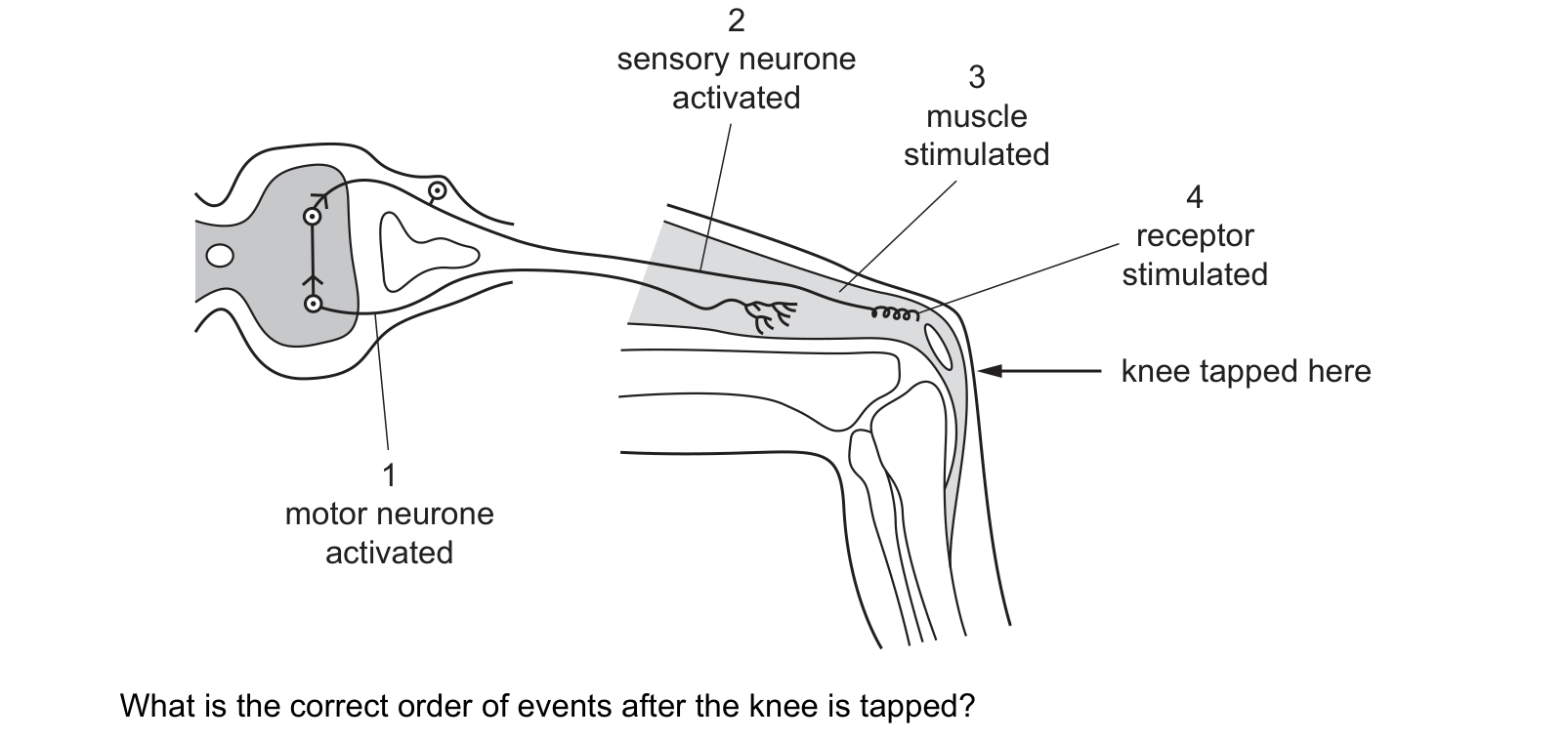
The diagram shows a simple reflex arc.
2 sensory neurone 3 What is the correct order of events after the knee is tapped?
Answer: C.
Follow the impulse from the tap.
4: the receptor is stimulated in the knee, where the tap lands.
2: the sensory neurone is activated, carrying the impulse in to the spinal cord.
1: the motor neurone is activated, carrying it back out.
3: the muscle is stimulated, and the leg jerks.
That is the standard pathway: receptor → sensory neurone → CNS → motor neurone → effector. The diagram simply places the labels in a different order from the sequence of events, which is the whole difficulty.
Starting from the arrow marking where the knee is tapped is the reliable way in, because it fixes the first step regardless of where the numbers sit on the page.
The knee-jerk is unusual in having no relay neurone, which makes it about as fast as a reflex can be.
Question 2
The structures listed are part of the nervous system. 1 brain 2 effector 3 receptor 4 relay neurone In a reflex arc, which structures are connected to a motor neurone by synapses?
Answer: C.
A motor neurone sits between those two in the pathway. On one side, a synapse joins it to the relay neurone inside the spinal cord. On the other, a synapse joins it to the effector, the muscle or gland it acts on. That second junction is a neuromuscular junction, and it works the same way, with a neurotransmitter crossing a gap.
The receptor (3) connects to the sensory neurone, at the far end of the pathway, so it is two steps removed from the motor neurone.
The brain (1) is not part of a reflex arc's pathway at all. The whole point of a reflex is that it is coordinated in the spinal cord, which is what makes it fast.
So the answer is simply whatever sits immediately either side of a motor neurone.
Question 3
A toxin that is the same shape as a neurotransmitter prevents muscle contraction.
Which statement explains why the toxin prevents muscle contraction?
Answer: A.
The stem says the toxin is the same shape as a neurotransmitter, and shape is what matters at a synapse. Neurotransmitters work by fitting receptors on the next neurone, in the way a substrate fits an enzyme's active site. A molecule of the same shape can occupy those receptors without triggering anything, so the real neurotransmitter has nowhere to bind and the impulse is not passed on. No impulse reaches the muscle, so it cannot contract.
The two options about increasing neurotransmitter release (B and C) would make contraction more likely, not less.
Stimulates impulses in motor neurones (D) would also cause contraction rather than prevent it.
So the reasoning is the same specificity idea that runs through enzymes and antibodies: a matching shape can occupy a site, and occupying it can block as easily as activate.
What the syllabus asks for on this topicSyllabus points
Syllabus points
- Describe the human nervous system and the function of neurones.
- Describe a reflex arc and explain the difference between voluntary and involuntary actions.
- Describe the structure and function of the eye, including the pupil and accommodation reflexes.
- Describe hormones and compare nervous and hormonal control.
- Explain homeostasis, including control of blood glucose and body temperature.
- Describe gravitropism and phototropism and the role of auxin.
Related CIE 0610 Biology topics
Not the topic you were looking for? Describe what you are stuck on in your own words and we will take you to the notes that answer it.