Diseases and immunity
Contents: 7 sections
Pathogens and transmission
A pathogen is a disease-causing organism. A transmissible disease is one in which the pathogen can be passed from one host to another.
Pathogens include bacteria, viruses, fungi and protoctists. Cholera is caused by a bacterium, influenza by a virus, athlete's foot by a fungus, malaria by a protoctist.
Transmission happens two ways:
- Direct contact — through blood or other body fluids, so by touching, by sexual contact, or from mother to child.
- Indirect contact — through contaminated surfaces, food, water or air, or carried by an animal such as a mosquito.
Cholera is the worked example the syllabus expects. The bacterium is taken in with contaminated water. It produces a toxin that causes the cells lining the intestine to secrete chloride ions. That lowers the water potential in the intestine, so water leaves the surrounding tissues by osmosis, and the result is severe watery diarrhoea and dehydration. Treatment replaces water and salts; prevention means clean water and proper sewage treatment.
The body's defences
Two lines, and questions often ask you to separate them.
Barriers that stop pathogens entering:
- Skin — a physical barrier of dead cells.
- Mucus in the airways traps pathogens, and cilia sweep it away to be swallowed.
- Hydrochloric acid in the stomach kills most pathogens in food and drink.
- Clotting seals wounds, closing an entry route.
- Tears and saliva contain enzymes that destroy bacteria.
Cells that destroy pathogens that get in: the white blood cells.
White blood cells
Two types, doing two quite different jobs.
Phagocytes engulf pathogens. The cell surrounds the pathogen, takes it inside, and digests it with enzymes. Phagocytes are non-specific: they attack anything foreign, and they have a lobed nucleus that lets them squeeze between cells.
Lymphocytes produce antibodies. Each antibody has a shape complementary to a particular antigen, which is a marker molecule on the pathogen's surface. Because the fit is specific, one antibody works against one pathogen and no other.
Antibodies work by marking pathogens for destruction by phagocytes, sticking them together in clumps, and neutralising toxins.
Active and passive immunity
Active immunity is defence gained when the body's own lymphocytes make antibodies in response to an antigen. It is slow to develop but long-lasting, because memory cells remain.
Passive immunity is short-term defence gained by receiving antibodies from elsewhere, such as across the placenta or in breast milk. It works immediately but does not last, because no memory cells are made and the antibodies are eventually broken down.
The trade-off is the point: active immunity is slow but lasting, passive is immediate but temporary.
Vaccination
A vaccine contains weakened or inactive pathogens, or their antigens. The sequence to describe:
- The vaccine is given, carrying the antigen.
- Lymphocytes recognise it and produce antibodies specific to that antigen.
- Memory cells are made and stay in the blood.
- If the real pathogen is met later, the memory cells produce antibodies faster and in greater quantity, so the pathogen is destroyed before symptoms develop.
That fourth step is what a vaccine buys. The person is not prevented from meeting the pathogen; they are prepared for it.
Vaccination is a form of active immunity, because the person's own lymphocytes do the work.
Herd immunity follows: if enough of a population is vaccinated, the pathogen cannot spread easily, which protects even those who are not vaccinated. This is why vaccination is treated as a public health measure and not only a personal choice.
Controlling the spread
Measures that break transmission:
- A clean water supply and proper sewage treatment.
- Hygienic food preparation and personal hygiene, particularly hand washing.
- Waste disposal that denies pathogens and their carriers a home.
- Vaccination programmes.
Each targets a specific route, and a good answer names the route as well as the measure: treating sewage prevents cholera because it stops the bacterium reaching drinking water.
Check you have it
Question 1
A disease cannot be treated with antibiotics.
What could be the reasons for this?
1 It is not a bacterial disease.
2 The pathogen is a virus.
3 The patient has become resistant to the antibiotic.
Answer: A.
Antibiotics attack structures that bacteria have and human cells do not, such as the cell wall. A virus has no cell wall and no metabolism of its own, reproducing inside the host's own cells, so there is nothing to attack. Reasons 1 and 2 are really the same point stated generally and then specifically.
Statement 3 is wrong, and it contains the single most common misconception in this topic. The patient does not become resistant. The bacteria do.
Resistance is natural selection acting on the bacterial population. A few individuals happen to carry a mutation that lets them survive the drug, they reproduce, and the resistant proportion rises. The person's own body is unchanged.
That distinction matters. It is why unnecessary antibiotic use is a problem for everyone rather than just the person taking them, and how strains such as MRSA arose.
Question 2
Transmissible diseases are transmitted when a pathogen is passed from one host to another.
What is an example of direct contact?
Answer: B.
Direct transmission means the pathogen passes straight from one person to another with nothing in between: body fluids, sexual contact or direct physical touch. HIV is the standard example, transmitted through blood and other body fluids.
The other three all place something between the two people, which makes them indirect.
Breathing in pathogens (A) uses the air as the carrier, as with influenza droplets from a cough.
Contact with contaminated surfaces (C) uses an object, and the pathogen may have been waiting there for hours.
Eating or handling contaminated food (D) uses the food, as with Salmonella.
The distinction matters for prevention. Direct transmission is reduced by hygiene and barrier methods; indirect transmission is reduced by cleaning surfaces, treating water and cooking food properly.
Question 3
When a pathogen enters the blood, the immune system uses different mechanisms to destroy the pathogen. The diagram shows one of these mechanisms. Which row describes the structures involved? Each answer gives, in order: structure X; X is made by; structure Y.
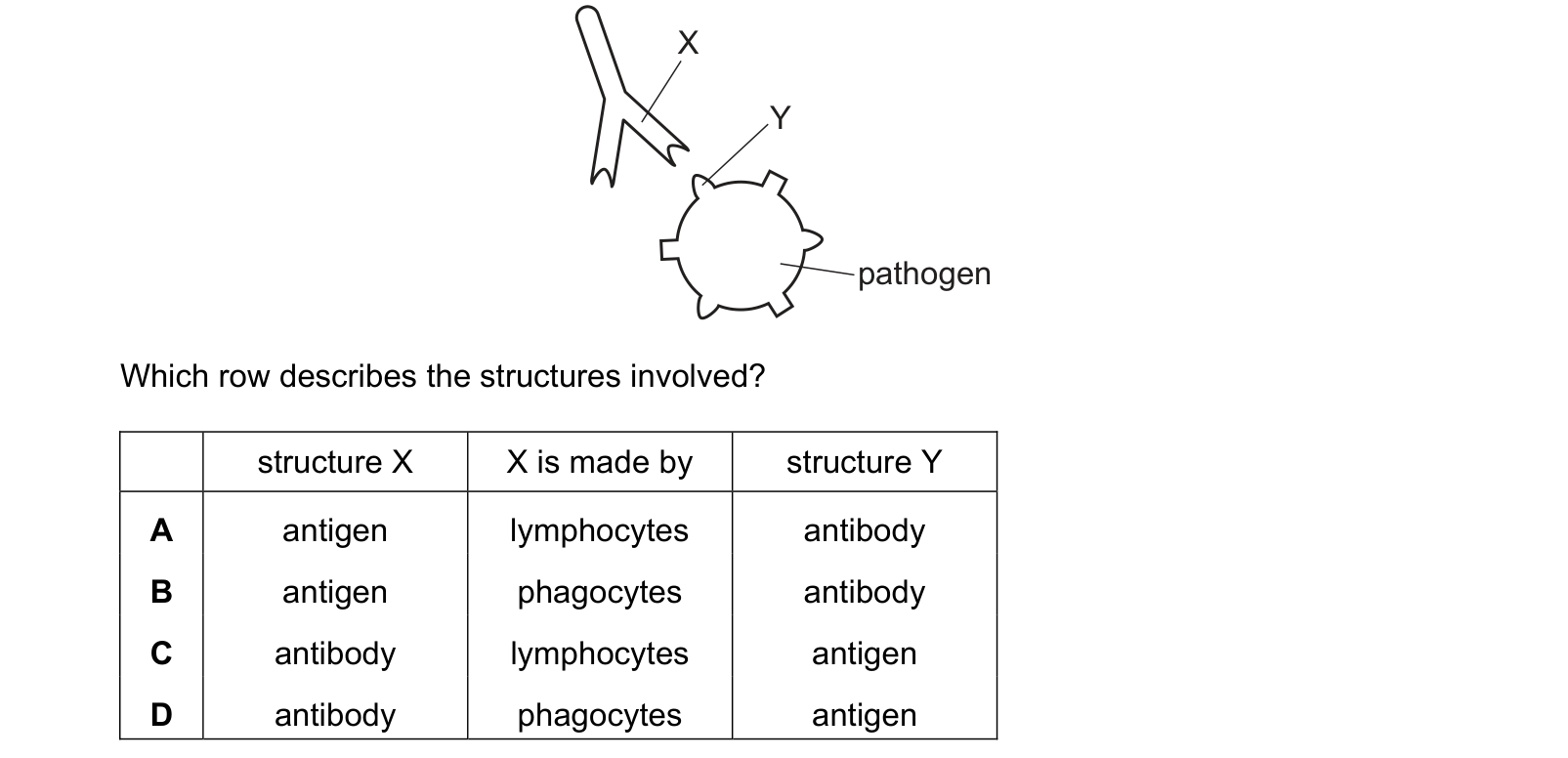
Answer: C.
The two words are the pair most often confused, and the relationship settles them. An antigen is a molecule on the surface of the pathogen, and it is what the body recognises as foreign. An antibody is the protein the body produces in response, shaped to bind to that particular antigen.
So the antigen belongs to the invader and the antibody belongs to the defender.
The cell that makes antibodies is the lymphocyte, recognisable by its large round nucleus. Phagocytes (B and D) are the other kind of white blood cell, with a lobed nucleus, and they engulf pathogens rather than producing anything.
The fit between antibody and antigen is specific, in the way an enzyme fits one substrate, which is why immunity to one disease gives no protection against another.
What the syllabus asks for on this topicSyllabus points
Syllabus points
- Describe a pathogen and a transmissible disease.
- Describe how diseases are transmitted.
- Describe the body's defences against pathogens.
- Explain the roles of white blood cells in defence.
- Explain active and passive immunity and how vaccination works.
- Describe the value of controlling the spread of disease.
Related CIE 0610 Biology topics
Not the topic you were looking for? Describe what you are stuck on in your own words and we will take you to the notes that answer it.