Enzymes
Contents: 8 sections
What an enzyme is
An enzyme is a protein that works as a biological catalyst: it speeds up a chemical reaction and is not used up in the process, so one molecule can catalyse the same reaction over and over.
Because enzymes are proteins, everything that damages a protein's shape damages the enzyme. That single link explains almost every enzyme question in the syllabus.
The active site and specificity
The active site is a small region on the enzyme's surface with a shape complementary to the substrate, meaning it is the shape that fits, not the same shape.
The sequence to describe is:
- The substrate collides with the active site.
- An enzyme-substrate complex forms.
- The reaction takes place and the products are released.
- The active site is free again and the enzyme is unchanged.
This is the lock and key model, and it explains specificity: one enzyme catalyses one reaction, because only a substrate whose shape fits the active site can bind. Amylase breaks down starch and nothing else, because nothing else fits.
Temperature
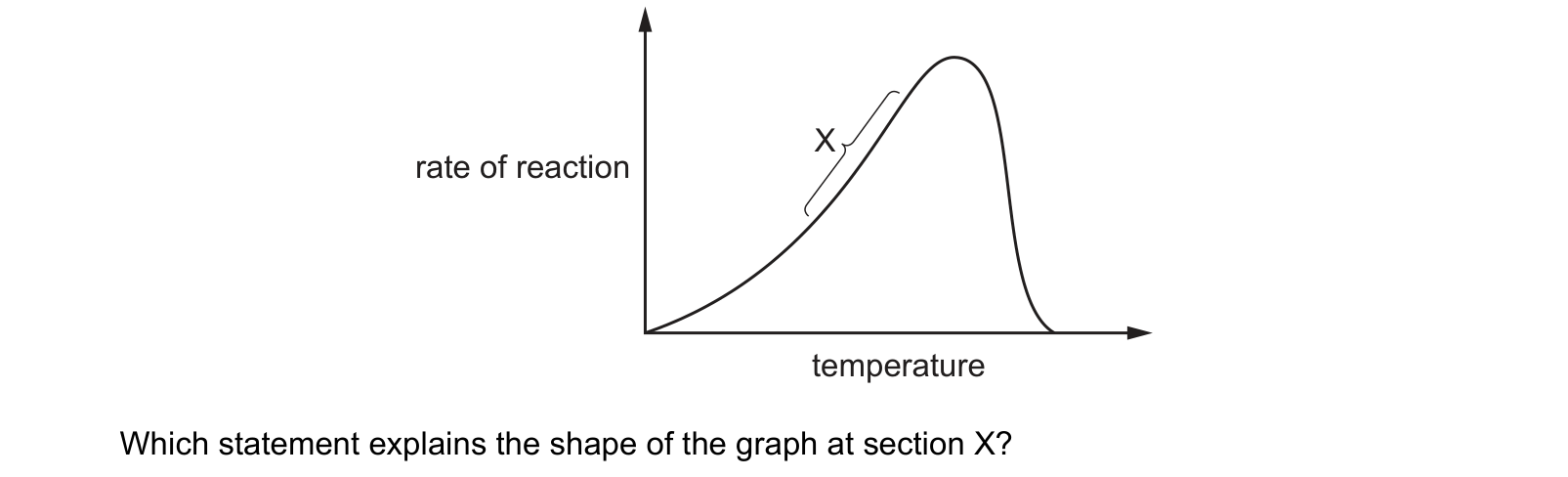
The graph rises to a peak and then falls sharply, and the two halves have completely different explanations. Giving one explanation for both is the most common way this question is lost.
Below the optimum, raising the temperature increases the kinetic energy of enzyme and substrate. They move faster, collide more often and with more energy, so more successful collisions happen each second and the rate rises.
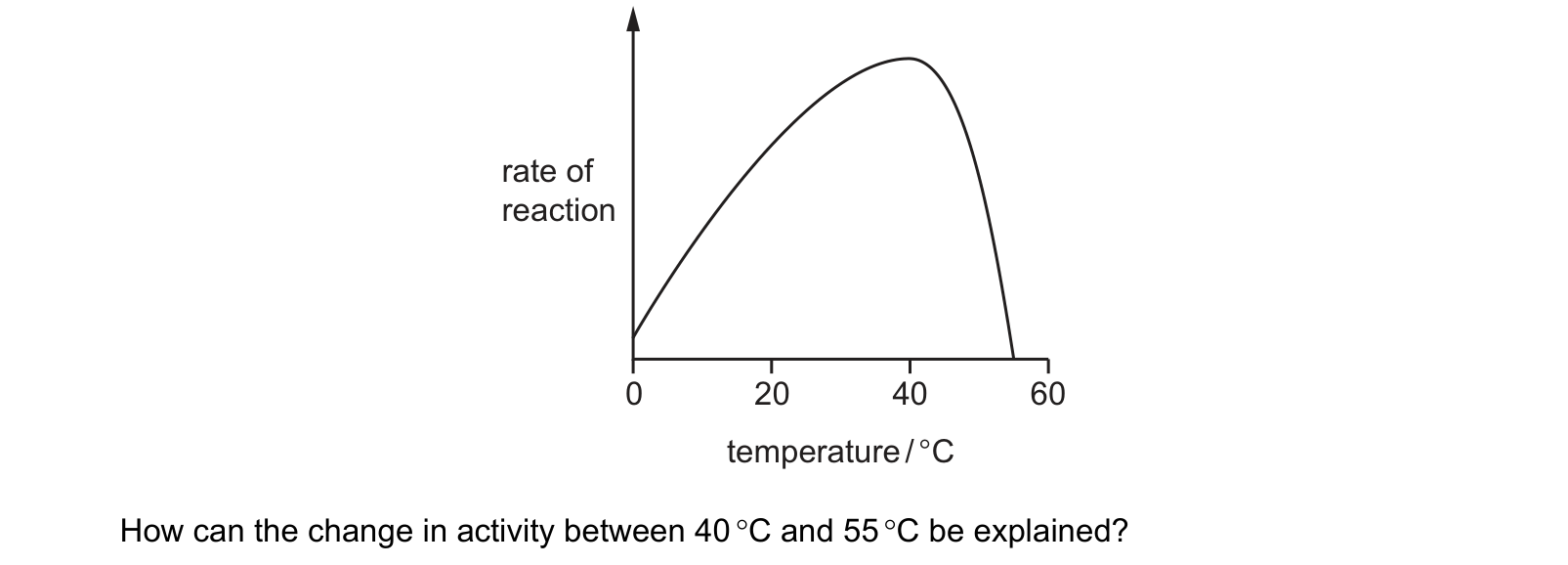
Above the optimum, the rise stops mattering because the enzyme is being destroyed. The extra vibration breaks the bonds holding the protein in its folded shape, the active site changes shape, and the substrate no longer fits. The enzyme is denatured.
Denaturation is permanent. Cooling a denatured enzyme does not restore it, which is a favourite exam point: an enzyme heated to 80 °C and then cooled to 37 °C stays inactive.
The optimum for most human enzymes is about 37 °C.
pH
The same shape of graph, a peak with falls on both sides, and the same underlying cause on both sides this time. Moving away from the optimum pH in either direction changes the charges on the amino acids that hold the protein in shape, the active site changes shape, and activity falls. Far enough from the optimum, the enzyme denatures.
Different enzymes have very different optima, and the values are worth knowing because questions use them to identify an enzyme:
- Pepsin, in the stomach: about pH 2, matching the hydrochloric acid there.
- Amylase, in the mouth and small intestine: about pH 7.
- Trypsin and lipase, in the small intestine: about pH 8, which is why bile makes the contents alkaline.
Enzyme concentration and substrate concentration
Increasing substrate concentration raises the rate at first, because more active sites are occupied at any moment. Eventually every active site is working continuously, the enzyme is saturated, and adding more substrate makes no difference. The graph levels off.
Increasing enzyme concentration raises the rate for as long as there is spare substrate, because more active sites are available.
Read which variable a graph is showing before explaining a plateau, since the two look identical and have different reasons.
The practicals
Amylase and starch. Samples are removed at intervals and tested with iodine solution. While starch remains the iodine goes blue-black; when the starch has all been broken down it stays orange-brown. The time taken to reach that point measures the rate, and a shorter time means a faster reaction.
Catalase. Catalase breaks hydrogen peroxide into water and oxygen. Liver or potato is added to hydrogen peroxide and the oxygen given off is measured, either by collecting the gas or by measuring the height of foam. More oxygen in a given time means a faster reaction.
For either practical, the variables to control are the ones to name in an answer: substrate concentration, enzyme concentration, volume, and everything except the factor being investigated.
Why enzymes matter to the organism
Reactions in cells would happen far too slowly at 37 °C without catalysts. Enzymes make them fast enough to sustain life at a temperature the organism can survive, and because each enzyme is specific, the cell can control which reactions run by controlling which enzymes it makes.
Check you have it
Question 1
The graph shows the effect of temperature on the rate of a reaction catalysed by an enzyme. Which statement explains the shape of the graph at section X?
Answer: D.
Higher temperature means more kinetic energy, so the molecules move faster and meet more often. More collisions means more enzyme-substrate complexes and a higher rate.
The enzyme is starting to denature (B) belongs to the section after the peak, where the curve falls. At X the enzyme's shape is completely intact.
The number of active sites is increasing (C) is impossible. The amount of enzyme is fixed, so the number of active sites does not change with temperature. What changes is how often they are used.
The enzyme is not the correct one (A) would give no reaction at all, and the graph clearly shows one happening.
The two halves of any enzyme temperature curve have different explanations: collisions on the way up, destroyed shape on the way down.
Question 2
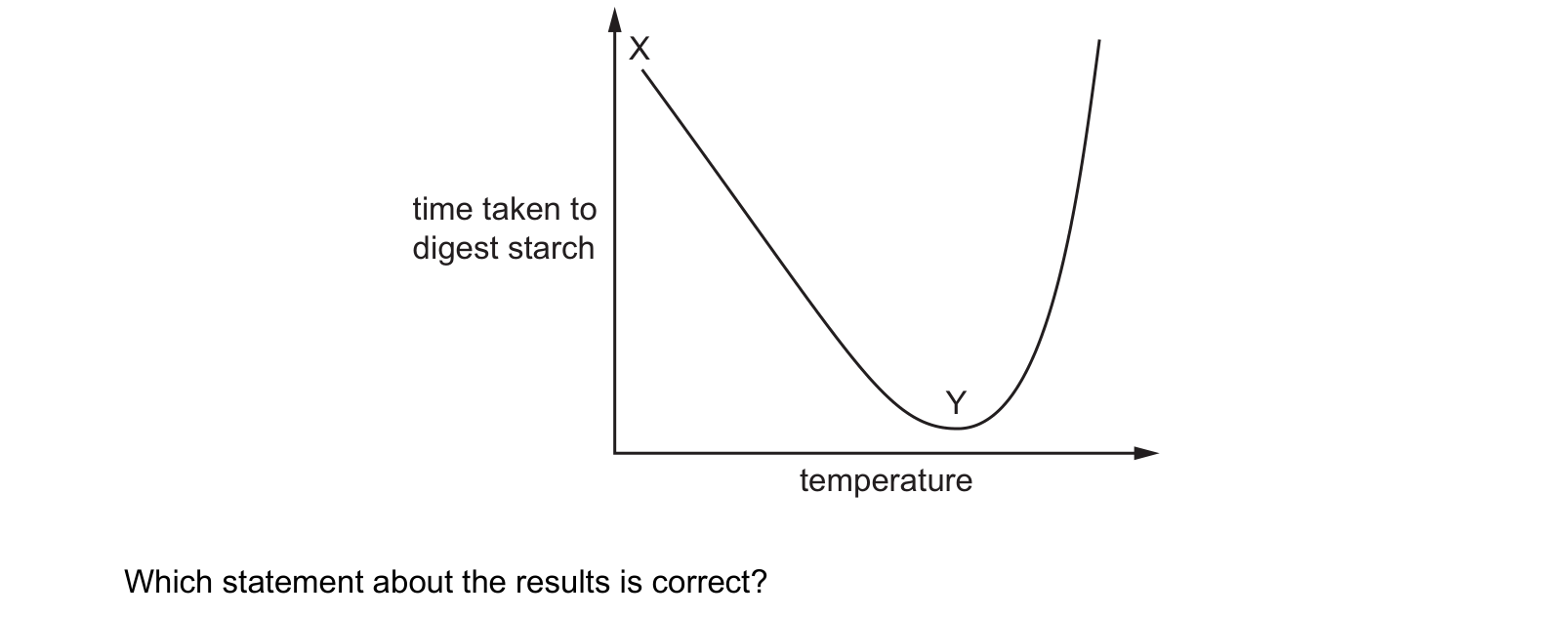
The diagram shows the effect of changing the temperature on the time taken for an enzyme to digest starch. Which statement about the results is correct?
Answer: D.
A shorter time means a faster reaction. So the fastest point is the lowest point on the graph, which is Y. The optimum temperature is therefore at Y, not at X, where the time is longest and the enzyme is slowest.
Between X and Y the time taken is falling, which means the rate is increasing. Warming towards the optimum gives the molecules more kinetic energy and more frequent collisions.
So the optimum is at Y and the rate increases between X and Y.
Beyond Y the curve turns sharply upward: the time rises again because the enzyme is being denatured. A time axis makes the shape look unfamiliar, but it is the same story upside down, and checking what the axis measures before reading the shape is what this question rewards.
Question 3
The graph shows how enzyme activity is affected by temperature. temperature / °C
How can the change in activity between 40 °C and 55 °C be explained?
Answer: D.
Heat breaks the bonds holding the enzyme's three-dimensional shape. The active site is distorted, and a substrate that no longer matches it cannot bind, so no reaction happens however often the two collide.
Heat has killed the enzyme (A) is the tempting phrasing and it is worth rejecting deliberately. An enzyme is a molecule, not an organism, so it was never alive and cannot be killed. The correct word is denatured.
The enzyme has been used up (B) contradicts what a catalyst is.
The reactants are moving faster (C) is perfectly true at higher temperature, and it would predict the rate rising. It is the right physics attached to the wrong conclusion, which is exactly why the fall has to be explained by shape rather than by speed.
What the syllabus asks for on this topicSyllabus points
Syllabus points
- Describe a catalyst and state that enzymes are proteins that function as biological catalysts.
- Explain enzyme action with reference to the active site, the substrate and the enzyme-substrate complex.
- Explain the specificity of enzymes.
- Investigate and describe the effect of temperature and pH on enzyme activity.
- Explain the effect of temperature and pH in terms of shape and denaturation.
Related CIE 0610 Biology topics
Not the topic you were looking for? Describe what you are stuck on in your own words and we will take you to the notes that answer it.