Organisms and their environment
Contents: 7 sections
Energy flow
The Sun is the principal source of energy for all biological systems.
Light energy is captured by producers in photosynthesis and converted to chemical energy in glucose. That energy then passes along the food chain as one organism eats another.
Energy is lost at every transfer, mostly as heat from respiration, and also in undigested material egested as faeces and in excretory products. Only about 10% of the energy at one level reaches the next.
Two consequences follow, and both are examined:
- Food chains are short, usually three or four links, because after a few transfers there is not enough energy left to support another level.
- Feeding humans on crops rather than on animals fed on those crops supports far more people from the same land, because one fewer transfer means far less energy lost.
Energy flows through an ecosystem and leaves it as heat. Nutrients, by contrast, are cycled. That difference is why the carbon and nitrogen cycles exist and energy has no cycle.
Food chains and webs
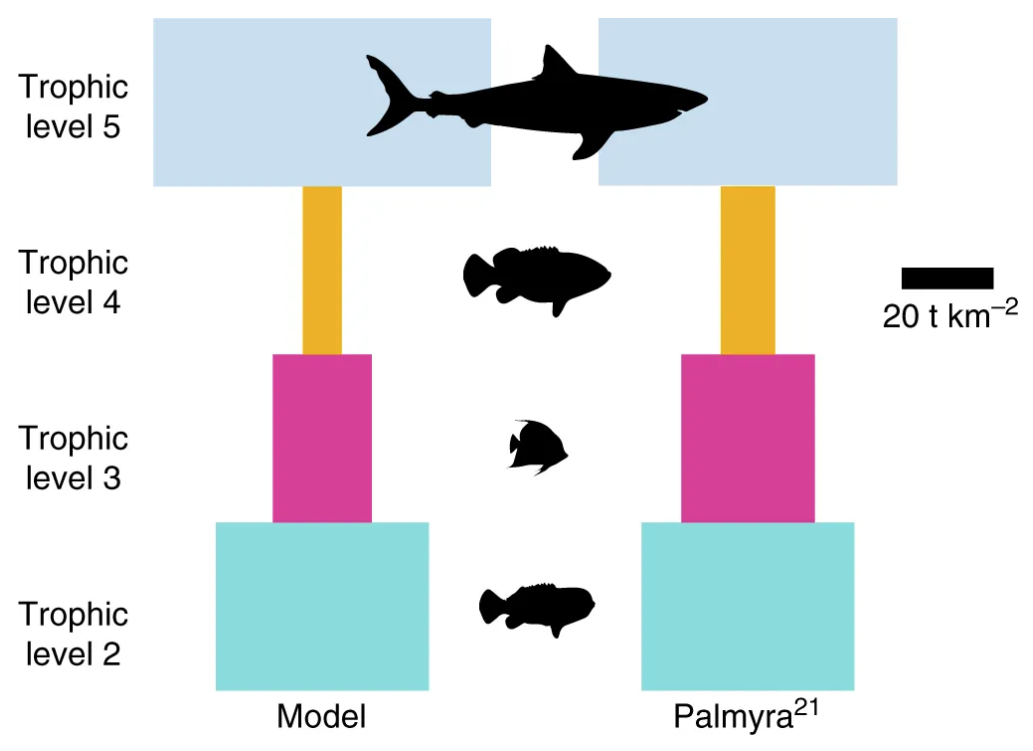
A food chain shows the transfer of energy from one organism to the next, beginning with a producer.
The terms:
- Producer — an organism that makes its own organic nutrients, usually using energy from sunlight through photosynthesis.
- Consumer — an organism that gets its energy by feeding on other organisms.
- Herbivore — eats plants. Carnivore — eats other animals. Decomposer — gets energy from dead or waste organic matter.
- Trophic level — the position of an organism in a food chain.
The arrows show the direction of energy flow, so they point from the eaten to the eater. Drawing them the wrong way is a common and costly error.
A food web is several food chains joined, and it is a truer picture because most organisms eat more than one thing. A food web lets you answer "what happens if this species is removed", which a single chain cannot.
Pyramids
Pyramid of numbers counts individuals at each level. It is not always pyramid-shaped: one oak tree supports thousands of insects, so the base is narrower than the level above. Parasites also invert it.
Pyramid of biomass shows the mass of organisms at each level. It is almost always a true pyramid, because the total mass must fall at each transfer. Its drawback is that organisms must be killed to measure dry mass.
Pyramid of energy shows the energy at each level per unit area per year. It is always a true pyramid, because energy is always lost at each transfer.
If a question asks which pyramid must be pyramid-shaped, the answer is energy; if it asks why a pyramid of numbers can be inverted, the answer is that a small number of very large producers can support many small consumers.
The carbon cycle
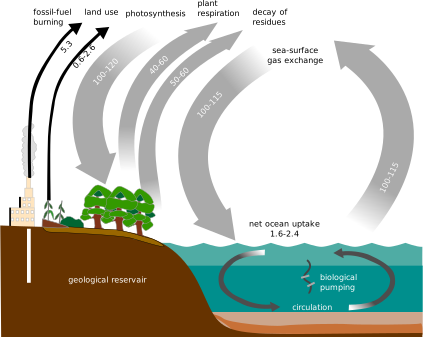
Processes that remove carbon dioxide from the air:
- Photosynthesis by plants.
Processes that return it:
- Respiration by plants, animals and decomposers.
- Decomposition of dead organisms by bacteria and fungi.
- Combustion of wood and fossil fuels.
Carbon passes from plants to animals by feeding. Fossil fuels form when dead organisms are compressed over millions of years without decomposing fully, which locks carbon away until it is burned.
Human activity has shifted the balance: burning fossil fuels adds carbon dioxide faster than it is removed, and deforestation removes the trees that would take it out.
The nitrogen cycle
Plants need nitrogen for amino acids and so proteins, but cannot use nitrogen gas directly. The cycle is the story of how nitrogen is made available and returned.
- Nitrogen-fixing bacteria convert nitrogen gas into nitrogen compounds. Some live free in the soil, others in root nodules of legumes such as peas and beans.
- Decomposers break down dead organisms and waste, releasing ammonium compounds.
- Nitrifying bacteria convert ammonium compounds into nitrites and then nitrates, which plants absorb.
- Denitrifying bacteria convert nitrates back into nitrogen gas, which removes nitrogen from the soil. They thrive in waterlogged soil with little oxygen.
Two exam points follow. Nitrifying bacteria need oxygen, so waterlogged soil favours denitrifying bacteria instead and the soil loses nitrates. And lightning also fixes nitrogen, though it contributes far less than bacteria do.
Farmers add nitrates as fertiliser, or grow legumes and plough them in, to replace the nitrogen removed when crops are harvested.
Populations
A population is a group of organisms of one species, living in the same area, at the same time.
Related terms: a community is all the populations of all species in an ecosystem, and an ecosystem is a unit containing the community and the non-living parts of the environment.
The sigmoid growth curve has four phases, and questions ask for the reason behind each.
- Lag phase — slow growth. Few individuals, and they are adapting to the conditions.
- Exponential (log) phase — rapid growth. Plenty of food and space, few predators, so the rate of reproduction far exceeds the death rate.
- Stationary phase — growth levels off. Food and space become limiting, waste accumulates, predation and disease increase, so births equal deaths. The population is at the carrying capacity of the environment.
- Death phase — the population falls, when resources run out or toxic waste builds up.
Factors limiting population growth: food supply, competition for space, predation, disease, and the accumulation of waste.
Check you have it
Question 1
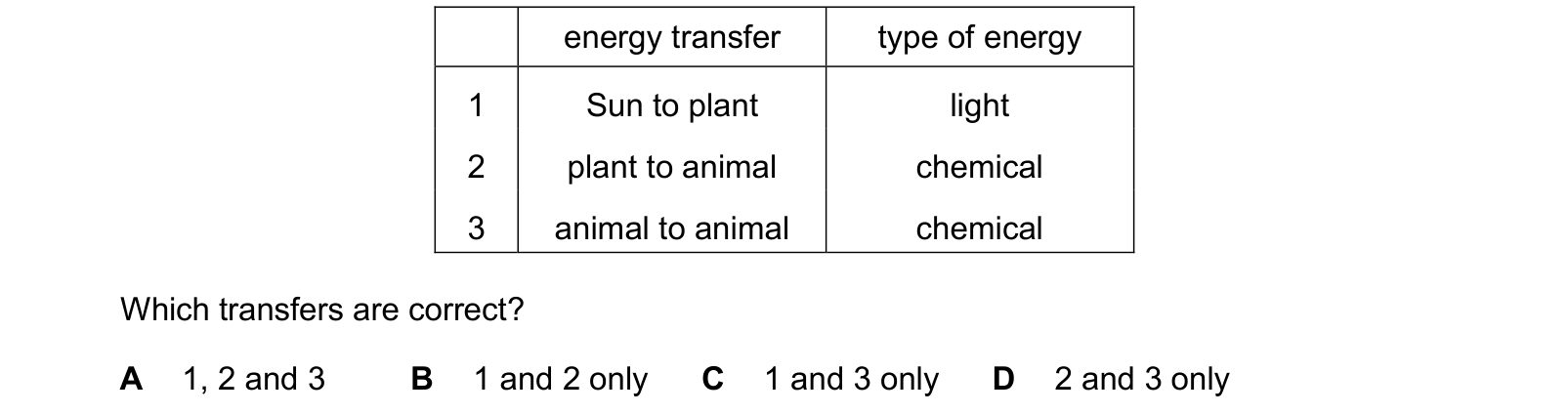
Energy transfers in an ecosystem are listed.
energy transfer type of energy
1 Sun to plant light
2 plant to animal chemical
3 animal to animal chemical
Which transfers are correct?
Answer: A.
1: Sun to plant is light. Sunlight is absorbed by chlorophyll and used in photosynthesis, which is how almost all energy enters an ecosystem.
2: plant to animal is chemical. The energy is stored in glucose and the compounds built from it, so what passes on when the animal eats the plant is chemical energy in food.
3: animal to animal is chemical for exactly the same reason. Every feeding step transfers energy in the same form, whichever organisms are involved.
That consistency is the point of the question: the form does not change part way along the chain just because the organisms do.
The fourth form appears at every stage but is not listed here. Heat is lost from each organism through respiration and movement, and it is why only about 10% of the energy at one level reaches the next.
Question 2
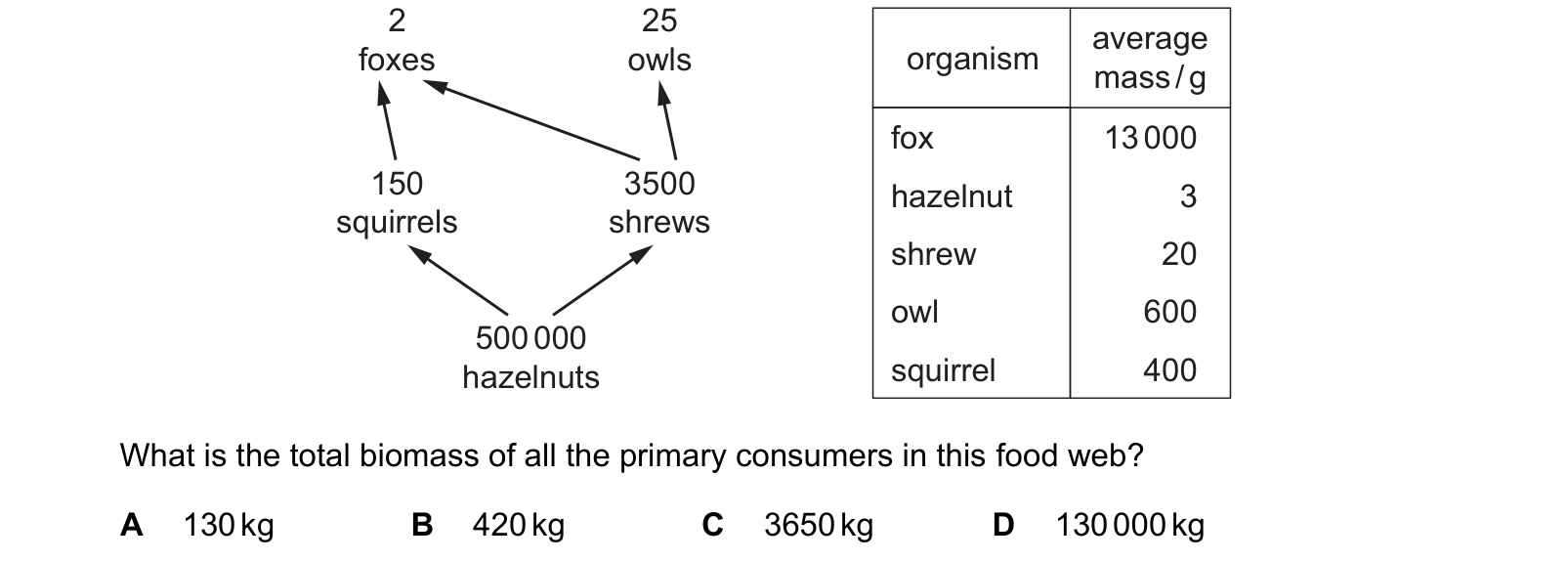
The diagram contains information about the number and mass of organisms in a food web. What is the total biomass of all the primary consumers in this food web?
Answer: A.
The primary consumers are the organisms that eat the producer. Hazelnuts are the producer, and both squirrels and shrews feed on them, so both count.
Biomass is number multiplied by average mass, so work each out and add them.
Squirrels: 150 × 400 g = 60 000 g, which is 60 kg.
Shrews: 3500 × 20 g = 70 000 g, which is 70 kg.
Total: 130 kg.
3650 kg (C) adds the two numbers of animals rather than their masses.
130 000 kg (D) is the right calculation left in grams, so it is out by a factor of a thousand.
420 kg (B) counts only one group.
The two steps that decide it are including both primary consumers and converting grams to kilograms at the end.
Question 3
The diagram shows a simple food chain.
grass → gazelle → lion
The arrows show the energy flow through the food chain.
Where does the grass obtain its energy?

Answer: D.
Grass is a producer. It absorbs sunlight using chlorophyll and uses that energy in photosynthesis to build glucose from carbon dioxide and water. All the energy that later reaches the gazelle and the lion entered the chain at that point.
Minerals in soil (C) supply nitrates for making proteins and magnesium for making chlorophyll. Those are nutrients the plant needs, but they carry no energy.
Water (B) is a raw material for photosynthesis rather than a source of energy.
Oxygen from air (A) is what the grass produces in photosynthesis, and it uses some of it in respiration. It is not where the energy comes from.
Energy flows one way through the chain, entering as light and leaving as heat at every step. Nutrients such as carbon and nitrogen are recycled instead.
What the syllabus asks for on this topicSyllabus points
Syllabus points
- State that the Sun is the principal source of energy input to biological systems.
- Describe the flow of energy through living organisms.
- Describe food chains and food webs and use the associated terms.
- Construct and interpret pyramids of numbers, biomass and energy.
- Describe the carbon cycle and the nitrogen cycle.
- Describe a population and interpret a population growth curve.
Related CIE 0610 Biology topics
Not the topic you were looking for? Describe what you are stuck on in your own words and we will take you to the notes that answer it.