Human influences on ecosystems
Contents: 8 sections
Increasing food production
Modern agriculture uses monoculture, growing a single crop over a large area, along with fertilisers, pesticides and herbicides, machinery, and intensive livestock farming.
Each raises yield and each carries a cost:
- Monoculture reduces biodiversity and removes habitats, and because every plant is identical the whole crop is vulnerable to one disease or pest.
- Fertilisers raise yield but run off into water and cause eutrophication.
- Pesticides kill pests but also harm other species, can accumulate along the food chain, and select for resistant pests.
- Herbicides kill weeds and remove food plants that other species depend on.
- Intensive livestock farming produces more meat from less land, but raises welfare concerns and concentrates waste.
Habitat destruction
Habitats are destroyed to make room for housing, farming, industry, roads and quarries, and by pollution and by taking too much from the environment.
The main effects:
- Reduced biodiversity, as species lose the conditions they need.
- Extinction, when a species loses its habitat entirely.
- Loss of food chains and webs, so the effect spreads to species whose own habitat is untouched.
Deforestation deserves separate treatment because so many effects follow from it:
- Less photosynthesis, so less carbon dioxide is removed from the air.
- More carbon dioxide if the trees are burned, adding to the enhanced greenhouse effect.
- Soil erosion, because roots no longer bind the soil and rain washes it away.
- Flooding, since trees no longer intercept rainfall and the soil holds less water.
- Loss of habitat and of the species that depend on it.
- Leaching of minerals from the exposed soil, leaving it infertile.
Eutrophication
A sequence question, and the marks come from getting the order right.
- Excess fertiliser runs off farmland into rivers and lakes, or untreated sewage enters them.
- Nitrates and phosphates cause rapid growth of algae, an algal bloom.
- The algae at the surface block the light reaching plants below, so those plants die.
- Decomposing bacteria feed on the dead plants and algae and multiply rapidly.
- Those bacteria respire aerobically and use up the dissolved oxygen.
- Fish and other aerobic organisms die from lack of oxygen.
The commonest error is stopping at step 2 and saying the algae use up the oxygen. It is the decomposers, not the algae, that deoxygenate the water.
Other pollution
- Untreated sewage spreads pathogens such as cholera, as well as causing eutrophication.
- Non-biodegradable plastics persist for centuries. Animals become entangled in them or eat them and starve with a full stomach.
- Acid rain forms when sulfur dioxide and nitrogen oxides from burning fossil fuels dissolve in rainwater. It damages leaves, acidifies lakes so that fish die, and releases toxic aluminium ions from the soil.
- Insecticides can pass along food chains and become concentrated in top predators.
The enhanced greenhouse effect
Greenhouse gases, mainly carbon dioxide and methane, absorb heat radiated from the Earth's surface and re-radiate some of it back, keeping the planet warm. That natural effect makes the Earth habitable.
Human activity has increased those gases: burning fossil fuels and deforestation add carbon dioxide, while cattle farming, rice paddies and landfill add methane. More gas means more heat retained, which is enhanced greenhouse effect and leads to climate change.
Consequences include rising sea levels as ice melts and water expands, more extreme weather, shifting rainfall patterns affecting food production, and species being unable to move or adapt fast enough.
Conservation
Reasons to conserve species and habitats:
- Maintaining biodiversity, so ecosystems remain stable.
- Protecting a source of future medicines and useful genes for crop breeding.
- Keeping a gene pool wide enough for species to adapt to change.
- Ethical and aesthetic reasons, and value for tourism.
Methods:
- Protected areas such as national parks and nature reserves.
- Captive breeding programmes in zoos, and release back into the wild.
- Seed banks, which store seeds cheaply and in great numbers for a long time.
- Monitoring and protecting endangered species, and controlling trade.
- Education, so that support continues.
Sustainable resources
A resource is used sustainably when it is used in a way that allows it to be replaced, so it remains available for future generations.
Fish stocks can be managed by imposing quotas on the mass caught, restricting net mesh size so young fish escape and can breed, setting closed seasons during breeding, and protecting areas entirely.
Forests can be managed by replanting at least as many trees as are felled, taking only mature trees, and coppicing so trees regrow from the stump. Timber is renewable if managed this way, and non-renewable in practice if it is not.
The general test is worth remembering: a resource is being used sustainably only if the rate of use does not exceed the rate at which it is replaced. Fossil fuels fail that test absolutely, because they form over millions of years.
Recycling paper, plastic, glass and metal reduces the raw materials taken from the environment, reduces landfill, and usually uses less energy than making the material from scratch.
Check you have it
Question 1
Which row shows whether the two natural resources are always managed sustainably? Each answer gives, in order: using fish stocks; using wood from forests.

Answer: D.
The word to notice is always. Both fish stocks and forests can be managed sustainably: quotas, closed seasons, minimum mesh sizes and protected areas for fish, and replanting and selective felling for forests.
But neither always is. Many fisheries have been overfished to collapse, and forests are still cleared faster than they are replanted. A resource is sustainable only when it is replaced as fast as it is removed, and that depends on how it is managed rather than on what it is.
So the answer is no for both, and any row containing a yes is claiming a guarantee that does not exist.
This is what separates them from fossil fuels, which can never be managed sustainably at all, since coal, oil and gas take millions of years to form.
Question 2
Three human activities are listed.
1 burning fossil fuels
2 deforestation
3 replanting forests
Which activities can cause the change shown in the graph?
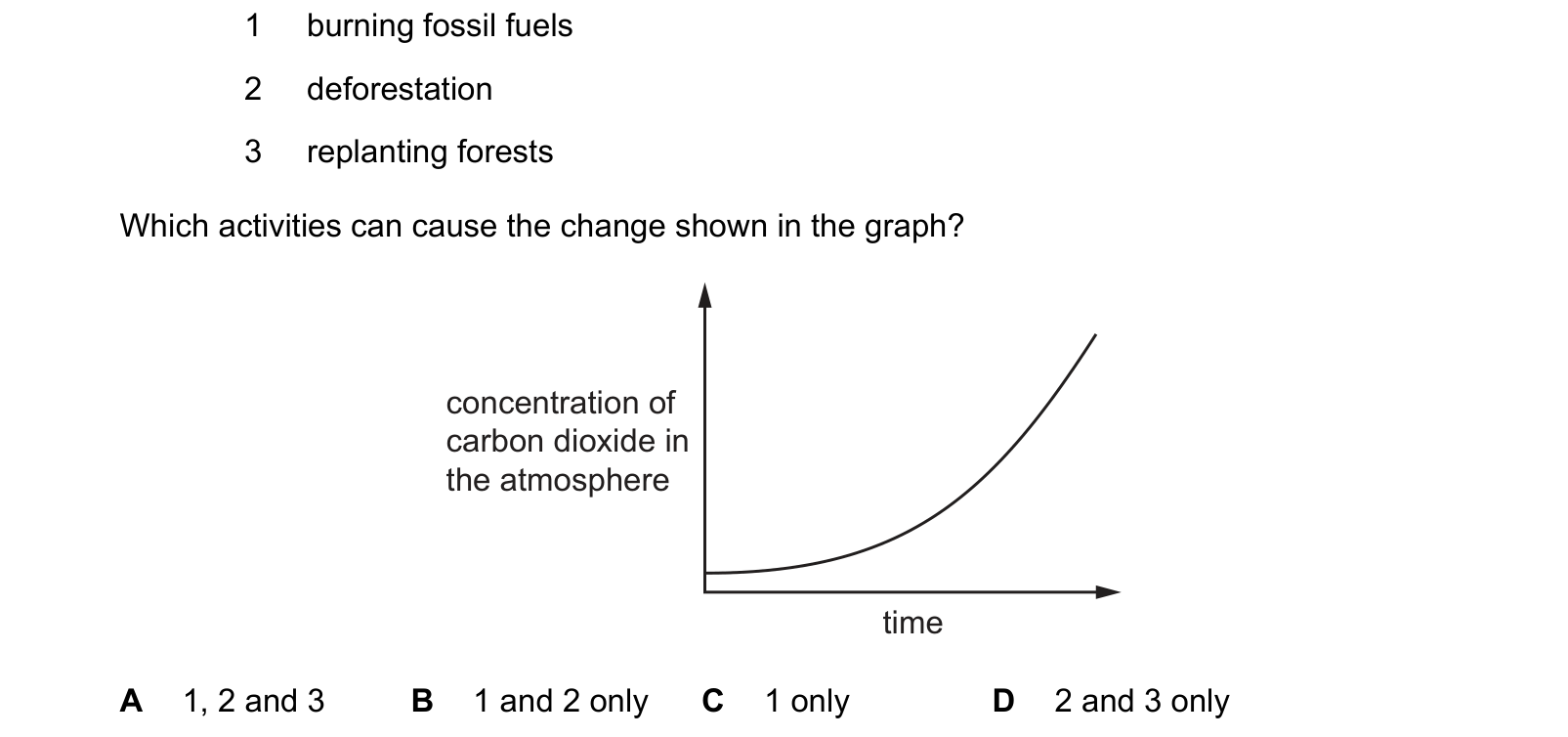
Answer: B.
Both raise atmospheric carbon dioxide. Burning fossil fuels releases carbon that has been locked away for millions of years. Deforestation raises it twice over, since fewer trees are left to absorb carbon dioxide by photosynthesis and the felled timber is usually burned or left to decompose.
Replanting forests (3) does the opposite. Growing trees take carbon dioxide in and build the carbon into their tissue, so replanting reduces the concentration rather than raising it.
That single judgement decides the question, since two of the four options include statement 3.
The carbon cycle normally balances photosynthesis against respiration, decomposition and combustion. Human activity has tipped it by adding a large new source and removing part of the sink at the same time.
Question 3
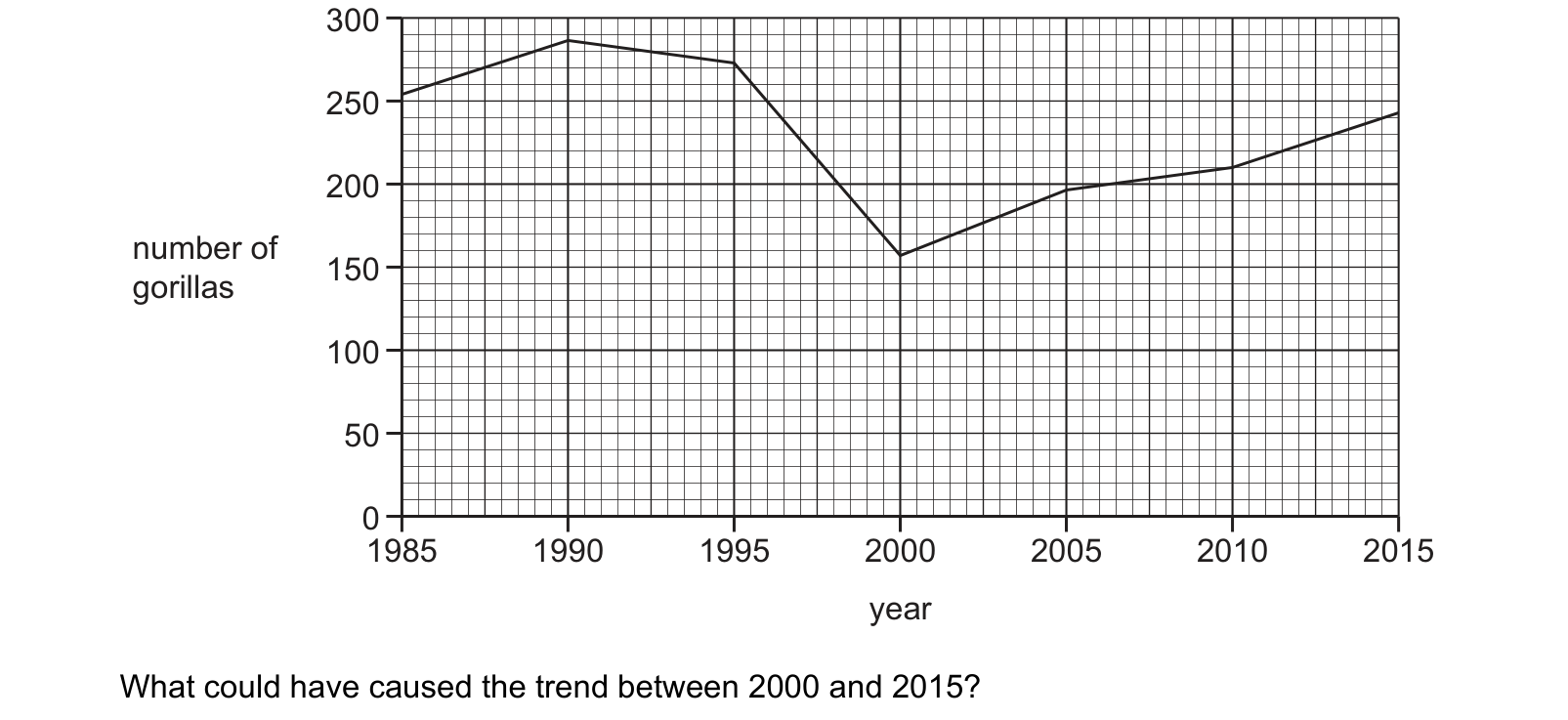
Gorillas are a type of large mammal. The graph shows the number of gorillas found in one region of a country. number of gorillas year
What could have caused the trend between 2000 and 2015?
Answer: C.
Between 2000 and 2015 the graph rises, from about 158 gorillas to about 240, so the cause must be something that lets more of them survive and breed. Banning hunting removes a direct cause of death, and the population recovers.
The other three would all push the numbers down, and the graph shows exactly that between 1990 and 2000, where the line falls steeply.
Deforestation (A) and habitat destruction (B) are the same thing for a forest species, removing the food and shelter the gorillas depend on.
Disease (D) raises the death rate directly.
The question is really asking which of the four is a conservation measure rather than a threat. The others are among the standard reasons a species becomes endangered, alongside pollution, introduced species and climate change.
What the syllabus asks for on this topicSyllabus points
Syllabus points
- Describe how humans have increased food production and the negative impacts of doing so.
- Describe the reasons for habitat destruction and its undesirable effects.
- Describe the effects of pollution, including eutrophication and the enhanced greenhouse effect.
- Describe the need for conservation and the methods used.
- Explain the risks of unsustainable resource use and how resources can be managed sustainably.
Related CIE 0610 Biology topics
Not the topic you were looking for? Describe what you are stuck on in your own words and we will take you to the notes that answer it.