Movement into and out of cells
Contents: 8 sections
Diffusion
Diffusion is the net movement of particles from a region of higher concentration to a region of lower concentration, down a concentration gradient, as a result of their random motion.
Three points carry most of the marks.
- It is passive. No energy from respiration is needed; the particles are moving anyway.
- It is net movement. Particles cross in both directions the whole time, and diffusion is the difference between the two flows. When concentrations are equal the movement continues but the net movement is zero.
- It happens in gases and in solution, so both oxygen entering a leaf and glucose crossing the gut wall are diffusion.
Examples worth having ready: oxygen and carbon dioxide across the alveoli, carbon dioxide into a leaf through the stomata, and digested food from the small intestine into the blood.
Osmosis
Osmosis is the net movement of water molecules from a region of higher water potential to a region of lower water potential, through a partially permeable membrane.
Water potential is simply how much water is present relative to solute. A dilute solution has lots of water, so a high water potential. A concentrated solution has less water, so a low water potential. Water moves from dilute to concentrated, and it does so because only water can cross the membrane, not the solute.
Osmosis is a special case of diffusion: the same random motion, the same downhill direction, but restricted to water and requiring a partially permeable barrier.
Plant cells in different solutions
The cell wall changes what happens, which is why plant and animal cells behave so differently.
In a dilute solution (higher water potential outside), water enters. The vacuole swells and pushes the cytoplasm against the cell wall. The wall is strong and resists, so pressure builds and the cell becomes turgid. It does not burst. Turgor is what holds a non-woody plant upright.
In a concentrated solution (lower water potential outside), water leaves. The cell loses turgor and becomes flaccid, and the plant wilts. If enough water leaves, the cytoplasm and membrane pull away from the cell wall and the cell is plasmolysed.
Animal cells in different solutions
There is no wall, so nothing resists.
In a dilute solution, water enters until the cell swells and bursts. For a red blood cell this is called haemolysis.
In a concentrated solution, water leaves and the cell shrinks and crenates.
This is why the water potential of blood plasma must be kept steady, and why a drip must be the right concentration rather than pure water.
The potato experiment
A standard practical, and a standard question. Pieces of potato of equal size are left in sucrose solutions of different concentration and their mass is measured before and after.
- In dilute solutions, mass increases: water entered by osmosis.
- In concentrated solutions, mass decreases: water left by osmosis.
- At the concentration where mass does not change, the solution has the same water potential as the cell contents, so there was no net movement.
Percentage change in mass is used rather than change in mass, because the pieces are never exactly identical to start with:
percentage change = (change in mass ÷ starting mass) × 100
Active transport
Active transport is the movement of particles through a cell membrane from a region of lower concentration to a region of higher concentration, against the concentration gradient, using energy from respiration.
The differences from diffusion are the ones to state.
| Diffusion and osmosis | Active transport | |
|---|---|---|
| Direction | down the gradient | against the gradient |
| Energy | none needed | needs energy from respiration |
| Carrier proteins | not required | required |
Because it needs energy, anything that stops respiration stops active transport. A cell starved of oxygen, or poisoned with cyanide, cannot carry it out, and that is the usual way an exam question proves active transport is involved.
Examples: ion uptake by root hair cells, where the soil is more dilute than the cell, and glucose absorption from the small intestine when the concentration in the gut has already fallen below that in the blood.
What affects the rate
For diffusion and osmosis:
- Steeper concentration gradient — faster, since the difference in the two flows is greater.
- Higher temperature — faster, since particles have more kinetic energy and move more quickly.
- Larger surface area — faster, since more particles can cross at once.
- Shorter distance — faster, which is why exchange surfaces are one cell thick.
For active transport, the rate depends on the rate of respiration and the number of carrier proteins, so it can be limited by oxygen supply and by temperature acting on enzymes.
Check you have it
Question 1
Which row explains why a plant wilts? Each answer gives, in order: water loss at the leaf surface; water uptake in the roots; state of the plant cells.
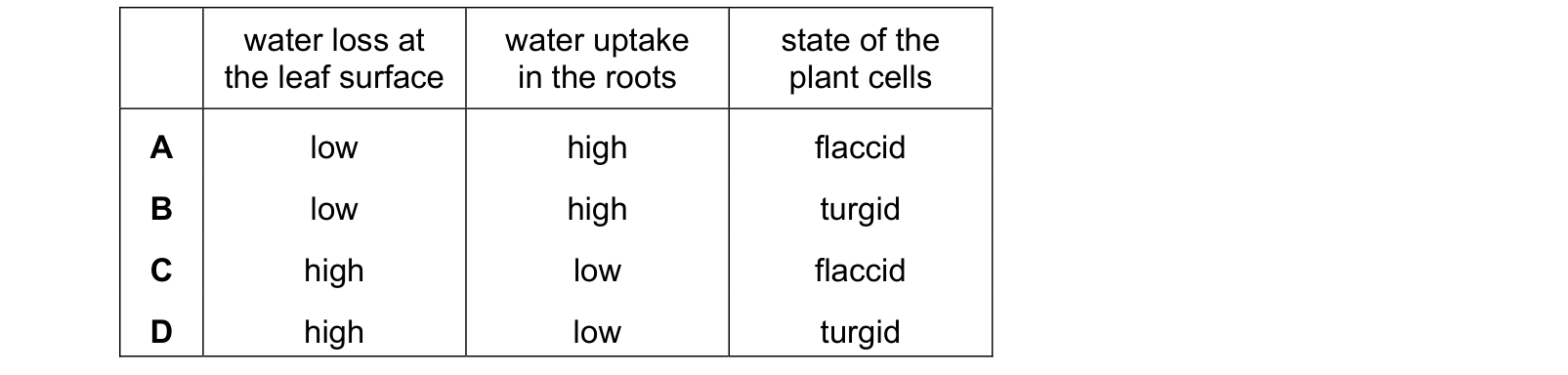
Answer: C.
The cells then lose water, lose their turgor pressure and become flaccid. Without each cell pressing outwards against its wall, the cells no longer support one another and the plant droops.
The rows offering turgid cells contradict the wilting itself, since turgor is precisely what a wilting plant has lost.
Wilting is partly protective: as the guard cells lose turgor the stomata close, which cuts further water loss. The cost is that carbon dioxide can no longer enter, so photosynthesis stops.
Question 2
The diagram represents a substance moving across a cell membrane, using energy from respiration. Which method of transport does the diagram represent?
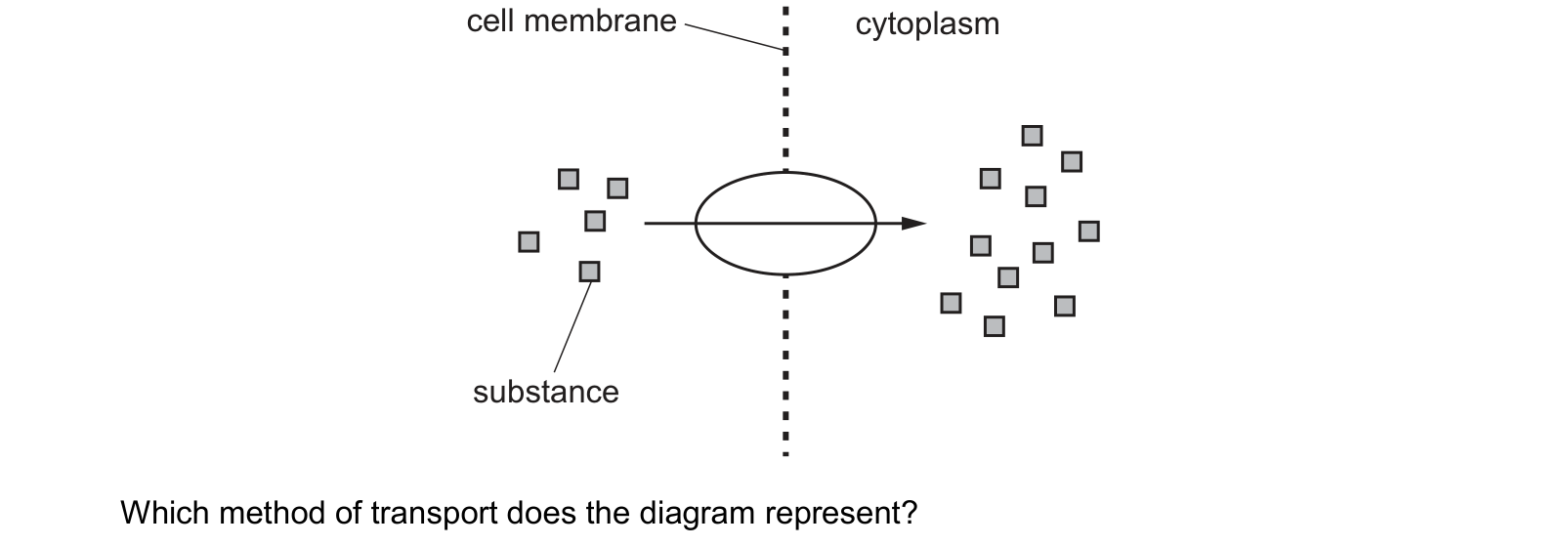
Answer: A.
Energy is needed because active transport moves particles against their concentration gradient, and going uphill has to be paid for. The work is done by carrier proteins in the membrane.
The other three are all passive. Diffusion (B) and osmosis (D) both run down a gradient, driven by the random motion the particles already have. Evaporation (C) is a change of state and does not involve crossing a membrane at all.
The presence of an energy arrow in a membrane diagram is always the signal for active transport.
Question 3
Plant cells are placed in a solution with a higher water potential than the plant cell contents. What will happen? Each answer gives, in order: direction of water movement; volume of vacuole.
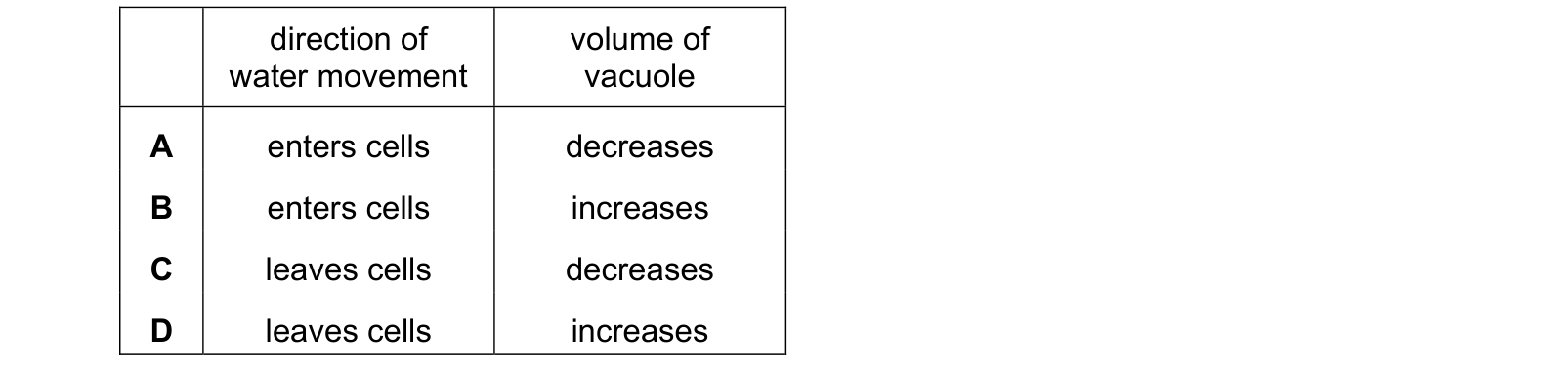
Answer: B.
That water collects in the vacuole, which therefore increases in volume. The swelling vacuole presses the cytoplasm outwards against the cell wall, and the cell becomes turgid.
The wall is what stops it bursting, and the resulting turgor pressure is what holds a non-woody plant upright.
The options combine direction with volume, and the two are not independent: water entering must go somewhere, and in a plant cell it goes into the vacuole. Deciding the direction first forces the second half.
What the syllabus asks for on this topicSyllabus points
Syllabus points
- Describe diffusion and explain its importance in living organisms.
- Describe osmosis in terms of water potential and a partially permeable membrane.
- Investigate and explain the effects of solutions of different concentrations on plant tissue and on animal cells.
- Describe active transport and explain its importance.
- State the factors that affect the rate of movement of substances.
Related CIE 0610 Biology topics
Not the topic you were looking for? Describe what you are stuck on in your own words and we will take you to the notes that answer it.