Drugs
Contents: 8 sections
What a drug is
A drug is any substance taken into the body that modifies or affects chemical reactions in the body.
That definition covers medicines as well as substances that are misused. Being a drug says nothing about whether it is harmful.
Antibiotics
Antibiotics kill bacteria or stop them growing, and are used to treat bacterial infections.
Antibiotics have no effect on viruses. The reason is worth stating properly: antibiotics work by attacking structures and processes that bacteria have, such as the bacterial cell wall or bacterial protein synthesis. A virus has no cell wall, no cytoplasm and no metabolism of its own; it reproduces inside the host's own cells using the host's machinery. There is nothing for the antibiotic to attack that is not also part of the patient.
This is why taking antibiotics for a cold or flu does nothing at all, and doing so is one of the ways resistance is encouraged.
Antibiotic resistance
The development of resistance is a clean example of natural selection, and questions want the steps in order:
- Within a population of bacteria there is variation, caused by mutation. A few individuals happen to be resistant.
- The antibiotic is applied and kills the non-resistant bacteria.
- The resistant ones survive and reproduce.
- They pass on the resistance allele, so the proportion of resistant bacteria rises.
- Eventually the antibiotic no longer works on that population.
Two things to avoid saying. The antibiotic does not cause the mutation; the resistant individuals were already there and the antibiotic merely selected them. And bacteria do not "become resistant" as individuals in response to treatment: the population changes, not the individual.
Reducing resistance means removing the selection pressure and reducing the chance for survivors:
- Prescribe antibiotics only when genuinely needed, never for viral infections.
- Complete the full course, so surviving bacteria are not left behind to reproduce.
- Use narrow-spectrum antibiotics where possible.
- Restrict use in farming.
Bacteria reproduce very rapidly, so resistance can spread through a population in a short time, which is why this is a serious medical problem rather than a distant one.
Alcohol
Alcohol is a depressant: it slows down reactions and nerve impulses.
Short-term effects: slower reaction time, impaired judgement, loss of self-control, blurred vision, drowsiness. This is why drink-driving is so dangerous, and reaction-time data is a common question context.
Long-term effects: liver damage, because the liver breaks down alcohol and is damaged by doing so repeatedly, leading to cirrhosis. Also brain damage, and addiction.
Tobacco smoke
Three components, three separate effects. Questions frequently ask which component causes which, so keep them apart.
- Nicotine — the addictive component. It is a stimulant, increases heart rate and raises blood pressure.
- Tar — a carcinogen, so it causes lung cancer. It also paralyses and destroys the cilia lining the airways, so mucus is no longer swept away. It collects, and the only way to clear it is coughing.
- Carbon monoxide — combines with haemoglobin in place of oxygen, and does so far more readily, so the blood carries less oxygen. In a pregnant smoker this reduces the oxygen reaching the fetus, which is why birth mass is lower.
Diseases linked to smoking: lung cancer, chronic bronchitis from the mucus and infection, emphysema from the breakdown of alveolar walls reducing the surface area for gas exchange, and coronary heart disease.
Emphysema is a good example of a structure-function answer: destroying the alveolar walls merges many small alveoli into fewer large ones, so the total surface area falls and less oxygen can diffuse into the blood, leaving the person breathless.
Heroin
Heroin is a powerful depressant and is strongly addictive.
Effects include severe withdrawal symptoms when it is not taken, so the user continues in order to avoid them. Tolerance develops, meaning larger doses are needed for the same effect, which increases the risk of overdose.
Injecting brings its own risk: sharing needles transmits blood-borne pathogens, notably HIV and hepatitis.
Anabolic steroids
Anabolic steroids resemble testosterone. They increase muscle growth and are misused in sport to build strength and to allow harder training.
They are banned because they give an unfair advantage and because they carry real health costs: high blood pressure, heart and liver damage, aggression, and infertility. In women they cause male characteristics such as facial hair and a deeper voice.
Medically, related steroids have legitimate uses, which is again the reminder that being a drug and being harmful are separate questions.
Check you have it
Question 1
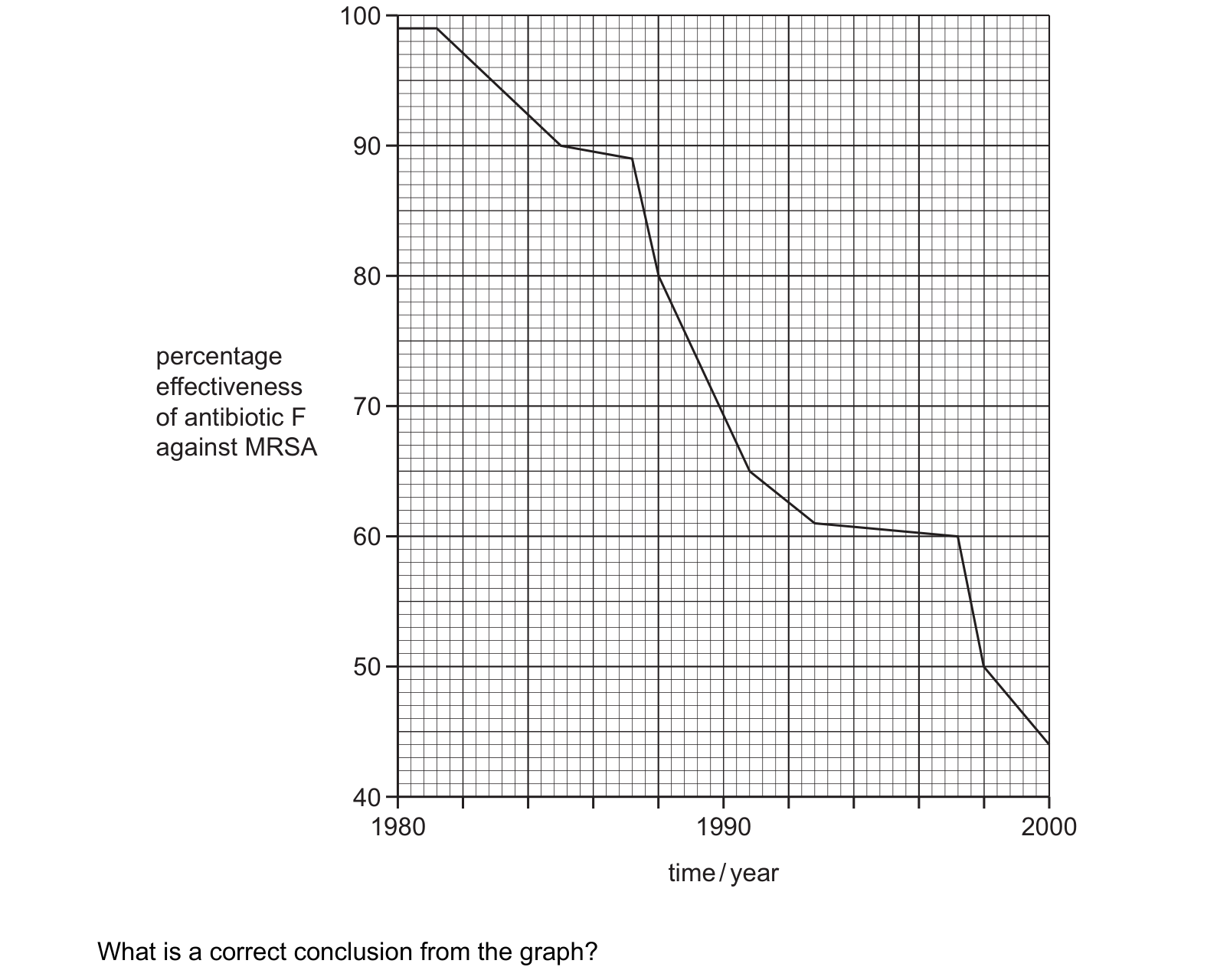
The graph shows how the percentage effectiveness of antibiotic F against MRSA bacteria varied between 1980 and 2000. percentage effectiveness of antibiotic F against MRSA time / year
What is a correct conclusion from the graph?
Answer: C.
The line falls from about 99% effectiveness to about 44% across that period. Falling effectiveness means a growing proportion of the bacteria survive the drug, which is what resistance is.
Completely ineffective in 2000 (A) is contradicted by the graph, which still shows about 44% in 2000. Completely ineffective would mean zero.
Most effective in 1982 (B) misreads the start. The line is at its highest in 1980 and 1981, before it begins to fall, so 1982 is already past the peak.
Greatest decrease between 1988 and 1990 (D) fails on comparison. The steepest section is 1997 to 1998, where the line drops from 60% to 50% in a single year. Between 1988 and 1990 the fall is comparable but spread over two years.
Three of the four options are readings of the graph; only C states the biology the graph reveals.
Question 2
A person suffering from influenza was given antibiotics. Influenza is caused by a virus.
Why did the antibiotics not cure the person with influenza?
Answer: A.
Antibiotics work by attacking structures that bacteria have and human cells do not, chiefly the bacterial cell wall. A virus has no cell wall and no metabolism of its own: it reproduces inside the host's own cells, so there is nothing for the antibiotic to act on.
Influenza is caused by a virus, which the question states, so no antibiotic could have cured it.
The course was not long enough (B) would matter for a bacterial infection but changes nothing here.
The virus became resistant (C) misapplies resistance. Bacteria develop resistance to antibiotics; a virus was never susceptible in the first place, so there was nothing to become resistant to.
The person was immune to antibiotics (D) is the classic reversal: it is the bacteria that become resistant, never the patient.
Question 3
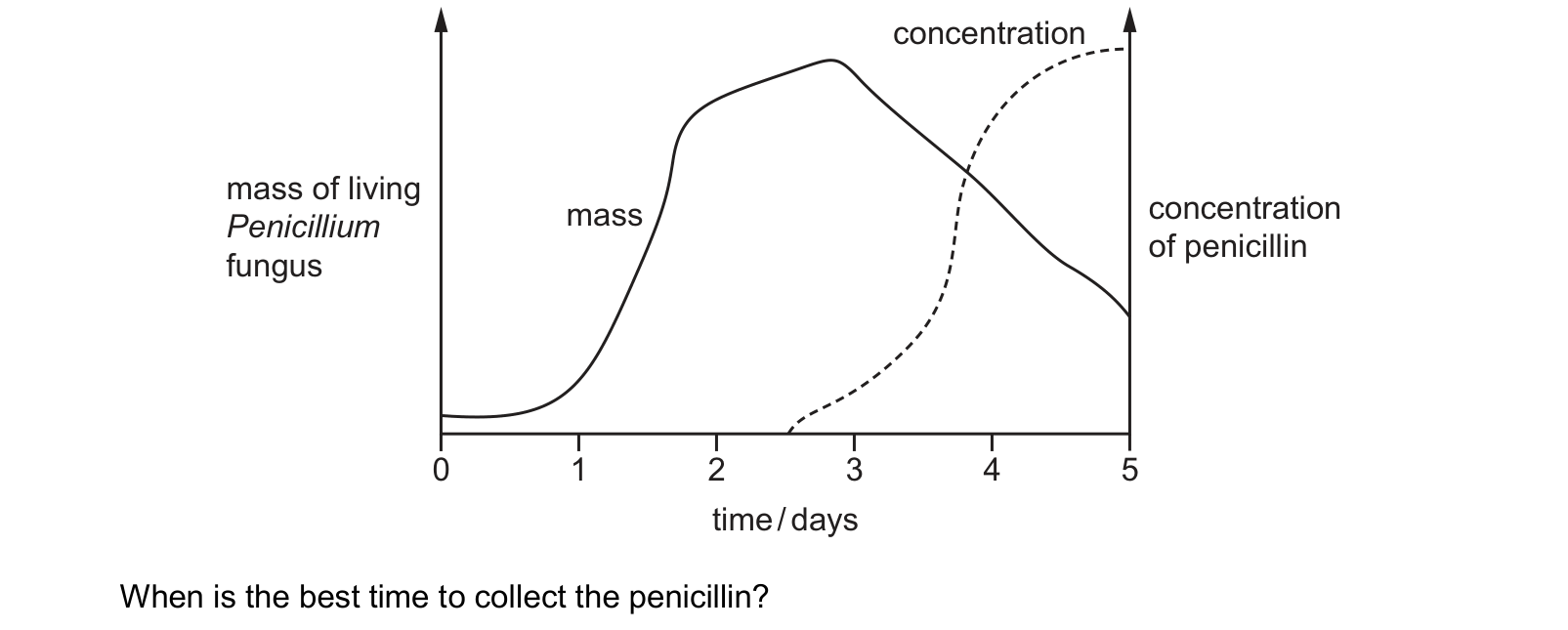
Penicillin is produced in a fermenter by growing the fungus Penicillium. The graph shows how the mass of living Penicillium fungus and the concentration of penicillin change over time. time / days
When is the best time to collect the penicillin?
Answer: D.
The question asks when to collect the penicillin, so read the dashed line. It is zero until about 2.5 days, climbs steeply from 3 to 4.5 days, and is at its maximum at 5.
The solid line is the trap. The mass of living fungus peaks at about 2.8 days and falls after that, so anyone reading the wrong line answers 3.0 days (B) or 3.5 days (C). Harvesting when the fungus is most abundant would collect very little antibiotic, because it has barely started making any.
1.5 days (A) is during rapid growth, with no penicillin present at all.
Penicillin is a secondary metabolite, made once growth slows and nutrients begin to run out rather than during the growth phase itself, which is why the two curves peak so far apart.
What the syllabus asks for on this topicSyllabus points
Syllabus points
- Describe a drug.
- Describe the use of antibiotics and explain why they do not affect viruses.
- Explain how antibiotic resistance develops and how it can be reduced.
- Describe the effects of alcohol and of tobacco smoke.
- Describe the effects of heroin and of anabolic steroids.
Related CIE 0610 Biology topics
Not the topic you were looking for? Describe what you are stuck on in your own words and we will take you to the notes that answer it.